

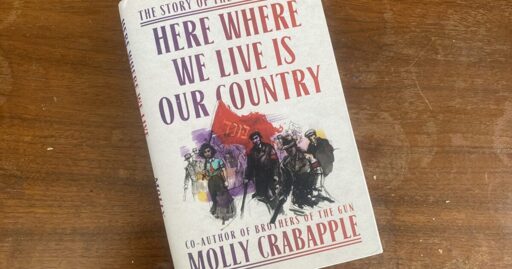
It’s astounding that Molly Crabapple’s new book on the General Jewish Workers Bund, better known as “the Bund,” briefly hit No. 4 on the New York Times Hardcover Non-Fiction Bestseller List. It’s received favorable reviews in the Times, the Economist, and other mainstream outlets, as well as unhinged denunciations by Zionists.
The Bund was once known mainly to history nerds. The success of Here Where We Live Is Our Country, which appeared in April, is yet another sign that masses of Jewish people in the U.S. and worldwide are breaking from Zionism; the book’s success both contributes to this rift and results from it. Crabapple started her research with an extremely popular essay about her great-grandfather, a Bundist, and expanded it by learning and translating Yiddish. She wrote much of it in the New York Public Library and would often abandon her work to join pro-Palestine protests outside.
Bourgeois reviewers are surprised to learn that there could be a “Judaism without Zionism” or that “not all Jews believed their future lay in Israel.” This is a widespread misunderstanding. For a generation or two, at least since 1967, the myth took hold that most Jews in the United States have been Zionists. Yet, as Benjamin Balthaser showed in a book last year, generations of U.S. Jews sympathized more with socialism than with Zionism. If anything made Zionism seem hegemonic, it was the Red Scare, which targeted Jewish Leftists with barely concealed antisemitism. Nonetheless, many U.S. radical movements of the 1930s, the 1960s, and today have been led by Jewish radicals.
Any serious historian knows that Zionism is not some ancient longing of the Jewish people but rather an invention of the capitalist era — a Jewish version of late 19th-century colonial conquest and blood-and-soil nationalism. Zionism was never more than a sect among eastern Europe’s Jewish masses, who had no inclination to flee to a distant land briefly mentioned in an ancient prayer until they had no other option. The inhabitants of bitterly poor shtetls and multiethnic metropolises fought for their rights where they lived, and one of the instruments they built for this was the Bund.
Jewish Workers in the Vanguard
The Algemeyner Yidisher Arbeter-bund in Lite, Poyln un Rusland was founded in 1897 in an attic in Vilnius. That city, with a rich Jewish culture that earned it the nickname “Jerusalem of the North,” was then part of the Russian Empire. Many of the Bund’s founders, such as Arkadi Kremer and Julius Martov, were assimilated Russian Jews who had to learn Yiddish, the language of the downtrodden Jewish proletariat. Vladimir Medem, the beloved hero of Yiddish-speaking workers, learned Yiddish while at university and wasn’t even legally considered a Jew — his family had converted to Christianity before he was born.
Since 1791, most Jewish proletarians had been forced to live on the empire’s western borderlands — an area known as the Pale of Settlement — under myriad antisemitic laws designed to secure the empire’s westward expansion. Their lack of rights and concentration in more economically developing areas turned them into the vanguard of the socialist struggle against the tsar. They, in turn, attracted intellectuals eager to organize them.
In 1898 the Bund led the first, though unsuccessful, attempt to forge the Russian Social Democratic Workers’ Party (RSDWP), which would unite workers of all nationalities across the vast Russian Empire. Bund founder Kremer led the RSDWP’s first Central Committee, whose members were soon arrested.
The Bund has been best known to history for its role in the second RSDWP congress in London in 1903. As the largest socialist organization in Russia by far, the Bund demanded almost complete autonomy inside the new party and recognition as the sole representative of Jewish workers in Russia. The group was rebuffed by Jewish members of Lenin’s Iskra faction, including Martov (who had helped launch the Bund but no longer believed in a separate Jewish organization) and a young Leon Trotsky. They instead called on Jewish workers to form part of a centralized party. Criticizing the Bund at the congress, Trotsky insisted that Jewish socialists like himself were “no less representatives of the Jewish proletariat” than the Bundists.
Over the next 15 years, the Bund continued as the main organization of Jewish workers in the Pale of Settlement, sometimes in the RSDWP and sometimes not (in different factional alignments far too complicated to recount here). Bundists fought in the two Russian revolutions of 1905 and 1917 — constantly battling antisemitic pogromists as well as undertaking an increasingly fierce competition with Zionists. This was especially the case after 1917, when the British Empire issued its Balfour Declaration, promising a “national home for the Jewish people” in Palestine.
Parallels to U.S. History
Crabapple, writing as a New York City artist and activist with Jewish and Puerto Rican roots, draws some interesting parallels to more recent and familiar U.S. history. The tsarist state sponsored antisemitic organizations, known as the Black Hundreds, that carried out bloody pogroms. Crabapple writes that the Black Hundreds, “with their secretive membership, government connections, and flagrant murders of ethnic minorities … came to resemble a Russian version of the KKK.” The Bund, in turn, organized self-defense against racist violence, and it had surprising similarities to the Black Panther Party — “another group of young radicals who carried guns and started free breakfast programs and asserted their people’s beauty in a country that wanted them dead.”
Both cases raise the same strategic question for revolutionaries: How can an oppressed and radical minority inside the working class relate to the organizations of the entire class, especially when the majority still harbors chauvinist prejudices? With its vision of an independent Jewish revolutionary organization as a component of a larger, federated socialist party in Russia, the Bund’s demand for national-cultural autonomy was not so different from Fred Hampton’s Rainbow Coalition or Huey P. Newton’s theory of revolutionary intercommunalism.
Everything Changed in 1917
World history changed in 1917 when workers and peasants toppled the tsar. The new Soviet government proclaimed that all oppressed nations had a right to self-determination. Several new nation-states emerged from the ruins of the empire in eastern Europe — many with ultranationalist, anti-socialist governments. The Bund broke into separate national organizations; the General Jewish Workers Bund in Poland went in a different direction from that of its former comrades inside the new Soviet Union. The first successful workers’ revolution in history put each socialist tendency through a trial by fire.
Like the Bundists, Crabapple wears her disdain for Lenin and Trotsky on her sleeve. Lenin she calls a “man of few scruples” who “excelled at backroom bureaucratic maneuvers” and “flew into debilitating rages.” Yet she provides little evidence for these ad hominem attacks. She writes, for example, that when Lenin returned to Petrograd in April 1917, he declared that the coming revolution would be of a socialist character and “quickly marginalized any Bolshevik dissenters.” But this assertion has no relation to the historical record. Lenin argued for this new strategic framework openly and slowly won majorities for his positions within elected party bodies. Dissenters such as Kamenev, Zinoviev, and Stalin, who countered that the Russian Revolution would have a bourgeois character, were not sidelined but remained in the party leadership.
This moralistic focus on Lenin’s allegedly odious personality prevents Crabapple from seriously grappling with the Bund’s political weaknesses and strategic mistakes. While Lenin was fighting to establish a workers’ and peasants’ government that would end the First World War and expropriate the capitalists and the big landlords, the Bund was propping up a social democratic government that administered the existing system. Bund leader Raphael Abramovitch, who was also a leader of the RSDWP’s Menshevik faction, advocated continuing the imperialist war, which was leading the working class to untold catastrophe. The Bund’s reformist politics prevented it from supporting the leap that would be necessary to topple capitalism.
When the workers’ councils, called soviets, resolved to take power on November 7, 1917, Bund leaders like Abramovitch and Henryk Ehrlich opposed them forcefully, hoping to save what remained of the old post-tsarist bourgeois state. Because they opposed the strategy of a violent workers’ insurrection, Bundist leaders were among the socialists whom Trotsky famously consigned to the “dustbin of history” as they stormed out of the soviet congress. Crabapple downplays the Bundists’ reformist strategy and thus fails to understand why so many Bundist workers joined the Bolsheviks in order to advance the socialist revolution.
Crabapple then wonders about an alternative 1917 in which an all-socialist government could have united reformist and revolutionary parties, overcoming the schism between reformists and revolutionaries — ignoring the fact that there was no “compromise” possible between destroying the imperialist state and defending it. When the revolutionary crisis reduced all political questions to the binary choice of for or against socialism, the Bund’s leaders — despite decades of heroic struggle by tens of thousands of Jewish workers — chose their place on the side of the old order.
The Bund in the Soviet Union
The new Soviet government immediately abolished all the tsar’s antisemitic laws and banned all forms of anti-Jewish discrimination. Yet as the Russian Empire disintegrated and the imperialist powers launched a bloody military intervention to smash the new workers’ state, the White Armies — the counterrevolutionaries — slaughtered tens of thousands of Jews. Antisemitic pogroms had been a regular phenomenon under the tsar, but during Russia’s civil war, they reached horrifying new heights.
It is no surprise that the counterrevolution targeted Jews, the favorite scapegoat of Russian reactionaries. Yet Crabapple engages in the both-sideism beloved by bourgeois historians, claiming that “every armed group” killed Jews. This blanket generalization overlooks obvious distinctions. The White Armies carried out systematic pogroms under the orders of antisemitic generals; their attacks stretched over vast territories and continued for several years. In contrast, there are only a handful of examples of Red Army units — led by Trotsky, a Jewish commander-in-chief! — committing massacres, and the perpetrators were ruthlessly punished. The White Armies used pogroms as a mechanism to restore the old system, while the Bolsheviks fought to build a new system without oppression.
Jews were not simply eternal victims of every conflict — antisemitism is not some primordial evil but a historical product of social reaction. This is why the Whites, defending traditional hierarchies, massacred Jews, whereas the Reds armed Jewish proletarians to defend themselves. The two sides were not the same. Given that Crabapple sympathizes with Ukrainian nationalism in the current Russian-NATO proxy war, she is surprisingly uncritical of Symon Petliura, head of a nationalist government in Ukraine from 1919 to 1921. Petliura’s forces, waging war on socialism, murdered tens of thousands of Jews, yet Crabapple almost seems to excuse this, writing that when the Red Army captured Kiev, “rumors spread that Jews had welcomed the invasion” and that pogroms were carried out “as vengeance.”
Most of the Jewish masses of Russia and Ukraine had not originally supported the October Insurrection. But these White pogroms, the worst in history, drove several million Jews into the camp of the Soviet government, which they saw as their protector. From 1918 to 1921, majorities of the Bund in Russia and Ukraine rebranded themselves as the Kombund and then dissolved themselves to join the Jewish sections of the Communist Party. Again, the precise factional alignments are too complicated to recount here, but in the brutal reality of the civil war, they realized that a workers’ state was the best protection against antisemitism.
The Bund in Poland
In Poland, now an independent state run by a right-wing military dictatorship, the Bund continued as a social democratic party (with a minority splitting off to join the Polish Communists). Interwar Poland is where Bundism reached its greatest heights: in 1939, the Bund won over 60 percent of the votes from Varsovian Jews, and 100,000 people joined the party’s May Day demonstration. The Bund was part of a vibrant Yiddish-speaking socialist culture, with schools, newspapers, libraries, sports clubs, and a sanatorium for children.
The Bund’s growth was violently interrupted by the Nazi invasion in 1939. As Jews were swept into ghettos, Bundists led the resistance to the SS thugs and their Jewish collaborators. As the Warsaw Ghetto was being liquidated in 1943, it was Bundists (alongside left Zionists, Stalinists, and Trotskyists) who led the hopeless and all the more heroic uprising.
The book movingly tells the ghetto fighters’ story, among the most important chapters of the international proletariat’s long struggle for self-emancipation. Crabapple has even unearthed long-lost aspects of the rebellion: even as they were fighting against their annihilation in a genocide, the ghetto fighters never lost their internationalist spirit, declaring their solidarity with Polish workers (even as some of them were collaborating with the Nazis). The insurrectionists even took time to send telegrams to the British government demanding independence for India and freedom for Mahatma Gandhi. “This humanism in the context of a genocide amazes me,” Crabapple writes.
The young Bundist Marek Edelman, deputy commander of the Jewish Combat Organization (ZOB), later explained: “To be a Jew means always being with the oppressed, never with the oppressors.”
Bundism vs. Zionism
“Where are all the Bundists now?” Zionists love this cynical question, implying that the Holocaust proved the Bundists’ internationalist convictions were mistaken.
This argument is based on deep ignorance. Zionism never aimed to save Jews. David Ben-Gurion, a Zionist leader who went on to become Israel’s first prime minister, declared in 1938, “If I knew that it was possible to save all the children in Germany by transporting them to England, but only half of them by transporting them to Palestine, I would choose the second.” The goal, in the words of Ben-Gurion’s biographer, was not to protect Jewish life but rather to establish a “state at any cost.” This is why Zionists opposed efforts to help Jewish refugees reach the United States or other countries.
Even the minority of Jews who escaped to Palestine were not safe. With a few flaps of butterflies’ wings, the Nazis’ Afrika Korps could have swept through El Alamein and turned the Jewish colony in Palestine into one big extermination camp.
After the Holocaust, many survivors still had no interest in colonizing Palestine. But Zionists worked together with antisemitic governments to ensure they would have no other option. The American Jewish Committee, for example, opposed opening the U.S. borders to refugees, claiming that accepting too many Jewish immigrants would provoke antisemitism. In reality, they worried that too few refugees were being shepherded to Palestine. It was left to U.S. Trotskyists (many of them Jewish) to campaign in favor of smashing the fascists and admitting all refugees.
The Bund fought the Zionists for decades. Bundists demanded equal rights where they lived. Zionists, in contrast, agreed with the worst antisemites that Jews did not belong in Poland. Zionist leaders worked hand in hand with far-right nationalists who longed to expel the country’s 3 million Jewish inhabitants. This is why Bund leader Henryk Erlich, in 1938, called Zionism “a Siamese twin of antisemitism.” He continued,
If a Jewish state should arise in Palestine, its spiritual climate will be: eternal fear of the external enemy (Arabs); eternal struggle for every bit of ground with the internal enemy (Arabs); and an untiring struggle for the extermination of the language and culture of the non-Hebraized Jews of Palestine. … Is this a climate in which freedom, democracy and progress can grow?
Crabapple has a deeper argument in defense of the Bund’s legacy: falling victim to a genocide does not mean they were wrong. They did not fail, Crabapple writes — they lost. An important distinction! “Failure is what happens to those overcome by their own faults and errors. To lose is to succumb to greater force,” she notes.
Zionism “won” — and herded Jews into a genocidal apartheid state, the biggest ghetto in history. Bundism “lost” — but it inspires young Jews today as an alternative to the horrors committed by the self-described Jewish state.
Bundism vs. Bolshevism
Yet Crabapple’s logic is inconsistent. Even as the Bund was physically annihilated by fascism, its leaders committed several errors — such as supporting the First World War — that contributed to their defeat.
This brings us back to Jews like Trotsky, the Kombund, and others who chose Bolshevism over Bundism. Following Crabapple’s terminology, did they fail? Or did they lose?
The emancipatory ideals of the October Revolution were devoured, within a decade, by a bureaucratic reaction personified by Stalin. Stalinism even revived antisemitic tropes in its struggle against the Left Opposition. Crabapple, following bourgeois common sense, presents Stalinism as an inevitable product of Lenin’s alleged authoritarianism. This ignores the fact that countless Bolsheviks fought and died in the struggle against Stalin’s Thermidor. The October Revolution had shown a path to the complete liberation of Jews and all people. And, in Crabapple’s terms, Jewish Bolsheviks like Trotsky didn’t fail — they lost.
This brings us back to the famous 1903 debate at the RSDWP congress. Looking back, who was right? Should Jewish workers in Russia have organized separately or as part of a centralized Russian party? Both sides of this debate ultimately failed and were annihilated (both Bundists and Bolsheviks fell victim to Nazism and Stalinism). Yet Bolshevik Jews, taking leading roles in a working-class revolution, made much more progress in the struggle for Jewish and universal liberation than the Bundists’ social democratic reformism — before ultimately succumbing.
Crabapple’s engaging book is part of an eruption of interest in anti-Zionist, leftist Jewish history — and the Bund is an important element of that tradition, but far from the only one.
The Bund’s internationalism is inspiring a modern generation of activists. But the Bund’s principle of Jewish-only organization lacks much relevance for today. Especially now that Jews no longer share a compact territory and a unique language, but rather live as a dispersed minority in many countries, what would a political project of Jewish separatism even look like?
One of Crabapple’s main takeaways is the importance of solidarity across identity lines. But to concretize a politics of solidarity, the Bolshevik perspective — trying to organize radical Jewish workers as part of a broader workers’ movement — is more relevant than ever. For this aim, Trotsky’s writings on the so-called Jewish question, including his polemics with Bundism, deserve study.
Nathaniel Flakin is currently editing a collection of Trotsky’s writings on the Jewish question, set to be published next year by Verso.
The post Bundism, Zionism, and Bolshevism: Review of Molly Crabapple’s New Book appeared first on Left Voice.
From Left Voice via This RSS Feed.