

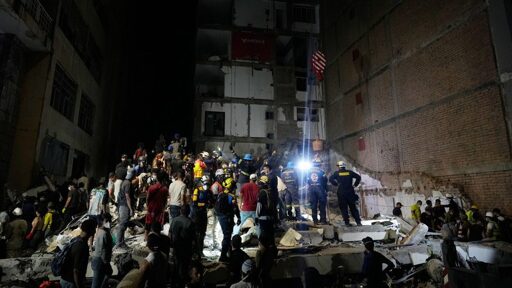

Just three days after Colombia’s new President Abelardo De la Espriella was sworn into office, an earthquake measuring 7.4 on the Richter scale struck the western part of the country. The quake was felt particularly strongly in the regions of Chocó, Caldás, Risaralda, and Valle del Cauca, among others, and was so powerful that it was even felt in neighboring Panama and Ecuador.
So far, authorities have reported the deaths of 280 people, a figure that is rising steadily as the hours pass, especially considering that anywhere between 2,000 and 4,200 people are currently reported missing (the total number of missing varies according to different entities). In addition, more than 1,300 people have been injured, some seriously.
Hundreds of rescue workers and civilian volunteers are conducting search operations in the hope of finding survivors amid the collapsed buildings, which number more than 100 according to the latest reports.
A new president takes office
The earthquake has become a focal point of De la Espriella’s early days as president. The new head of state was inaugurated on August 7 at a private university (breaking with protocol). Immediately after, he traveled by helicopter to a military battalion, where he delivered his first speech, sending a clear message about the future of his term: the private sector and the military, as hinted at by his military salute and his preference for private capital.
In fact, just a few hours after taking office, the Colombian government announced that several members of irregular armed groups had been killed in clashes with the armed forces, thus marking the beginning of a radical shift in the Army’s military operations. This shift is in line with De la Espriella promises. Throughout the campaign, he harshly criticized the peace process initiated by the government of Juan Manuel Santos and continued and strengthened by Gustavo Petro. “The option of dialogue has been completely exhausted,” said the new president.
He added: “Security is not built through concessions to crime, but through authority and perseverance … I reaffirm my intention to relentlessly defeat narco-terrorism and all criminal organizations that threaten Colombia’s freedom … El Tigre has arrived, and they will learn just how hard he bites when it comes to defending the Colombian people.”
Furthermore, the inauguration had a clear religious component, during which, amid prayers and hymns, a rabbi delivered a speech, exclaiming “Long live Israel!” to applause, thereby symbolically bringing to a close the diplomatic rift that had existed between the Colombian government and Tel Aviv during Petro’s presidency regarding Gaza. De la Espriella has stated on several occasions that he recognizes the Jewish people as “God’s chosen people.”
However, his response to the earthquake has quickly overshadowed various other actions in the first days of his term.
Earthquake aid rejected
Despite the magnitude of the tragedy, the De la Espriella administration reportedly rejected international aid that could have provided relief to the exhausted rescue workers. In fact, several countries and international organizations offered assistance to the newly elected government to help it address the crisis.
However, De la Espriella reportedly decided to disregard these offers, with the exception of the one from the United States. One of the international representatives who made this claim was the right-wing Salvadoran president, Nayib Bukele, an ally of De la Espriella: “The Colombian government has requested humanitarian aid solely in the form of supplies to assist families affected by the earthquake. We have been informed that their rescue teams, medical personnel, and other emergency responders are deployed and addressing the situation; therefore, at this time, they do not require personnel support.”
Similarly, the Chinese ambassador to Colombia, Zhu Jingyang, implied on X that offers of aid were not being heeded: “We hope the Colombian government will immediately release the name of the official and their designated contact person to coordinate international assistance for the earthquake victims. Please help us spread this message—it’s urgent!”
The specific reasons for rejecting the aid are not yet known, although it has been said that the government believes it can handle the disaster on its own; others, however, have interpreted the move as a rejection of multilateralism or simply an attempt by the new government to avoid appearing weak so early in its term.
Early criticism
The opposition did not wait for the new government to settle in before criticizing its handling of the earthquake, especially regarding its refusal of international aid to address the severe consequences the earthquake will bring.
We have already seen the destruction and economic crisis that persist in a country following an earthquake, as was the case in Venezuela; and while the situation in Colombia appears likely to be much less severe than in Venezuela, many analysts predict a difficult recovery for the affected areas. That is why the government declared an economic and social emergency in response to the earthquake.
Controversial diplomacy
At the same time, the opposition has also criticized the government’s decision to issue two highly controversial international decrees in the midst of the earthquake crisis. The first, which breaks with the international consensus (with the exception of the United States), was the recognition of Israeli sovereignty over the Golan Heights, which Syria has claimed since 1967 following the Six-Day War.
Furthermore, Bogotá has recognized Morocco’s sovereignty over the territory of Western Sahara, while freezing diplomatic relations with the Sahrawi Democratic Republic. Morocco has occupied the territory of Western Sahara since 1975, ignoring the demands of the UN and those of several countries. Likewise, in 2020, during Trump’s first administration, the United States recognized Moroccan sovereignty over that territory.
Thus, from the outset, De la Espriella has clearly been following Washington’s foreign policy to the letter, which sets the tone for his administration in the coming years. Furthermore, several analysts have stated that the fact that the current administration issued these two decrees at the very moment a national tragedy was unfolding speaks to De la Espriella’s priorities.
From BT News via This RSS Feed.