

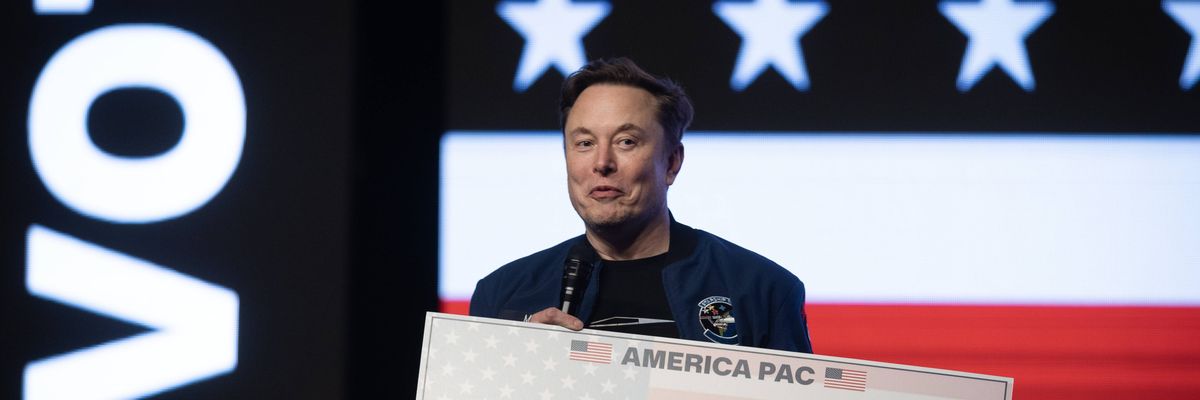
Critics are warning that the Trump administration just made financial crimes a lot easier to commit by permanently gutting a law that prevented criminals from using shell companies to obscure their activities. Elon Musk may benefit.
On Tuesday, the Treasury’s Financial Crimes Enforcement Network (FinCEN) issued a final rule permanently exempting US individuals and companies from a section of the Corporate Transparency Act (CTA) requiring them to identify the true owners of opaque companies.
The law, which passed in 2020, was ironically introduced and championed by then-US Senator Marco Rubio (R-Fla.), who is now President Donald Trump’s secretary of state and national security adviser.
At the time, Rubio called the law—which he introduced with Sens. Ron Wyden (D-Ore.) and Sheldon Whitehouse (D-RI)—“the most significant anti-corruption and money laundering law in decades.”
But Republicans have since pushed to repeal the legislation, which Sen. Tommy Tuberville (R-Ala.) referred to as “big government overreach.”
With Republicans in Congress unable to muster the votes to reverse it legislatively, the Trump administration has effectively killed the law by weakening Treasury Department policy. In March 2025, Treasury adopted an interim rule exempting US companies from its requirements.
Plans for a rule change were announced by Treasury less than 24 hours after the SpaceX and Tesla CEO, Musk—who was then leading the so-called Department of Government Efficiency (DOGE)—commented on his social media platform X that he would “look into” the statute in response to a right-wing comedian who’d complained about it.
According to a May report by the nonpartisan Government Accountability Office, more than 99% of entities previously required to report under the law were now exempt. That exemption was made permanent this week.
Treasury Secretary Scott Bessent said it was “a victory for common sense and American small businesses” and called the reporting requirements "burdensome… for millions of law-abiding business owners without compromising our national security.”
Nelson Bunn, executive director of the National District Attorneys Association, said the exact opposite was true.
"By exempting domestic entities and owners from reporting, FinCEN has significantly hindered prosecutors’ ability to identify the bad actors from legitimate businesses when investigating US shell companies used by transnational cartels, human traffickers, and cyberscammers,” Bunn said. "Taking away this indispensable tool for law enforcement endangers American families and communities.”
The change is drawing outrage from Democrats and some Republicans. In a statement on Thursday, Whitehouse and Sen. Chuck Grassley (R-Iowa) said the rule change “undermines the clear intent of the law.”
“The act gave the federal government needed tools to address criminal activity like human trafficking, terrorist financing, drug distribution, sanctions evasion, and more without unduly burdening legitimate commercial entities,” they said. "This decision is an unfortunate one that fails to use all available tools to protect Americans and crack down on illicit financial schemes.”
Sen. Elizabeth Warren (D-Mass.), the ranking member of the Senate Banking, Housing, and Urban Affairs Committee, highlighted that the committee’s previous oversight found the rollback would likely hamper efforts to stop a host of bad actors.
These included Chinese money-laundering networks that have been used to funnel proceeds to drug cartels, fraudsters using opaque ownership to rip off federal grants and benefits, and a Venezuelan national who allegedly used shell companies to hide over $1 billion in cryptocurrency transactions.
Rep. Don Beyer (D-Va.) said the law was “designed to stop criminals from laundering money, and Trump and Secretary Bessent are violating the Constitution to gut it,” and in doing so, “intentionally facilitating corruption and crime.”
In a letter sent to Bessent in March 2026, Warren and other Democratic lawmakers noted that Musk himself would be a direct beneficiary of the rule change, since he “uses a network of dozens of secretive companies—potentially the type of entities that, under the CTA, are required to report ownership information to the Treasury Department.”
The New York Times found that in Texas alone, there are over 90 different companies and other legal entities tied to Musk, with others in California, Delaware, and Nevada, which he has used to buy property, structure business deals, hold assets, and pay for political activity—including more than $80 million in super political action committee spending to support Trump in 2024—without putting his own name on the transactions.
“Trump is making it easier for cartels, criminals, and US adversaries to abuse our financial system and harm Americans,” said Sen. Andy Kim (D-NJ). “Why? Because he’s in the pocket of billionaires like Elon Musk, who’d potentially benefit from his shady and corrupt actions.”
Warren said: "Secretary Bessent should reverse this decision. And he needs to testify in front of this Committee to explain why he’s putting American national security at risk.”
From Common Dreams via This RSS Feed.
Step 1: make it so people don’t have to disclose they are part of a company
Step 2: company bankrolls politicians and buys the votes that put money in their pockets.
Step 3: bask in the glory of saying “I didn’t donate any money to politicians, everyone must just want what’s best for me”. While the constituents all sit there wondering how any of it could fixing the issues their taxes are paying to create.