

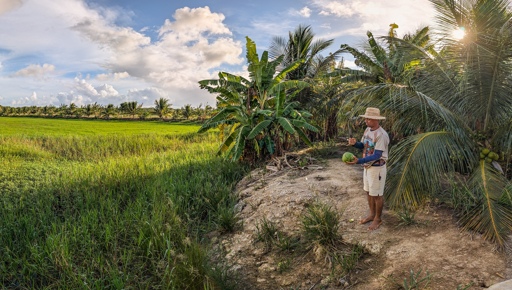
BREJÃO DOS NEGROS, Brazil — It’s hard to tell where one ends and the other starts. Here on Brazil’s Atlantic coast, where the São Francisco River meets the sea, waves ripple across the crystal-clear water. In the vast blue expanse, the green of islands and islets blends with fertile lands covered in Atlantic Forest remnants, white dunes, small docks, marginal lagoons, and mangroves — a biological heritage that serves as a nursery for countless marine species. But this beauty has not always belonged to those who lived there. Remnants of cotton plantations and more than 20 mills tell of an era before the so-called Golden Law of 1888 abolished slavery in Brazil. This region once held the largest number of enslaved people in the lower catchment area of the São Francisco River. Because of its dense native forests, it was also an ideal refuge for those who managed to escape, which earned it the name Refúgio dos Negros. Even after abolition, the people who lived off artisanal fishing and farming here enjoyed little real freedom. The land where they had lived on and worked for generations was claimed by local landowners who, with or without legal titles, exercised uncontested dominance. According to residents of the Brejão dos Negros Quilombola Territory — a group of traditional communities, or quilombos, founded by formerly enslaved Afro-Brazilians — fences and cattle grids went up everywhere, making them feel like prisoners in their own land. “It was like this: if you harvested a field of…This article was originally published on Mongabay
From Conservation news via This RSS Feed.