

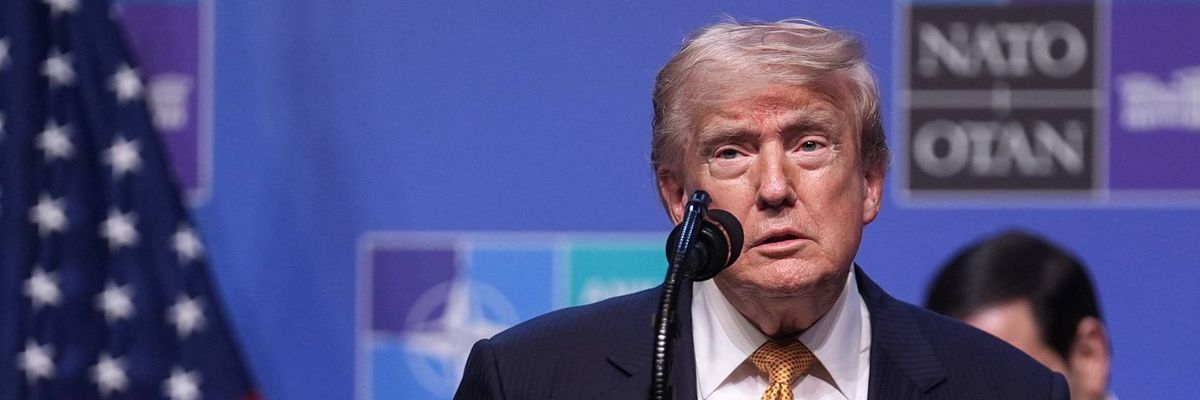
US and Turkish officials are reportedly suspicious that the supposed Iranian assassination plot that led President Donald Trump to make an elaborate escape from Ankara using a catering truck last month may have been a fabrication by Israeli intelligence.
Earlier this week, it was reported that Trump had to be secreted onto a nondescript plane to leave a NATO summit on July 8 after Israel passed an intelligence report to the CIA warning that Iran had planned to launch a missile at Air Force One. But new reporting indicates that neither Turkish nor American officials found the evidence all that compelling.
The alleged threat came at a highly volatile time, as the “memorandum of understanding” between the US and Iran to end nearly five months of war was on the verge of collapse, in part thanks to Israel’s attempts to undermine it.
As Middle East Eye reported on Tuesday, Turkish officials suggested that the intelligence report was “probably a ruse by [Israeli Prime Minister Benjamin] Netanyahu’s government to portray itself as protecting Trump, derail negotiations with Iran, and undermine Trump’s apparently close relationship with [Turkish President Recep Tayyip Erdoğan].”
Turkey tightened security after US officials informed it of the plot. But after examining the details of the scheme—which purportedly involved using shoulder-fired missiles to attack Trump’s plane within a kilometer of the runway—they said they found the intelligence report highly implausible.
“Of course, we took the report very seriously and tried to assist our American counterparts as much as possible,” one person familiar with the matter said. “Yet it was very clear to us that there was no way this report was true.”
It turns out that it wasn’t just Turkish officials who felt this way. The Washington Post on Wednesday cited a senior US official who said that the CIA analysts who’d received the report from Israel “did not view the intelligence as compelling and conveyed that skepticism to Trump administration officials.”
Another official said the report was “Israeli-derived, not US-generated, and viewed as low confidence.” The Secret Service acted on the report anyway out of an abundance of caution.
Nevertheless, the Post indicated that there was a striking amount of doubt among US intelligence officials about the motives of one of the country’s top allies, whom they suggest passed the information along to nudge Washington toward Israel’s own foreign policy objectives:
Some US intelligence officials saw Israel’s sharing of the warning about threats to Trump’s life as designed less to inform than to influence the president’s decision-making and US policy in the region, a current and a former US official said. Israel views Iran as by far its most urgent near-term threat.
But it views Turkey as a medium- to long-term threat and is anxious about warming ties between Washington and Ankara, bolstered by the personal rapport between Trump and Turkish President Recep Tayyip Erdoğan, the current official said.
It “fit a broader pattern of Israeli intelligence reporting that some officials see as designed as much to shape presidential decision-making as to inform it,” the former official familiar with the matter said.
Iranian leaders have denied any attempt to assassinate Trump. As they try to push him to admit defeat in the war the US and Israel started in February and accept a series of harsh surrender terms, they are having a laugh at his reaction to what they say was a fabricated plot.
Abbas Araghchi, Iran’s foreign minister, portrayed it as part of a larger pattern of the US having been misled by faulty Israeli intelligence.
Netanyahu was notably one of the driving forces behind Trump’s mistaken belief that an operation to topple the Iranian government would be quick and painless.
“The US has long miscalculated due to intelligence failures,” Araghchi wrote Thursday on social media. “Case in point: The war on Iran. Now, an even bigger miscalculation on the Strait of Hormuz.”
“Worse than fake news is fake intelligence,” he said. “Be careful.”
Joe Kent, the former director of the US National Counterterrorism Center, who resigned in March after accusing Trump of being manipulated into starting the war by false reports that Iran posed an imminent threat, said that “the story of Trump secretly switching airplanes is actually a great example of how we got into the war with Iran… ‘Israeli-derived, not US-generated, and viewed as low confidence’ by our own intelligence agencies.”
“It’s smart to take all threats seriously,” Kent said. “But if you’re basing a decision about going to war on information from a liaison intel service or an ‘ally,’ it’s important to remember they are most certainly providing that information to influence us as well as inform us.”
From Common Dreams via This RSS Feed.