

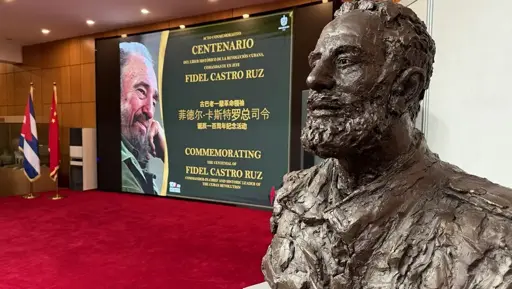
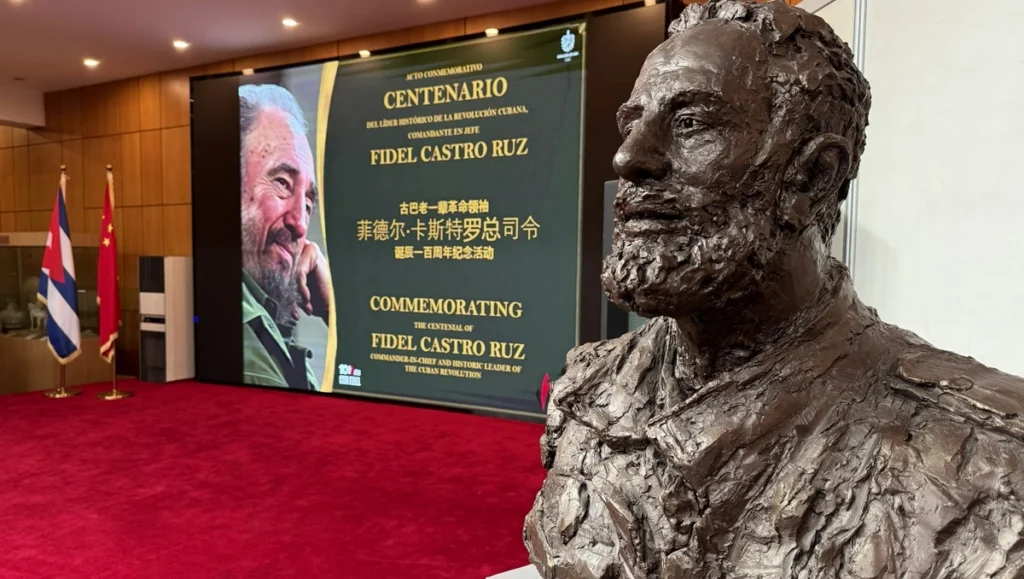
His birthday is being commemorated around the world with events honoring his lifelong struggle for justice for all humanity.
The Jintai Art Museum in the Chinese capital hosted a ceremony this Thursday, August 13, marking the 100th anniversary of Fidel Castro’s birth. Organized by the Cuban Embassy in China, the event brought together government representatives, diplomats, social movements and organizations from different countries, in a tribute marked by the defense of sovereignty, internationalism and solidarity among peoples.
RELATED:
Fidel Castro’s Centenary Pays Tribute To His Revolutionary Legacy
“A figure who transcends borders, time, generations and ideologies,” said the Cuban ambassador to China, highlighting the legacy of the leader of the Cuban Revolution.
The program featured speeches, testimonies and musical performances, including an interpretation of Que lindo es Cuba by the Amigos Hispanohablantes Choir, made up of Chinese performers.
Speakers at the ceremony recalled different aspects of Fidel’s political legacy: the Cuban Revolution, the confrontation with U.S. pressure, solidarity with other revolutionary and national liberation processes, and the construction of relations between Havana and Beijing.
Fidel Castro was born on August 13, 1926, and died in 2016 at the age of 90. In 1959, he led the Cuban Revolution, which overthrew the dictatorship of Fulgencio Batista.
The revolutionary victory came in a Latin America marked by strong U.S. political, economic and military influence. In Cuba, U.S. companies had a major presence in the economy, while Washington maintained close ties with Batista’s government.
After the Revolution, the new government carried out agrarian reform, nationalized companies and expanded social programs. At the same time, ties with the Soviet Union deepened and tensions with the United States increased.
Washington imposed economic sanctions and later an embargo that remains in place today. In 1961, a force of Cuban exiles trained and supported by the United States attempted to invade the island at the Bay of Pigs. The operation was defeated by revolutionary forces.
The following year, the Cuban Missile Crisis placed Cuba at the center of one of the most dangerous moments of the Cold War.
It was in this context that Havana also expanded its relations with countries in Asia, Africa and Latin America and supported national liberation movements and revolutionary processes.
During the ceremony in Beijing, Cuba’s ambassador to China highlighted this dimension of Fidel’s legacy:
“A figure who transcends borders, time, generations and ideologies. A man whose life was devoted to Cuba’s independence, social justice, solidarity among peoples, Latin American and Caribbean integration, the Global South, the socialist cause and the defense of a more just and equitable international order.”
The diplomat also highlighted the principle of internationalism:
“From Fidel, we learned to practice solidarity through actions, not beautiful words, as well as to remain firm in the face of adversity and prudent in the face of triumph.”
"Fidel Castro: One Hundred Years and a Grain of Corn in a Granite Boulder"…
Today, August 13, 2026, Fidel Castro would have turned one hundred years old. He was born on August 13, 1926 in Birán and died on November 25, 2016, yet his traces remain alive in the Cuban… pic.twitter.com/qPtNkwp9tT
—
geopolitics in the picture (@geogeolite) August 13, 2026
Cuba and China
One of the first major international decisions of the revolutionary government was to establish closer ties with the People’s Republic of China.
On September 28, 1960, Cuba established diplomatic relations with China, becoming the first Latin American country to do so. The decision came in the midst of the Cold War, when Beijing faced significant diplomatic isolation promoted by the United States and its allies.
More than six decades later, relations between the two countries have developed into a partnership covering trade, healthcare, biotechnology, agriculture, education and technology.
In 2025, China and Cuba marked 65 years of diplomatic relations. In 2026, they reach their 66th anniversary.
During the ceremony, Ma Hui, deputy head of the International Department of the Central Committee of the Communist Party of China, highlighted Fidel’s role in building those ties.
“Fidel Castro was one of the founders and main promoters of relations between China and Cuba. Thanks to his strategic vision and commitment, Cuba became the first country in Latin America to establish diplomatic relations with the New China.”
Ma Hui also recalled Fidel’s personal contacts with Chinese leaders: “Fidel visited China twice and warmly received Chinese leaders in Cuba on several occasions, including Xi Jinping, building a deep friendship and making a historic contribution to the development of China-Cuba relations. The Chinese people will never forget him.”
The Chinese official also highlighted Fidel’s contribution beyond bilateral relations: “He also made an indelible contribution to the defense of international justice and equity and to the progress of humanity. History will not forget him.”
The relationship between the two countries was also built through exchanges between their peoples. The director of the Amigos Hispanohablantes Choir spoke to teleSUR in an exclusive interview about the significance of the tribute.
“It is a very, very important day. Last year we were also at the Cuban Embassy singing in honor of Mr. Fidel Castro. This year is more important because it marks one hundred years since his birth.”
She described Fidel as a figure beloved in Latin America and China: “He is a great man, very much loved by all the Latin American peoples and by the Chinese people. A great friend.”
She connected Fidel’s legacy with the struggle for freedom and better living conditions: “It is important because he followed a path to give freedom, to give his people a better life.”
She also highlighted his resistance in the face of pressure against Cuba: “And in the face of challenges of aggression, invasion and oppression, especially from the Americans, he never surrendered. He is a revolutionary spirit that we have to follow and honor. That is why we are here.”
The director also spoke about the historic ties between China and Cuba: “Cuba was the first country to establish diplomatic relations with China, in the entire Eastern world. It was the first.”
She recalled that “last year marked 65 years. This year it will be 66 years since diplomatic relations with China were established.” For her, the relationship goes beyond governments:
“In other words, we support each other, we know each other.” She also mentioned educational exchanges: “China has sent many students to learn Spanish in Cuba.”
And she highlighted cooperation in healthcare: “And Cuba has also sent [people], for example, because it has very good medicines, as far as I know.”
She herself has visited Cuba three times: “I had been to Cuba on three different occasions. I loved Cuba.”
Fidel Castro, born on this day in 1926:
‘We repudiate with all our might the ruthless persecution & genocide unleashed by Nazism against the Jews…
But I cannot recall anything more similar in our contemporary history than the genocide carried out today by imperialism and… https://t.co/FCps6vcjAV pic.twitter.com/dx3YDGCIig
— Afshin Rattansi (@afshinrattansi) August 13, 2026
Cuban Internationalism
Cuban foreign policy during the period when Fidel was at the helm of the country extended far beyond Latin America.
Cuba established relations with liberation movements and governments in Africa and Asia. One of the best-known episodes was Cuban involvement in the war in Angola.
In 1975, Cuba sent troops to support the Angolan government during the conflict that followed independence. Cuban involvement was also linked to the struggle against apartheid in South Africa and the independence process in Namibia.
The episode became one of the main symbols of the Cuban internationalism championed by Fidel.
Cuba’s international engagement also extended to healthcare. Cuban doctors and medical professionals began working in different countries, particularly in Africa, Latin America and the Caribbean.
This policy of solidarity helps explain why internationalism emerged as one of the central themes of the tribute in Beijing.
Fidel, Nicaragua, and the Sandinista Revolution
In Central America, the Sandinista Revolution represents another important chapter in this history.
In 1979, the Sandinista National Liberation Front overthrew the dictatorship of the Somoza family, which had ruled Nicaragua for decades with U.S. support.
The new government launched literacy campaigns, social programs and agrarian reform measures. At the same time, it began facing the Contras, armed groups supported by Washington.
The war turned Nicaragua into one of the main arenas of the Cold War in Latin America.
Cuba stood alongside the Nicaraguan revolutionary process. In an exclusive interview with teleSUR, Nicaragua’s ambassador to China, Ramiro Cruz, recalled the 1980s:
“Cuba stood alongside Nicaragua in the 1980s, when U.S. aggression against our territory and our revolution was enormous. The Cuban people and Commander Fidel were there.”
For Cruz, remembering Fidel also means remembering other revolutionary processes:
“Commemorating Fidel means commemorating the struggles of revolutionary peoples such as Nicaragua, Cuba and all the peoples of the world.”
The ambassador added: “So we are very happy to accompany the Cuban Embassy and the Cuban people in this celebration today.”
“Whoever attempts to conquer Cuba will only gain its blood-soaked soil, if they do not first perish in combat. Patria o muerte!"
-Leader of the Cuban Revolution Fidel Castro, born on this day in 1926 https://t.co/BmjpmMlASP pic.twitter.com/aUQFrPn1zq
— Afshin Rattansi (@afshinrattansi) August 13, 2026
The Blockade and Cuban Sovereignty
The Cuban Revolution also became defined by its prolonged confrontation with Washington. The U.S. economic blockade has remained in place for more than six decades and is condemned annually by the United Nations General Assembly. In October 2025, a resolution calling for an end to the blockade received 165 votes in favor, seven against and 12 abstentions.
For the Cuban government and solidarity organizations, the blockade is a form of economic pressure that affects the island’s access to resources, fuel, medicines, food and equipment.
The question of sovereignty is central to how participants in the ceremony describe Fidel’s legacy. It is also where the MST’s intervention connects with the Cuban experience.
Fidel’s Internationalism and Brazil’s MST
Brazil’s Landless Workers’ Movement, known as the MST, turns 42 in 2026. The organization emerged in Brazil amid struggles for agrarian reform and democratization and has built relations with peasant movements and popular organizations in other countries throughout its history.
In China, the MST maintains a brigade involved in projects, exchanges and international cooperation. Barbara Loureiro, coordinator of the MST’s China Brigade, spoke to teleSUR in an exclusive interview during the tribute. She connected Fidel’s centenary with the MST’s 42nd anniversary:
“We are here during this centenary of Fidel, also remembering that the Landless Workers’ Movement is reaching its 42nd year, drawing on the legacy and the living example of what the Cuban Revolution was, and learning from and practicing what Fidel’s internationalism teaches us.”
For Barbara, Fidel’s internationalism is a direct reference for the movement: “We know that Fidel’s internationalism is also a living foundation for the internationalism practiced by the MST: looking at the struggle of others, the struggle of oppressed peoples, as our own struggle.”
The brigade also develops projects and cooperation initiatives with Cuba from China: “From here in China, our brigade has also developed a series of projects, initiatives and cooperation with Cuba, in a firm defense of the Cuban Revolution against U.S. attacks and for the sovereign development of the Cuban people.”
She concludes: “So our brigade continues here practicing this internationalism that we learned from Fidel.”
One Hundred Years Later
The ceremony in Beijing brought together different chapters of the political history associated with Fidel Castro.
The Cuban representative spoke about independence, socialism and international solidarity. The Chinese representative recalled the construction of diplomatic relations between Havana and Beijing. Nicaragua’s ambassador remembered Cuban support for the Sandinista Revolution. And the MST presented internationalism as a practice that remains part of its work.
The participation of the Amigos Hispanohablantes Choir added another element to the tribute: the presence of Cuban culture among Chinese performers.
The relationship between Cuba and China, officially established in 1960, has survived the Cold War, the collapse of the Soviet Union and transformations in the international order. Today, both countries continue to deepen cooperation in different areas.
At the Jintai Art Museum in Beijing, Fidel’s centenary was remembered by representatives of different countries and organizations who continue to associate his legacy with national sovereignty, socialism, internationalism and solidarity among peoples. Bruno Falci, teleSUR Correspondent in China
Bruno Falci, teleSUR Correspondent in China
From teleSUR English via This RSS Feed.