

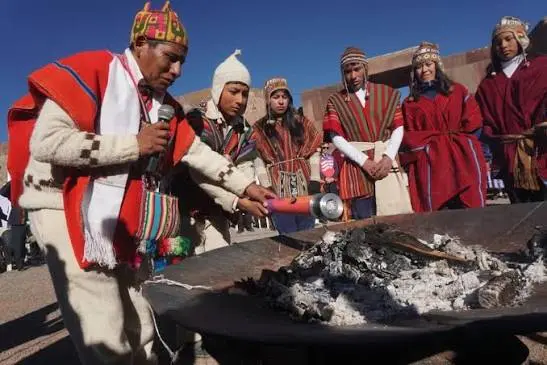
On Wednesday, the pre-Hispanic citadel of Tiahuanaco, in the Bolivian Altiplano, was the setting for the lighting of the flame that will accompany the thirteenth edition of the South American Games, to be held in the province of Santa Fe, Argentina, from September 12 to 26.
RELATED:
Bolivia Awarded 2029 Bolivarian Games Hosting
The ceremony took place at the entrance to the Kalasasaya temple, one of the most representative structures of the site, located just over 70 kilometers from the city of La Paz. The event was preceded by Andean rituals in which a group of amautas (Andean sages) presented an offering to Pachamama (Mother Earth) to ask for good omens for the competition.
Afterward, a group of young people dressed as chaskis—messengers of the Inca Empire—descended with the torch from the top of the Akapana pyramid. Following the official speeches, the flame from the offering was used to light the torch, which was then handed over by the president of the Bolivian Olympic Committee (COB), Marco Arze, and the director general of the Vice Ministry of Sports, Alejandro Menacho, to the head of the South American Sports Organization (ODESUR), Mario Moccia.
The ODESUR statutes stipulate that every four years the flame of the South American Games must be lit in Tiahuanaco, considered one of the main spiritual centers of the Andean world.
En el marco de la cuenta regresiva para los Juegos Suramericanos 2026, la vocera del Gobierno provincial, Virginia Coudannes, visitó los estudios de LT10 y destacó el ritmo de las obras, la articulación entre los municipios y el impacto social y deportivo que tendrá la…
— LT10 (@radiolt10) August 13, 2026
The text reads, “As part of the countdown to the 2026 South American Games, the spokesperson for the provincial government, Virginia Coudannes, visited the LT10 studios and highlighted the pace of the works, the coordination between the municipalities and the social and sporting impact that the competition will have in the region.”
In his remarks, Arze recalled that in 1978 La Paz was the first host city of what were then called the Southern Cross Games, created by five countries with 600 athletes and 16 sports. “Things have evolved so favorably, so magnificently, that after 50 years, we have the opportunity to bring together more than 4,000 athletes in 43 sports and an even greater number of sporting disciplines,” he noted, attributing this growth to the camaraderie among the region’s sports leaders.
For his part, Moccia stated that the ceremony marks a milestone in the organization of the South American Games since 1978 and emphasized that every four years, without interruption, they come here to retrieve the sacred flame, which will then be taken to the host city, in this case, the province of Santa Fe, with the cities of Rosario, Santa Fe, and Rafaela.
The president of ODESUR highlighted that Santa Fe is organizing exceptional games and described the event as a comprehensive phenomenon that generates a legacy that transforms people’s lives through investment, infrastructure, and skills development.
#Bolivia | The month of Pachamama, Mother Earth, began with traditional offerings that include sweets, medicinal plants, incense, and dried llama fetuses, symbols of gratitude and prosperity.https://t.co/xhFCMkZyMX
— teleSUR English (@telesurenglish) August 4, 2026
From teleSUR English via This RSS Feed.