

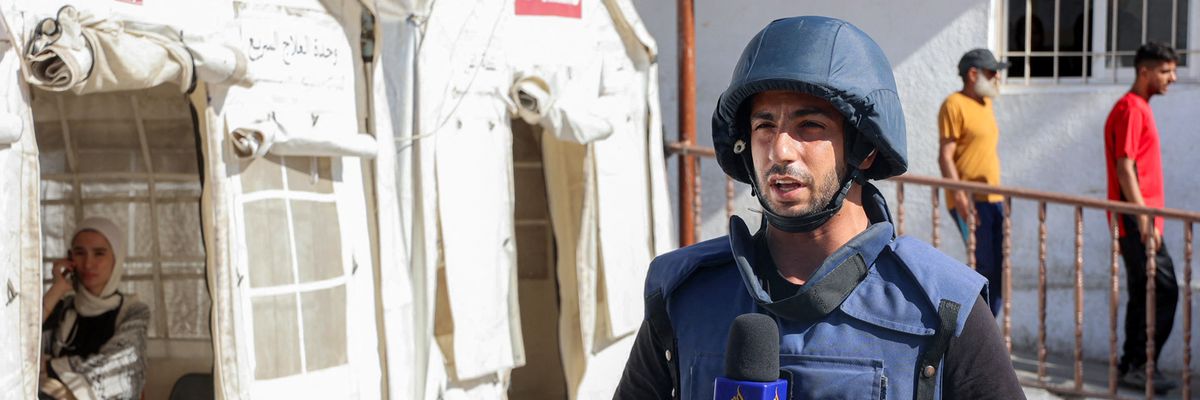
Just over a year after six journalists—Anas al-Sharif, Mohammed Qraiqea, Ibrahim Zaher, Mohammed Noufal, Mohammed al-Khalidi, and Moamen Aliwa—were assassinated in an Israeli strike on their tent outside Al-Shifa Hospital in Gaza City, a collective of media workers on Wednesday set out to ensure that all 270 Palestinian reporters who have been killed while covering Israel’s nearly three-year assault on the exclave are remembered by the world.
The New York War Crimes collective, a project of Writers Against the War on Gaza (WAWOG), said it initially aimed to gather remembrances of al-Sharif, a 28-year-old Al Jazeera correspondent who was born in Jabalia refugee camp and started his career as a volunteer for Al-Shamal Media Network before becoming internationally known for his “ceaseless coverage” of Israel’s US-backed assault on Gaza.
The responses the collective got, said the organizers, “transformed the project. Anas, his colleagues told us, would not have wanted to be remembered as a singular hero, but as a servant of the Palestinian cause.”
“So, over the course of the following year, we gathered spoken testimonies from fellow journalists, photographers, cameramen, journalism professors, students, and workers across the media sector in Gaza,” reads the website for the project, titled A Living Record. “Each contributor was asked to record a personal remembrance of one or more martyrs, to tell a small part of the history that, as [journalist] Samira Nassar says, should be written in gold.”
A number of journalists spoke to WAWOG about al-Sharif, who reported from northern Gaza while the Israel Defense Forces (IDF) were heavily restricting humanitarian aid there as they waged intense attacks there on refugee camps and other civilian infrastructure.
“All the journalists were in awe—really in awe—of him,” said Isra al-Madallal. “Just the fact that he was in the north while all the other journalists were in the south was enough to make everyone keep asking, ‘How are you? Where are you? What are you doing? What is happening? May God keep you steadfast.’ And the starvation—that was something that they lived through together, something intense.”
Another colleague, Doaa Shaheen, said Al-Sharif served as "the voice of Jabalia, the voice of the north as a whole; he never left
“He never wavered for a single moment from carrying out his mission, reporting the news, delivering the truth, and exposing the atrocities of the Israeli genocide in the Gaza Strip,” said Shaheen, adding that when her fellow Jabalia camp native was killed she thought: “So that’s it? He’s been martyred? So where is Anas’ voice?”
Freelance journalist Baraa Lafi remembered Mariam Abu Dagga, a visual journalist who extensively documented how children were being affected by Israel’s attacks, which have been called a genocide by leading human rights groups and Holocaust scholars. She photographed overwhelmed hospitals as medical workers struggled to care for sick and injured Palestinians, as well as documenting the impact of Israel’s blockade on humanitarian aid.
Lafi was wounded in the Israeli double-tap strike on Nasser Hospital that killed Abu Dagga, as well as Moaz Abu Taha, Hussam al-Masri, Ahmad Abu Aziz, and Mohammad Salama, just weeks after Al-Sharif and his colleagues were killed.
“As a journalist, Mariam was brave. Braver than many men,” said Lafi. “Everyone could see that. Mariam in the field was not unassuming and timid—no. She was fearless. She ran toward the fire, she was first on the scene. If she saw an injured child in distress, she would stop and comfort them. If she saw someone upset, she would stop and stay by their side. If Mariam saw a mother searching for her children—whether during famine or bombardment—she would stop filming and stay by her side, going with her from hospital to hospital to help her find them.”
WAWOG collected remembrances from several reporters of “journalists as a collective,” with Bisan Owda, who won the Peabody Award in 2024 for her coverage of the war on social media, saying that despite Israel’s slaughter of more than 73,000 Palestinians and decimation of the exclave’s civilian infrastructure, “there’s still goodness here, in this small place, in the ground underneath us, in those who fight the evil spreading through the rest of the world. To me, those are the people and journalists of Gaza.”
“To me, these individuals were daring enough to dream, to believe that we can make a difference,” said Owda. “We are brave. We are the ones who have the courage to document with our cameras, to change the narrative, change our current conditions, and to draw attention to our people’s oppression. To change what is happening. You are dealing with the bravest people on the face of the Earth. They are the ones spreading the truth to combat every false narrative in the world.”
As The Living Record was published Wednesday, protesters rallied outside The New York Times headquarters in New York City to demand accountability for the killing of journalists in Gaza, while Drop Site News correspondent Mohamed Awad was detained by Israeli forces in Ramallah, the West Bank.
WAWOG said that in the fall, as the third anniversary of Israel’s assault on Gaza approaches, it plans to publish more eulogies of Gaza journalists who have been killed in the exclave.
From Common Dreams via This RSS Feed.