

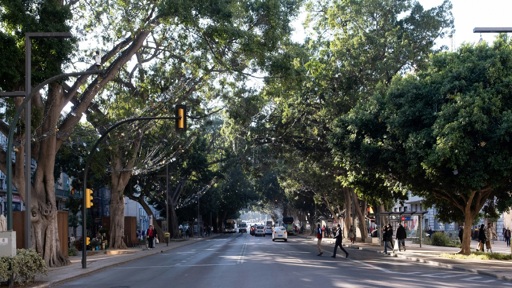
Urban heat islands pose a growing global health threat. But in tropical cities, the peril is surging. Already burdened by hot-humid equatorial weather, global warming, intense poverty, rapid urbanization, and a lack of cooling infrastructure, tropical city officials now face a powerful 2026-2027 El Niño that could put millions of vulnerable urban dwellers at risk. Heat islands form because artificial surfaces, like roads and rooftops, trap heat by day and release it by night, never giving highly-urbanized spaces time to cool. When climate change-induced heat domes stall over cities, temperatures can soar for weeks into the triple digits. Every “city has a rhythm, it has a metabolism,” Matthias Roth, a National University of Singapore researcher, told Mongabay in a video interview. “The metabolism of each city — especially how incoming solar energy is divided between heating surfaces, warming the air, evaporating water, and being stored in the ground and buildings — influences how much energy heats up buildings, surfaces, and air. The prevalence of concrete and asphalt and the absence of vegetation creates a heat island.” But not all tropical urban heat islands (UHIs) are created equally, with the severity of their heat burdens dependent on innovative city planning and the financial clout to keep pace with global warming. In wealthy Singapore (which has devoted high levels of funding to curb UHI effects), air temperatures can still swell; compact high-rise building complexes there can see outdoor temperatures 4.3° Celsius (7.9° Fahrenheit) above rural areas. But in poorer cities, like Lagos,…This article was originally published on Mongabay
From Conservation news via This RSS Feed.