

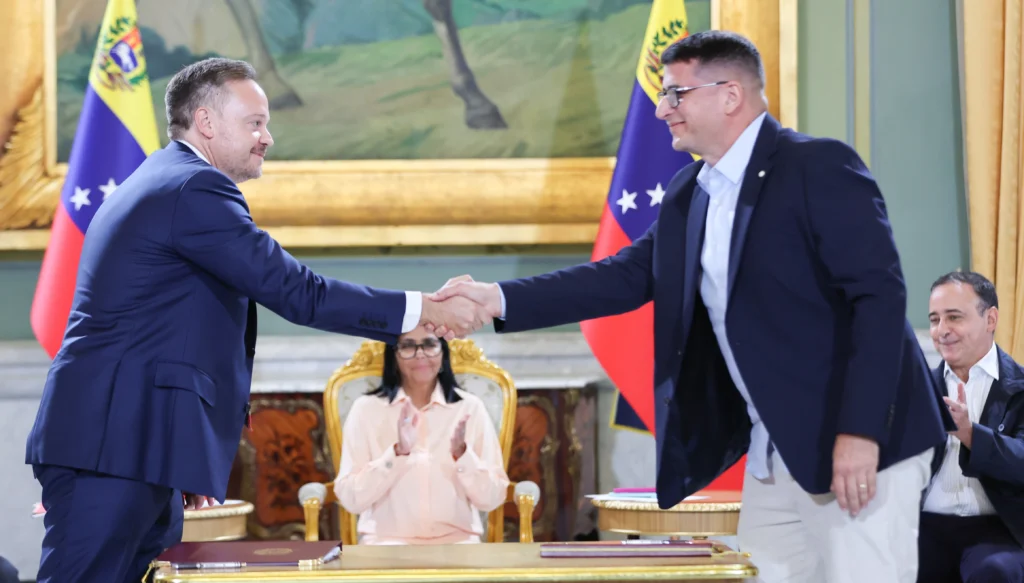
Venezuela’s Acting President Delcy Rodriguez led this Wednesday the signing of an addendum between Corpoelec and Argentinean firm IMPSA to restart works at the Macagua and Tocoma hydroelectric plants, adding megawatts to the National Electric System.
The ceremony, held on August 12, 2026, materialized the memorandum of understanding signed on June 13 between the National Electric Corporation (Corpoelec) and the Argentinean technology company.
The alliance will allow work to begin at the two power stations located in the Bajo Caroní complex, Bolívar state, to increase generation capacity and advance the stabilization of Venezuela’s electrical network.
RELATED: Venezuela Delivers 102 Rehabilitated Homes to Earthquake-affected Families
On Monday at 2:44 P.M. local time, Venezuela registered the most elevated electricity demand of 2026, reaching 15,625 megawatts (MW). According to official records, this behavior represents an increase of 3.6% compared to the maximum demand in 2025, a product of high temperatures and sustained economic growth.
Following this, the Venezuelan Acting President reported that the country recorded its highest electricity demand in eight years, driven by rising temperatures and intense droughts linked to the global climate emergency.
The record consumption reflects the reactivation of the national economy, which demands a stable and reliable power supply to sustain industrial production, commerce and services across the country.
Ver esta publicación en Instagram
Una publicación compartida de teleSUR English (@telesurenglish)
The Venezuelan Electric Energy Minister Rolando Alcalá explained the agreement with Argentine firm IMPSA comprises a large-scale undertaking involving civil infrastructure and turbine interventions, guaranteeing immediate job creation and the highest quality standards.
Minister Alcalá stressed that the partnership with IMPSA will generate immediate employment in Bolívar state, strengthening local economies while reinforcing the country’s energy sovereignty. The modernization of the Bajo Caroní complex also serves as a strategic response to the climate challenges facing not only Venezuela but the entire region.
In this sense, the government framed this cooperation as an example of regional integration and sovereign technological development, capable of overcoming the obstacles imposed by unilateral sanctions. With the expansion of hydroelectric capacity, the administration seeks to build a resilient and self-sufficient energy matrix that supports long-term social and economic development while guaranteeing the well-being of the Venezuelan people.
Seismic Damage Recovery
During the meeting, Acting President Rodríguez detailed the consequences of the recent double earthquake on the National Electric System. The seismic event toppled transmission lines and took the Carabobo thermoelectric plant out of service in the center of the country, affecting system stability with the loss of 600 megawatts.
“We have already recovered 50% of those 600 megawatts. In the coming days and weeks we will continue working on the recovery of the transmission lines that fell with the double earthquake,” declared the Acting President. “This signing represents our medium and long-term vision: the incorporation of more megawatts and more stability to the national electrical system,” she affirmed.
To balance demand while megawatt restoration advances, the Venezuelan government maintains an energy saving plan in the Public Administration, with in-person workdays every other day between 8:00 a.m. and 12:30 P.M. local time, keeping only essential public services in continuous operation.
“We must strengthen the electrical system, recover it from the earthquake situation and consolidate it to face these climate challenges that are coming, not only for Venezuela, but for the region and the planet,” emphasized Rodríguez, calling on the people to raise awareness about responsible energy consumption.
The strategic partnership with IMPSA underscores the importance of regional cooperation in Latin America for the development of sovereign energy capacity. By upgrading the hydroelectric plants, the government advances toward a resilient and self-sufficient energy matrix capable of supporting long-term social and economic development in the face of climate challenges and external pressures.
From teleSUR English via This RSS Feed.