

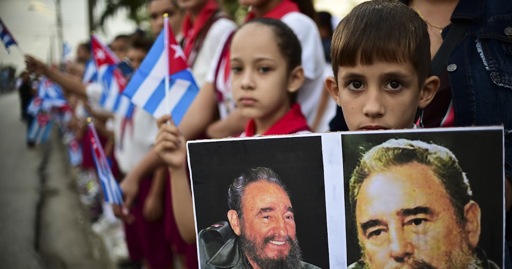

By Nikos Mottas
“Socialism is and will be the hope, the only hope, the only path for the peoples, the oppressed, the exploited, the plundered. Socialism is the only alternative"— Fidel Castro Ruz
A century after the birth of Fidel Castro Ruz, on 13 August 1926, the hatred directed against him has hardly diminished. Nearly ten years after his death, the same vocabulary is repeated with remarkable persistence: “dictator,” “tyrant,” “totalitarian.” Fidel is vilified, the Cuban Revolution is slandered, its achievements are denied or reduced to inconvenient footnotes, while the Cuba that existed before January 1959 is carefully pushed out of sight.
There is something revealing in this persistence. The bourgeois world does not spend decades fighting harmless ghosts. What remains intolerable to Fidel’s enemies is not simply the memory of a revolutionary giant, but what the Cuban Revolution proved in practice: that capitalist ownership is not eternal, that imperialist domination can be broken, and that political power can pass into the hands of forces determined to reorganize society according to the needs of the working people rather than the profitability of capital.
The revolutionary road opened on 26 July 1953, when a group of young rebels led by the 26-year-old Fidel attacked the Moncada Barracks in Santiago de Cuba against the dictatorship of Fulgencio Batista. The operation failed militarily. Many of the revolutionaries were murdered after their capture, while Fidel was arrested, tried and imprisoned. Yet Moncada became the political starting point of the process that, less than six years later, would overthrow Batista and change the course of Cuban history.
It was during his trial that Fidel delivered the defense whose closing words became inseparable from his name: “Condemn me. It does not matter. History will absolve me.” They were the defiant words of a young revolutionary before the courts of the dictatorship, but they expressed something deeper: the conviction that the Cuban people could cease being an object of foreign domination and capitalist exploitation and become the conscious makers of their own history.
The victory of January 1959 was not simply the replacement of one government by another. Had Batista been succeeded by a more respectable manager of the same social order, Washington could have lived with it. Dictatorship itself had never troubled the United States when capitalist interests and U.S. domination were secure.
The Revolution did something fundamentally different. Agrarian reform struck at the great landowners. Nationalizations confronted foreign monopolies and the Cuban bourgeoisie. The commanding sectors of the economy were progressively removed from capitalist ownership. Cuba broke the chains of dependency that had tied it economically and politically to the United States and opened the road to socialist construction. There lay the real rupture.
Before the Revolution, Cuba was formally independent but economically subordinated. Sugar dominated an economy heavily dependent on foreign capital. Large estates coexisted with deep rural poverty. Havana was sold abroad through the glitter of casinos, luxury hotels, prostitution and organized crime, while behind that façade stood another Cuba: unemployment, illiteracy, miserable housing and profound class inequalities.
Batista tortured and murdered political opponents, but Washington remained his ally. The decisive question was never abstract “democracy.” It was class interest. Batista defended capitalist property and U.S. domination; the Revolution challenged both.
That is why pre-revolutionary Cuba must disappear from the anti-communist account. Once it is restored to the picture, the essential questions become unavoidable: Who lost estates, monopolies, privilege and political power after 1959? And who gained schools, hospitals, land, social rights and sovereignty?
The gains that followed were neither miracles nor gifts bestowed from above by one exceptional leader. They were rooted in the change of power itself. Mass illiteracy was virtually eliminated. Education became a universal social right. A nationwide public health system was created. Cuba trained generations of doctors, teachers, scientists, engineers and other professionals on a scale remarkable for a country of its size. Women entered economic, political and social life in vastly greater numbers, while science, culture and sport were opened to the broad masses of the people.
Socialism did not abolish contradictions, mistakes or bureaucratic distortions. No serious communist would claim that it did. What the Cuban experience demonstrated was something more important: once private profit ceased to be the supreme criterion, society could direct enormous human and material resources toward needs that capitalism routinely neglects.
Cuban internationalism became one of the finest expressions of this new social morality. In it one can recognize something of what Che Guevara meant when he spoke of the formation of a new human being: not a creature of individual competition and private accumulation, but a conscious participant in collective struggle, solidarity and socialist construction.
Cuban medical personnel went to Chile after the devastating earthquake of 1960 and, three years later, to newly independent Algeria. In the decades that followed, doctors, nurses, teachers and other specialists travelled across Latin America, Africa and Asia, often reaching places from which capital saw no profit to be made.
That internationalism also took up arms when history demanded it. In Angola, Cuban internationalists crossed the Atlantic not to acquire colonies, seize mines or obtain concessions for Cuban corporations, but to assist a people fighting aggression backed by apartheid South Africa. Their blood was shed thousands of kilometres from Havana in a struggle whose blows were felt from Angola and Namibia to the very foundations of apartheid.
Here the contrast with imperialism becomes almost brutal in its clarity. The historical trail of U.S. imperialism is littered with coups, invasions, proxy wars, assassination operations, reactionary dictatorships and the economic strangulation of peoples who dared refuse submission. Its tentacles have stretched across Latin America and far beyond it — an imperialist octopus wrapping military bases, monopolies, financial coercion and political intervention around entire countries while speaking, invariably, in the language of “freedom.”
Cuba committed the unforgivable crime of cutting those tentacles.
For more than six decades, the United States has imposed on the heroic Cuban people an economic, commercial and financial blockade — a genocidal policy of economic warfare aimed at exhausting an entire society, sowing hardship and creating the conditions for the defeat of the Revolution from within. Presidents have changed, tactics have shifted and particular measures have been tightened or loosened, but the strategic objective has remained intact.
The blockade is neither an abstraction nor an all-purpose excuse. Its consequences enter hospitals, factories, power stations and Cuban homes. It obstructs access to financing, medicines, technology, fuel, machinery and spare parts; its extraterritorial reach threatens banks, shipping companies and businesses thousands of kilometres from Cuba. The calculation behind it is as cynical as it is simple: make life unbearable enough, and perhaps suffering can accomplish what invasion, sabotage and political isolation failed to achieve.
Yet Marxists have no need to explain every Cuban difficulty through the blockade. Bureaucratic weaknesses, errors in planning, ineffective measures, low productivity and other internal contradictions have existed and must be confronted. Socialist construction does not advance through praise alone, and criticism directed at correcting weaknesses is indispensable. But that has nothing in common with the “criticism” of those for whom every Cuban problem has the same prescribed cure: dismantle socialism, restore capitalist property and return the island to the embrace of U.S. capital.
The Revolution’s harshest historical test came with the counterrevolutionary overthrow of socialism in the Soviet Union and Eastern Europe. Cuba lost its principal economic relations almost overnight and entered the devastating Special Period. Production collapsed, fuel became scarce, transport deteriorated and shortages deepened. Washington, Miami and much of the bourgeois press began preparing the Revolution’s obituary. It was premature.
The Cuban people endured enormous sacrifices, but capitalist restoration did not follow. A small socialist country, only ninety miles from the most powerful imperialist state on earth and suddenly deprived of the international economic framework on which much of its economy had depended, remained standing. Imperialism expected the Cuban Revolution to be buried beneath the ruins of the USSR. More than three decades later, it is still waiting.
It is against this background that Fidel Castro’s stature comes fully into view. The Cuban Revolution was not the work of one man. Revolutions are made by masses, through organized struggle and under concrete historical conditions. But denying Fidel’s exceptional role would be as absurd as reducing the Revolution to his personality.
He became one of the giants of the revolutionary movement of the twentieth century not because history granted him some mystical quality, but because his life became inseparable from a revolution that overthrew Batista, confronted the Cuban bourgeoisie and U.S. imperialism, defended socialist power through extraordinary trials and placed a small Caribbean island on the side of peoples fighting colonialism, apartheid and imperialist domination across the world.
Nor does Fidel need to be transformed into a saint. Marxism has no use for saints. He made mistakes; the Revolution made mistakes. Policies were corrected, experiments failed and contradictions were sometimes underestimated. The decisive historical question is not whether errors occurred, but which class interests were being fought, which power was being defended and in which direction Cuban society was struggling to advance.
That question remains decisive today.
Cuba faces grave difficulties. Shortages, inflation, migration, deteriorating infrastructure and prolonged electricity cuts weigh heavily on its people. The great achievements of earlier decades cannot substitute for solutions to the problems of the present. Socialist power must confront these contradictions, improve planning, unleash the initiative of the working people and resist every road that leads toward capitalist restoration.
And here again, the class line is unmistakable. Washington does not seek a “better” socialism in Cuba. It does not merely demand administrative reform. Its objective is the reversal of 1959: the restoration of capitalist property, bourgeois power and Cuba’s return to the economic and political orbit of U.S. imperialism.
That is why Fidel still provokes such hostility.
The real enemy was never one bearded revolutionary from Birán. It was, and remains, the example of the Cuban Revolution itself: proof that the exploiting classes can lose power, that capitalist property can be expropriated, that imperialism can be defied and that a people considered small and expendable can refuse the place assigned to it by the powerful.
This is what lies beneath the endless sermons about “Castro’s dictatorship.” Workers must not ask what Cuba was before 1959. They must not ask which classes lost their wealth and privileges, why Washington embraced Batista but sought to destroy revolutionary Cuba, or why generations of U.S. governments have considered a small Caribbean island such an intolerable enemy.
Above all, they must not ask the most dangerous question of all: What could humanity achieve if the immense productive forces created by labour belonged to those who produce society’s wealth and were organized to satisfy human needs rather than enrich a minority?
Marx exposed the fundamental contradiction of a society in which those who create its wealth do not control it. Cuba dared to carry that critique from the pages of theory into the terrain where every revolutionary question is ultimately decided: the question of power.
Fidel Castro helped place that question before history.
When he stood before Batista’s court after Moncada and declared that history would absolve him, neither he nor his judges could have known everything that would follow. Batista would fall. The mercenaries at Playa Girón would be defeated. Cuba would proclaim the socialist character of its Revolution. Cuban internationalists would confront the forces of apartheid in Africa. Doctors and teachers bearing no weapons other than knowledge and solidarity would travel across continents. The Soviet Union would disappear — and socialist Cuba would remain.
History does not deliver verdicts in the manner of a bourgeois court. Nor does it absolve revolutionaries of every error. Its judgment is written in the interests they fought for, the enemies they confronted, the transformations they helped achieve and the possibilities their struggle opened for those who came after them.
By that measure, Fidel’s challenge to his judges has long since received its answer.
His centenary should therefore be neither an exercise in nostalgia nor an occasion to turn a revolutionary into a harmless bronze statue. Fidel belongs not in a museum, but in the living history of the struggle between exploitation and emancipation, imperialism and sovereignty, capitalism and socialism.
A hundred years after his birth, the imperialist colossus that has tried for more than six decades to bring Cuba to its knees has still not achieved its objective. The island has not returned to the Cuba of the casinos, the latifundia and foreign masters. Despite suffering, contradictions and an economic siege of extraordinary duration and cruelty, capitalist restoration has not prevailed.
Therein lies the bourgeoisie’s continuing hatred. And therein lies the lesson for the working class and the peoples of the world.
Fidel Castro was condemned by Batista’s courts, hunted by imperialism and vilified for decades by its apologists. A century after his birth, the cause to which he gave his life remains unfinished, embattled and alive on Cuban soil. The giant has gone, but the Revolution that made him — and that he helped make — endures — and will continue to exist.
History has absolved him!
* Nikos Mottas is the Editor-in-Chief of In Defense of Communism.
From In Defense of Communism via This RSS Feed.
I fucking haven’t