

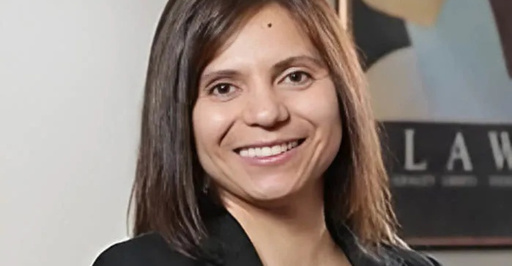
Janine Jackson interviewed the Food Research and Action Center’s Gina Plata-Nino about food aid cuts for the August 7, 2026, episode of CounterSpin*. This is a lightly edited transcript.*
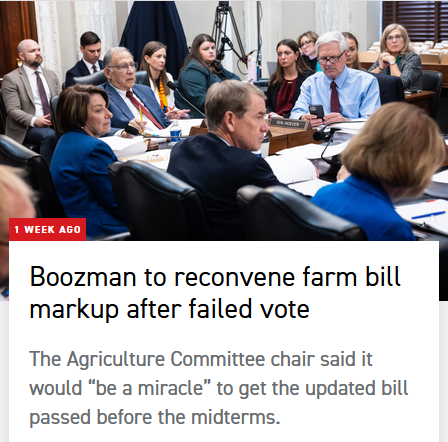
Janine Jackson: We are recording Tuesday, August 4. That’s two days ahead of a proposed meeting of the Senate Agriculture Committee called by its chair, John Boozman, Republican from Arkansas, for a markup of the farm bill.
According to the House Agriculture Committee website, this farm bill, or the Farm Food and National Security Act of 2026, “builds on the historic ag investments made last summer in HR 1,” which, they assert, is “often known as the Working Families Tax Cuts.” Of course, in Realityland, HR 1— last year’s budget reconciliation package—is more often known by the weird, Trumpian “One Big Beautiful Bill Act.”
Many people don’t realize that what’s called the “farm bill” is not just about farmers. It’s about food, and who has access to it. And so it covers not just investment in crops, or agricultural input prices, but SNAP—the federal Supplemental Nutrition Assistance Program that offers food benefits to families that need it.
But confusion and concern around the farm bill, and the role of HR 1, is not just about language; it’s about the opacity around legislative process—how laws get made and changed—and who’s at the table.
Here to help us sort through some of this is Gina Plata-Nino. She’s director of SNAP policy and advocacy at the Food Research and Action Center. She joins us now by phone. Welcome to CounterSpin, Gina Plata-Nino.
Gina Plata-Nino: Thank you for having me.
CounterSpin (10/20/23)
JJ: We can’t know precisely what’s going to happen in committee on Thursday, but please ground us in what we do know about the impacts on SNAP from HR 1 that maybe are going to come up. What are the major concerns for anyone who cares about access to food supports?
GP: Yes, absolutely. I think what we need to realize is that the farm bill has always been a partnership between agriculture and food. And there should never be losers and winners when it comes to our food systems. The reconciliation law from past July already gave a significant amount of money, in terms of ag relief, for very ultra-wealthy companies, almost $66 billion. So that weakened the conversation that we’re having today, in terms of the partnership, and where the conversations around agriculture and SNAP come into play.
What happened last year is that the states’ administrative share went from 50% to 75%. That additional 25% averages about $17 billion every five years. Those are additional monies that states now have to pay, beginning this October.
It created, for the first time in history, SNAP benefit cost share, meaning that states, beginning in FY28, will have to pay a portion of the benefit amounts. And for some states, it’s anywhere within the range of a billion to $5 billion extra, making SNAP, for the first time in history, part of a state’s line-item budget, and having to compete with other state priorities.
It eliminated SNAP access for humanitarian noncitizens, which include refugees and asylees. It defunded SNAP education. It eliminated home internet as a deductible utility cost, therefore lowering SNAP benefit amounts. And it made changes to another utility, which made it increase paperwork.
And it expanded the documentation requirements of individuals who now can only get SNAP for three months in a three-year period, to now include individuals up to age 64, and caretakers of children, veterans, homeless individuals, or unsheltered individuals, and youth aging out of foster care.
I mentioned that background, because this farm bill doesn’t address all the concerns that I just mentioned. It specifically only does one, which it tries to address the benefit cost share. And I can answer more questions if you want on that piece.
Hartford Courant (7/31/26)
JJ: Please, I mean, I think I’m going to ask folks to go back and listen more slowly to what you’ve just rolled out, in terms of those impacts. But I will say that I think folks who are just kind of consuming media might think, “Oh, well, the federal government is offsetting a cost here. And that might be cruel, but it still amounts to ‘us’ saving money.”
And what you’re talking about is it’s about shifting responsibility and costs from the federal level to the state level. It’s not about eliminating the need, certainly. And it’s not even about eliminating the cost. It’s just about shifting it, yeah?
GP: It is, but also, what did we get in return? Number one, to pass this bill that also included the largest cuts to healthcare, education and other priorities for working Americans, we as a country didn’t lower house costs or improve wages; we didn’t get anything. Those in the top 20%, and really in the top 1%, got the most transfer of wealth. And both conservative and progressive groups have said that this was the largest tax cut to go to these very wealthy people.
So in order to pay for it, Congress decided to offset programs that benefit low-wage and working Americans. And that impacts us all, because a lot of these states are already called funder states, meaning that they give more to the federal government than they get back. So this idea that states are not putting in enough, it really doesn’t add up with the evidence and the facts.
JJ: Absolutely. And I think that folks will only, unfortunately, learn in the future about the cascading effects and impacts of HR 1, in particular in terms of SNAP.
And just to build on that, I read in, I think it was in the Hartford Courant, but it was about how it’s hard to even put together a story, for advocates and for reporters, about SNAP, because you can’t always get the data. The data, the information that you’re talking about, about the impacts, it’s not necessarily so easily accessible. And that’s also a choice.

Gina Plata-Nino: “The majority of people utilizing SNAP are children, followed by older adults, followed by people with disability…some of the most vulnerable in our country.”
GP: It’s interesting, because for years, for over 25 years, we had the gold standard in terms of data capturing the poverty and food security and hunger of our nation. And right after this bill passed, about a couple of weeks later, the administration chose to no longer have that survey, a survey that has been the gold standard.
So we don’t have the data for last year, 2025, to see, like, did hunger increase? Did poverty increase in our country? And same thing for this year. Unless Congress works to force the administration to make these changes, the administration ensured that we wouldn’t have the data to validate what everyone is saying.
What we do have, in the limited data that we have access to, and this is published by the US Department of Agriculture almost every two months, is a droppage in participation. And based on April data, which is the most up-to-date data, we have almost 5 million individuals who have lost access to SNAP.
And we also have data that shows that the majority of people utilizing SNAP are children, followed by older adults, followed by people with disability. So these are some of the most vulnerable in our country, who most likely are the ones who have lost access to these benefits as a result of these policies.
JJ: And it so countervails the narrative. And I hate to spend time with corporate media’s narrative, but it impacts what happens. And so the storyline we hear is, “People gaming the system, people who could work and just don’t want to.” And I guess the inaccessibility or difficulty of accessing information is so important, because if reporters wanted to tell the real story about who accesses SNAP—who they are, for how long, for what reasons—the whole conversation would be different, is my understanding. And we might have a different conversation about it.
GP: Absolutely. I mean, the data that we do have is studies that show that most people are in SNAP anywhere from six months to two years. It’s not a permanent program. People are in the program because the economy is not strong. The program reacts to the economy.
They join it for three main reasons: It’s “I lost my job,” “my wages have been reduced” or “I have a family member to take care of.” Single moms are most likely to be in the program. And part of that is the childcare issues, and the ability to be able to have full-time wage employment.
And, like I said, the majority of folks are children, followed by older adults and people with disabilities. So, yes, the five-year-old is not working, because he’s going to school. So, same thing.
But the other data that we do have is that 80% of these households have someone who is working. And if you go state by state, with some of the states that we do have data of, they’ll tell you the majority of people are working. They’re just not documenting enough hours.
We live in a gig economy. We have some of the largest employers who benefit from SNAP, who do not provide sufficient hours for individuals, because the moment you do, you have to provide healthcare. And so these are individuals trying to do two to three jobs in order to make ends meet.
JJ: I want to pull you back to maybe a more boring aspect, but I think it’s important, which is, we’re talking about the impacts of HR 1 on the farm bill, and what maybe will happen to try to fiddle with it.
I think that we don’t see the administrative struggle. We don’t see the behind-the-scenes dysfunction, but it’s an important part of what HR 1 threw, the monkey wrench they threw, into the farm bill, and to SNAP benefits. This paperwork aspect—this is important. This is materially important, even though reporters might not think it’s interesting enough to write about, but it’s going to change people’s lives.
GP: Absolutely. Historically, state agencies have not been funded as they should, particularly after the pandemic. We had veteran workers retire. Cases did increase because there was so much need, and the states didn’t keep up with that need. So we have caseworkers doing more cases than they should. The technology is not there.
And every time you create new policy—just think about having a job, and there’s a new modem, or anything you have to learn. Think about, it’s not just two or three employees; some of these state agencies have sometimes hundreds if not thousands of people working for them, depending on the size.
But you have to teach every one of these caseworkers, “Oh, these are the new policies, and this is the way you have to implement it.” They have to do new trainings. They have to update their computer systems to do all of it. It’s a huge administrative burden.
And that relates to individuals’ access, also, because as caseworkers are spending more time implementing this, they have less time to pick up the phone. They have less time to process the applications on time. And so people are getting cut off.
JJ: It’s just the reality of it. And I wish that reporters would just connect those dots better.
Let me ask you this question: The moral policing of what SNAP benefits ought to be used for, it’s part of the moral policing of people accessing benefits. It’s an age-old narrative in the media. And, let’s be clear, it’s just about some people accessing some federal benefits.
But I’m old enough to remember “welfare queens,” who I was told were buying steak and lobster on my tax dollars. And I’ll just never stop blaming news media for this, because it’s such an easy, lazy, punching-down narrative. But as we’ve talked about, it thrives on an ignorance of who uses benefits, why they use benefits. But the media conversation, to me, is like three blocks down from what’s actually happening, and it worries me.
Pew (11/14/25)
GP: A hundred percent. You know, when President Johnson started his war on poverty, he chose an Appalachian family, white family with kids, to see and tell the country to invest, because this is important. But when those attacks began under the Reagan administration, and then continued through the Clinton administration, they utilized a Black woman for a negative aspect.
And that has really led to the media portraying who utilizes these benefits, when the data tells us a different story. What it has led to is that less communities of color utilize this program. It’s mostly white Americans, by almost 50% more, than other populations who utilize this program.
Yet as they are attacking the program, people are always thinking it’s “others.” They’re not thinking about the teacher in your school who doesn’t make enough money and has to be on SNAP; in order to provide for their children, they have to apply for this program.
JJ: We’re certainly not thinking about the fact that Amazon and Walmart are posting historic profits while large numbers of their workers are relying on SNAP. We’re not connecting that dot. Media are not encouraging us to connect those dots at all.
Food Research and Action Center
GP: Yeah, absolutely. And the state records show that for the labor market, that of these very large corporations who made extra money as a result of HR 1, their CEOs make more than 400% to 500% more than their employees. And they’re part of the reason why, you know, people are working, you’re just not giving them enough hours, or paying them enough, in order that they don’t have to rely on this program.
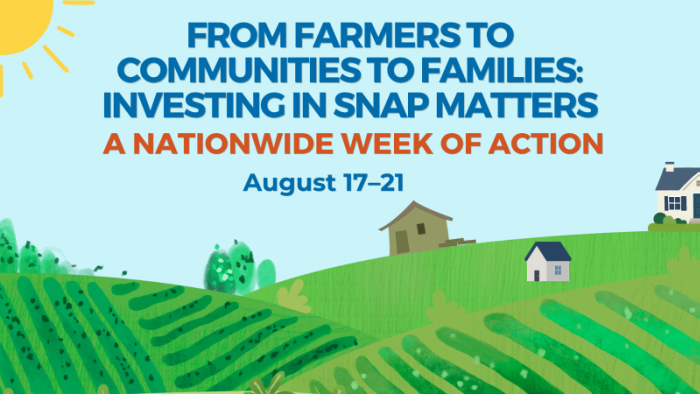
JJ: I’m going to ask you, I know that Food Research and Action Center has a week of action coming up at the end of this month, hoping folks will engage the information that they learn into something to do about it, which is where we’re at in 2026. We’re very much looking for levers of power to use. We’re very informed, some of us, and we just don’t know what to do. And I just want to ask you, what is this week of action about?
GP: This week of action is to make sure that every person is involved in protecting and restoring SNAP. And people may think, “Well, I’m not in SNAP. I don’t know anyone.” It does impact you, because there are less resources now going into your state. There’s even less resources going into your city.
And SNAP, for every dollar spent, $1.80 stays in your local economy. As your local grocer closes its doors, as your state gives less money for funding for the cities, because now they have to offset some of the harms that result of HR 1, maybe you didn’t get that additional school bus. Maybe you didn’t get that road paved. Maybe you didn’t get the extra teacher. It touches us directly and indirectly.
And so people need to just call out their members of Congress and say: “We are the wealthiest country on earth. Hunger is an issue. And it is a political will that we can stop now. There have been almost 5 million people who have lost access to SNAP. That gets carried out by local cities and municipalities. We want you to be aware of how important this program is, and why we as a country need to protect it and restore it.”
Politico (8/6/26)
JJ: I said that was the last question, but this is my actual last question. By the time that folks hear this show, they may have seen reporting—I’m not expecting a torrent of reporting, but they maybe have seen reporting on the Boozman committee markup. And I just would ask, what questions would you have folks keep in mind as they read media coverage of this Agriculture Committee conversation? What would you have them keep front of mind?
GP: To think about this as a food system. SNAP is one of many titles, but it is the bigger one that has been most impacted. See who’s getting a benefit. And as they listen to his proposal, do not fall into the strawman argument, and the trickery that says we are already doing as much as we can, because you’re not.
You’re asking states to pay 20% more. You’re only doing this for one year, while other states like Alaska, who had higher payment error rates, have two years. Why can’t all the states be treated in parity?
And I’m getting super in the weeds. But just: question things, and look at how unfair this proposal is in terms of priorities, particularly when it comes to SNAP.
JJ: We’ve been speaking with Gina Plata-Nino from the Food Research and Action Center. You can find further conversation on this, as well as other issues they cover, online at FRAC.org. Thank you so much, Gina Plata-Nino, for joining us this week on CounterSpin.
GP: Thank you for having me.
From FAIR via This RSS Feed.