

The following article is by Amos Wolf.
What Is Pittsburgh Now?
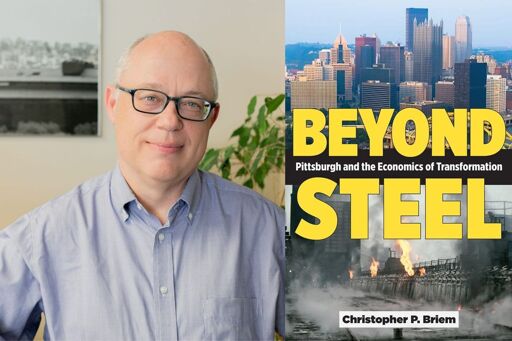
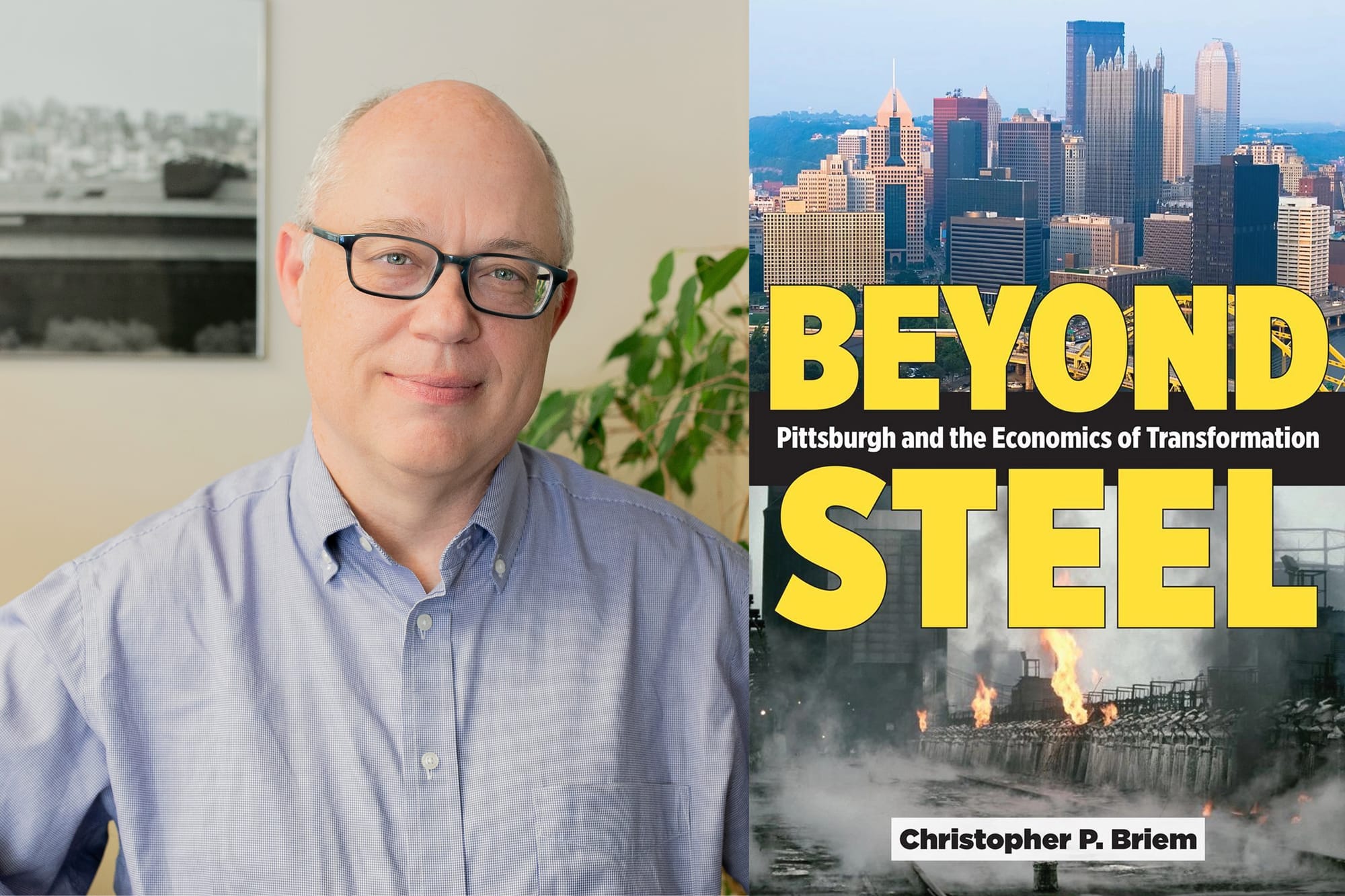
University of Pittsburgh regional economist Christopher Briem’s new book, Beyond Steel, is an essential text for understanding the confusing identity of Pittsburgh in the 21st century.
Twentieth-century Pittsburgh was united around one common identity and shared destiny: steel. Anyone seeking to understand the political economy of the city knew exactly where to look: the massive corporations that ran the mills, the unions that represented the workers, and the various politicians and NGOs that negotiated between them. The culture of the city was blue collar.
In contrast, 21st-century Pittsburgh is a bundle of economic, social, and political tendencies that are often contradictory and likely to baffle anyone trying to understand the city. Depending on who you ask, the “New Pittsburgh” economy is driven by hospitals, tech corporations, universities, or foundations.
Some say that Pittsburgh is still a union town and others believe it’s been taken over by the bosses.
“Where once a majority of Pittsburgh’s manufacturing-centric workers were covered by collective bargaining protections,” writes Briem,“by 2014 less than 10 percent of all private-sector workers in the Pittsburgh metropolitan statistical area were unionized.”
Population flux has changed Pittsburgh’s composition with the city losing over a quarter of its residents after the collapse of US Steel in the 1980s. Now, the population has rebounded with highly educated workers of the “creative class” displacing working class families in the urban core. The East End neighborhood of Lawrenceville has become emblematic of this shift, where median home prices have jumped tenfold since 2000.
However, the broader region is still full of generational Pittsburgh families whose communities have been hollowed out by deindustrialization. Throughout the Mon Valley, municipalities like Braddock struggle to maintain basic public services. The borough lost 90% of its population from a 20th century peak of over 20,000.
Briem points out how various politicians have used Pittsburgh’s shifting identity as a soapbox.
Trump has repeatedly sought to harness the resentments of abandoned working class Pittsburghers, holding large rallies in nearby Ambridge and Butler County. In 2017, he invoked the region’s industrial past to justify his withdrawal from the Paris Climate Accords, “I represent the people of Pittsburgh, not Paris.”
In contrast, Obama chose Pittsburgh to host the G20 Summit in 2009 because his administration believed it was a model for urban redevelopment and “how subsidy-reliant cities and regions can transform themselves to compete in a 21st-century environment.”
In this midst of these swirling and often contradictory tendencies, none have done a more effective job of making sense of Pittsburgh’s transformations than Briem.
Making Sense of New Pittsburgh
Briem grew up in the South Side when the mills were still open and few could imagine them closing.
“I to this day have a moment of cognitive dissonance, because if you go over the Birmingham Bridge, the J&L plant should be right there,” said Briem in an interview with Payday Report. “That was a very large, huge presence as it had been for a century or more in that neighborhood. For me to still wonder about looking over, expecting it to be there, I can’t quite imagine what folks who had worked a lifetime there think, realizing there’s just none of it left.”
In Beyond Steel, Briem seeks to explain the myriad impacts of Pittsburgh’s shift away from steel, as well as correct the record about the factors that led up to its downfall.
“I think most people conflate the story of steel decline in Pittsburgh with greater issues that they know about in the steel industry nationally, and they just think we went along for the ride,” says Briem. “The fundamental core of my writing of this book is that there’s a Pittsburgh version to why we collapsed so much and so fast, and that’s the story that we did not move away from steel decades before we should have.”
To tell the full story of how Pittsburgh was transformed by deindustrialization, Briem reaches back to the origins of steel production in the region, and how Pittsburgh became a one-industry, monopolist company town.
Rhapsody of Steel
“When J.P. Morgan bought Andrew Carnegie’s Carnegie Steel and created this behemoth called U.S. Steel, it operated in a very different way,” said Briem, “It was not an entrepreneurial firm. It was a very monopolistic firm, and in that sense, it didn’t have the same incentives to create lower costs and create new markets.”
The transition from Carnegie to Morgan is a decisive moment that other narratives of Pittsburgh’s history gloss over. Briem devotes a whole chapter to the “basing point” price system that was the result of this buyout, and the primary way that Morgan exerted his monopolistic control over the steel industry.
“Basing point pricing was nothing less than a codified form of price fixing,” writes Briem. By fixing the price of steel based on Pittsburgh’s production and transportation costs, competition was suppressed nationally and diversification was stifled locally.
Primarily, Pittsburgh produced slabs of steel that were sent elsewhere to be forged into finished products. “What we were good at was bulk commodity steel, and not much else,” said Briem.
The result was an economy with little diversification, which would have been perfect if nothing ever threatened Pittsburgh’s control of the steel industry. However, Briem shows how economic studies were already beginning to warn Pittsburghers in the 1930s that the local economy was risking collapse if it didn’t diversify.
“By 1935, the Bureau of Business Research at the University of Pittsburgh concluded that the city had already ‘passed through its period of mushroom growth in the eighties and nineties of the last century and the first decade of the present one,’” writes Briem.
A 1945 report to the Allegheny Conference on Community Development (ACCD) by the Econometric Institute, a New York consulting firm, warned that Pittsburgh would slowly decline in the post-war years unless it could develop more industrial and workforce development.
Pittsburgh did not heed these warnings. By this point, regional steel production was considered a birthright. Even the ACCD, who commissioned the report, vociferously refused to accept its conclusions.
“So embedded was heavy industry in Pittsburgh, so permanent…that business leaders considered industrial infrastructure akin to the seemingly inexhaustible supply of coal in the ground,” writes Briem.
Warnings came again in 1963, with University of Pittsburgh professors Edgar M. Hoover and Benjamin Chinitz’s four volume Economic Study of the Pittsburgh Region, and again in 1968 with the US Department of Labor’s report Pittsburgh: A Study of a Static Economic-Area Situation.
Both reports flagged Pittsburgh’s lack of economic diversification as a major risk, yet regional economic planners repeatedly refused to accept this conclusion.
“If anything, Pittsburgh’s civic leadership more often than not abetted the region’s insistence on remaining dependent on steel and associated industries, to the detriment of all other paths,” writes Briem. “Industrial concentration provided palpable benefits when times were good but gave the region little to fall back on in times of cyclical change and led to a catastrophic contraction when structural change eventually came to those industries.”
Death of Steel
The common story in Pittsburgh is that US Steel’s outdated technology was undercut by newer, non-union steel production, both in the South and overseas. However, in the early 1980s, despite a short and severe recession, production was still chugging along. “Initial signs reinforced hopes for a rapid economic rebound,” writes Briem.
Slow plant modernization, competition from smaller plants (called minimills), and nonunion labor had only eroded the foundations of Pittsburgh steel. It took Federal Reserve Chairman Paul Volcker to push the house over by implementing massive Federal interest rate hikes.
“So this is about as big a shock as the U.S. monetary policy has ever had, and what that did was, by intent, slow the economy down, and heavy industry being driven by investment is probably the first thing to go,” said Briem.
Volker’s primary objective was to control inflation, and he was willing to crank Federal interest rates to their highest levels ever in order to achieve it, reaching a 21.5% prime rate by the end of 1980. While industry nationwide suffered, Pittsburgh went into freefall.
By the end of the 1980s, twelve of Southwestern PA’s integrated steel mills had been permanently shuttered. These massive facilities anchored whole communities. U.S. Steel abandoned the industry entirely and morphed into a petroleum company, acquiring Marathon Oil and changing its name.
“In February 1982,” writes Briem, “unemployment in the Pittsburgh metropolitan area topped 18 percent as the official count of unemployed workers in the region peaked at over 210,000, three times the region’s average of 70,000 unemployed through the 1970s.”
Concentrated areas of industry were hit even harder, like Beaver County, which recorded an unemployment rate of 28 percent in 1983—higher than most states’ peaks during the Great Depression.
Damage Control
It’s clear that Briem has some admiration for creative and heroic attempts at survival and repair during this period, even if they ultimately failed, like the “Save Dorothy” campaign. In 1984, when US Steel announced their plans to demolish the Dorothy Six blast furnace, a coalition of union officials, activists, and community organizers emerged called the Steel Valley Authority (SVA).
The SVA had a novel legal strategy, inspired by activist attorney Staughton Lynd, whose “innovation would be to use eminent domain against the corporations that were trying to shut down operating plants,” writes Briem. Ultimately, their legal challenges were blocked in federal district court and “no operating plant in Pennsylvania would ever be taken over against the will of its owner using the power of eminent domain," writes Briem.
Briem also explores economic schemes that didn’t work, like when Pittsburgh City Council threatened to boycott the Clark candy company if 130 jobs were not retained in the city. Temporarily, the jobs were saved through an ownership transition, but “the new owners abandoned its city facility two years later and remained in operation at a suburban Pittsburgh location for a few more years,” writes Briem.
Federal shortcomings, like Reagan’s Job Training Partnership Act (JTPA), were even more lackluster.
“In 1983, at the very peak of Pennsylvania’s manufacturing-centric job destruction,” writes Briem, “the entire state was allocated a total of $1.8 million under JTPA’s Title III program for dislocated workers.” This amounted to $2.30 per unemployed worker, not nearly enough to meet the needs of the hundreds of thousands of laid off workers in the Pittsburgh region.
At the state level, politicians attempted to revive the region through expensive infrastructure projects, like the construction of a new midfield terminal at the Pittsburgh Airport, and lavish tax incentives for new production facilities.
In 1990, the state offered Sony Corporation $40 million in incentives to take over a plant in New Stanton that Volkswagen had abandoned after receiving $78 million in incentives to locate there a decade earlier. Briem is keen to point out that for the creation of an anticipated four thousand jobs at Volkswagen, they received $19,500 per worker. This would be equal to $95,345 per worker in 2026, adjusted for inflation.
(Full disclosure; Payday Report’’s Founder Mike Elk’s mother worked at this Volkswagen plant while pregnant with him.)
Stumbling Into “New Pittsburgh”
None of the attempted economic fixes worked as planned. Instead, “economic transformation was based on growth that occurred across a number of industries that had been secondary or supporting industries during Pittsburgh’s industrial heyday,” writes Briem.
More than anything else, the vacuum left by steel was filled by a burgeoning nonprofit care sector. While Briem discusses Pittsburgh hospital industry growth and consolidation in Beyond Steel, this topic was covered in greater depth by historian Gabriel Winant in his book The Next Shift.
“In Pittsburgh, both the booming market for care and the huge workforce to supply care grew out of the social and political context of the steel mill, ” wrote Winant*.*
Winant connects the legacy of steel to the growth of the care economy as hospitals extracted money from blue-chip steelworker pension plans alongside swelling medicare and medicaid rolls. The collapse of steel allowed the hospitals to draw on a large labor pool desperate for jobs.
Eventually, the city was left with two giant consolidated hospital/insurance systems, UPMC (University of Pittsburgh Medical Center) and Highmark. Together, they provide more jobs than the next five largest employers in the area combined, the University of Pittsburgh, PNC Bank, Giant Eagle, FedEx, and the government.
At the same time, Pittsburgh’s leading research universities, Carnegie Mellon University and the University of Pittsburgh, planted the seeds of the Pittsburgh tech sector.
“By the first decade of the twenty-first century the expansion of technology-based employment inside academic institutions and the attraction of national technology firms in the city were generating jobs, increasing incomes, and transforming entire neighborhoods,” writes Briem.
Briem focuses on the region’s universities as a source of innovation fueling tech industry expansion, but doesn’t take on the educational industry as an economic force of its own. Currently, the region’s five largest universities employ 26,058 workers, while the five largest tech employers only count for 8,818.
Pittsburgh’s universities have expanded dramatically in recent decades. Between 2000 and 2012, Pitt completed a $2 billion capital campaign which included the construction of major sports complexes, event centers, and research facilities for cutting-edge medical technology. Mirrored by a $1.9 billion campaign at Carnegie Mellon and growth at Pittsburgh’s other universities, this major fundraising boom is a rare oversight in Briem’s otherwise thoroughgoing analysis of the region’s trends.
Out of This Foundation
While Pittsburgh’s manufacturing economy was collapsing, its philanthropy sector was growing rapidly as stocks held by big foundations boomed in bull stock markets that took off in the mid-1980s.
“As the region emerged from the depths of the economic construction of the 1980s, the nation entered into an extended period of economic growth,” writes Briem. “The economic boom translated into significant asset gains for most institutional investment holding, to include the assets of major charitable foundations.”
Before this boom, local foundations held modest endowments and retained minimal staff. “The Howard Heinz Endowments and the Pittsburgh Foundation—two of Pittsburgh’s largest private foundations—operated with a combined staff of two, only adding a third staff member in 1980.”
The Pittsburgh Foundation now employs 63 employees on its own, and funds distributed by philanthropies in Pittsburgh now dwarf those distributed by local governments.
“By 2007, the fifteen largest foundations based in or active in Pittsburgh held combined assets exceeded (sic) $7 billion, with charitable distributions nearing $350 million annually, an amount slightly less than the total annual tax revenues of the city of Pittsburgh,” writes Briem.
Foundations and public-private partnerships have stepped in to redevelop brownfields left by demolished mills. Guided by private regional planning organizations, like the ACCD and the Regional Industrial Development Corporation (RIDC), these sites were turned into residential/shopping complexes, parks, and office space, particularly for Pittsburgh’s growing technology sector.
The growth of tech, foundations, and universities have all made the city more white-collar. A benchmark of this shift occurred in 1999, when a community coalition emerged to block the resumption and expansion of coking operations at the former LTV Coke Works at Hazelwood.
“Many who lived in close proximity to the site did not see the benefits of the new plant but feared a return to emissions that would be hard to prevent in a new coke works,” writes Briem. “Nearby residents were far more likely to be employed in education or healthcare—which had sustained steady growth as the region’s manufacturing sectors contracted—than in any other industry.”
A Fractured Legacy
While politicians herald the revitalization of Pittsburgh’s economy, Briem points out how deeply uneven the recovery has been, with the surrounding region continuing to suffer.
“Moving on from steel continues to prove hardest for the individual mill towns created around individual steel plants: cities, boroughs, and townships that had virtually no history prior to the erection of the production plants they once hosted,” writes Briem.
The result are cities like Duquesne, “which once counted over twenty-one thousand citizens, had dropped to a total population of less than fifty-one hundred,” writes Briem. Or even worse, towns like Brownsville, thirty miles southeast of Pittsburgh, where no remaining economic base survived deindustrialization.
“In 2001, the local volunteer fire department declared most of the borough’s main street real estate too unsafe to enter under any circumstances,” says Briem.
These problems are exacerbated by an extremely fragmented regional government. The ten county Southwestern PA region includes over 340 municipalities, most of them built around factories.
“Nearly every industrial plant had spawned an independent municipality,” writes Briem. Repeated attempts to merge municipalities in Allegheny County have failed, trapping former milltowns in dysfunctional anachronistic governance structures. Allegheny County remains the most municipally fragmented county in the United States.
Pubilc-private partnerships like the ACCD have attempted to alleviate this problem, often acting as unelected quasi-governmental authorities in areas of transportation infrastructure, large scale development, and long-term regional planning.
However, ACCD priorities have tended to bolster the core of Pittsburgh in order to attract investment, corporations, and high-wage workers. As a result, peripheral municipalities are often left to fend for themselves.
Rivers Run Apart
Now, for the first time in 200 years, Southwest Pennsylvania finds itself without a common destiny. First Pittsburgh was united by steel, and then it was united by the plight of deindustrialization.
The truth is that Pittsburgh is now defined more by divergence than convergence, and the region is a metropolitan Rorschach test, conjuring images of the past, present, and possible futures. Beyond Steel does an excellent job of telling this story, how Pittsburgh’s taken-for-granted steel birthright shattered and transformed into a patchwork of affluence and inequality.
While the city has finally developed the economic diversification that Briem’s predecessors long advocated, it now faces a different challenge. Can the city’s newfound prosperity also reinvigorate blighted communities and uplift low-wage workers, or will this geography of affluence and abandonment become our new entrenched order?
From Payday Report via This RSS Feed.