

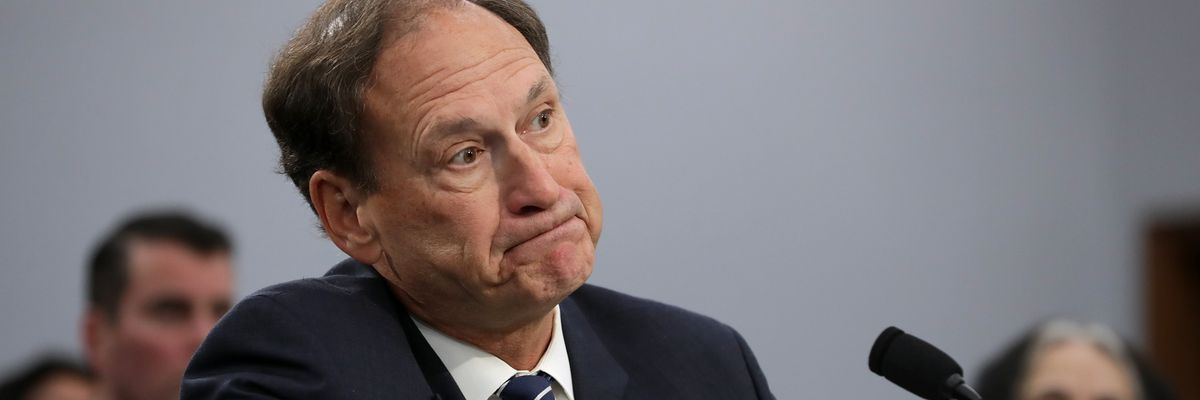
Calls for US Supreme Court Justice Samuel Alito to recuse himself from a major climate case mounted Tuesday after an analysis found that he made as much as $2.9 from oil and gas stocks from roughly the time he joined the nation’s highest court in 2005 through 2024.
The analysis by judicial watchdog Court Accountability, reviewed exclusively by The Guardian, found that Alito earned between around $390,000 and $2.9 million from fossil fuel interests during his tenure as a justice.
“Between 2005 and 2024, Alito’s assets—not including his personal residence or other personal property not required to be reported on his financial disclosure—grew from a nominal value of $1.1 million to a value somewhere between $3.4 million and $8.4 million,” the analysis states.
“Importantly, much of the Alitos’ oil- and gas-related wealth in this estimate comes from a single asset: a Grady County, Oklahoma property in which Martha-Ann Alito holds a ‘mineral interest,’” the publication notes, referring to the right-wing justice’s wife. It adds that “divergent values” on his financial disclosures apparently “indicate that Alito has significantly understated the value of the Grady County property.”
These revelations come just weeks before the Supreme Court is scheduled to hear Suncor Energy (USA) Inc. v. County Commissioners of Boulder County, a potentially consequential case over whether federal law bars state and local governments from holding fossil fuel companies accountable for climate-related harms.
Progressive watchdogs say Alito’s participation presents an obvious appearance of conflict—even though the justice does not currently own shares of either ExxonMobil or Suncor, the companies directly involved in the case. His disclosures show realized gains of between $105,004 and $216,000 from shares of ExxonMobil he owned and sold, and no previous ownership of Suncor shares. The records also show Alito has invested in around a dozen fossil fuel industry companies during his Supreme Court tenure.
“His impartiality may be reasonably questioned in terms of his affinity towards the industry that has helped build his nest egg,” Lisa Graves, co-founder of the judicial ethics watchdog Court Accountability, told The Guardian’s Dharna Noor.
“A reasonable person would think if you’re invested in the industry that could benefit from the outcome of a lawsuit, then you could personally stand to benefit from the outcome, even if you don’t hold the stock in the specific company that happens to be the named plaintiff," Graves added.
“His impartiality may be reasonably questioned in terms of his affinity towards the industry that has helped build his nest egg."
Alito has repeatedly ruled in favor of the fossil fuel companies. He also recused himself in this year’s Chevron USA v. Plaquemines Parish due to his stock in ConocoPhillips, one of whose subsidiaries is involved in the case.
Court Accountability and other groups recently called on the US Senate to investigate “Alito’s inconsistent history of recusals from cases from which he should be compelled to recuse under long-standing federal law, given his substantial holdings in individual oil and gas companies and other personal ties.”
“His irregular recusal practice in oil and gas industry-related cases is undermining public confidence in the impartiality of the court,” the groups warned in a May letter to Senate leaders. “They could not occur were he compelled to adhere to enforceable ethics standards against adjudicating cases where he has financial interests or the appearance of a conflict of interest where his impartiality might reasonably be questioned.”
Alito has also come under fire for his relationship with Leonard Leo, a key architect of the conservative judicial movement who helped arrange a 2008 Alaska fishing trip for Alito involving billionaire donor Paul Singer, who later had business before the court. Alito did not disclose the private jet travel.
In 2023, the Supreme Court unveiled a code of conduct that was derided by the watchdog group Revolving Door Project (RDP) as a “toothless PR stunt.”
“This unenforceable public relations document serves absolutely no purpose other than to permit the media to revert to pretending that our unaccountable and unethical Supreme Court retains legitimacy,” RDP founder and executive director Jeff Hauser said at the time.
From Common Dreams via This RSS Feed.