

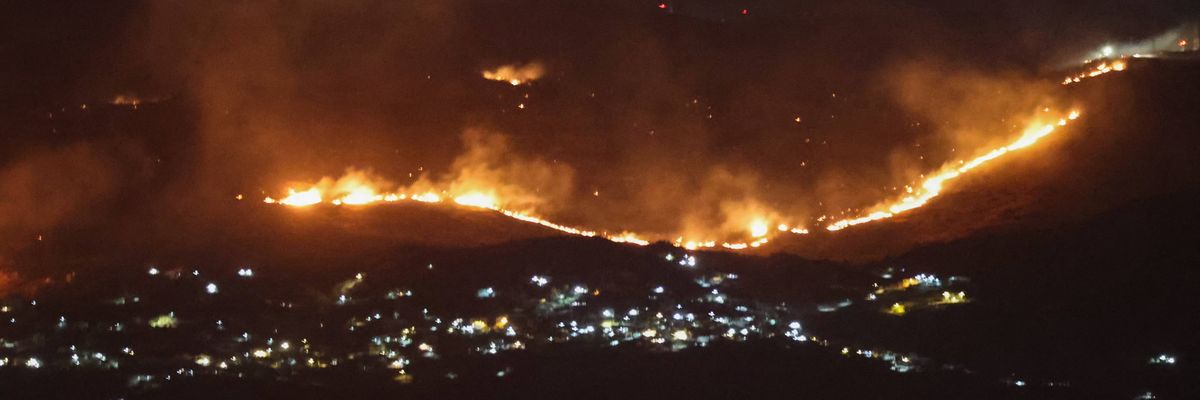
Environmental and rights advocates are condemning what one academic called “the latest in a neverending series of international crimes” by the Israel Defense Forces as firefighters and residents in southern Lebanon report that the IDF’s has purposely started destructive wildfires by continuing to bomb the region.
The blazes are an attempt, one town mayor said Wednesday, to make it appear "as though nobody had ever lived here.”
Israel renewed attacks against Hezbollah in Lebanon in March, as the US-Israeli war on Iran widened across the Middle East. Following a “ceasefire” agreement in June, Israeli forces have continued occupying about 20% of Lebanese territory after forcibly displacing over 1 million people from the southern part of the country.
Israeli officials have said they aim to apply the “Gaza model” to Lebanon, deploying the kinds of attacks that have destroyed 90% of civilian infrastructure in Gaza since the IDF began attacking the exclave in October 2023 in retaliation for a Hamas-led attack, and Israeli Defense Minister Israel Katz recently boasted that the IDF had destroyed 24 villages “that had existed for hundreds of years."
Now, Hafez Ghasham, mayor of the southern town of Yaroun, told The Guardian, “they are trying to make the land uninhabitable."
“They had already bulldozed the whole village. Then they set fire to the trees. What remained in this particular area were the olive trees—large groves, with very old olive trees," Ghasham told the newspaper. “Many of these trees, most of them, in fact, were inherited from our grandparents and parents. They have enormous sentimental value. The trees were also an important source of income for the people of the village."
Residents who had been forced out of Yaroun said they learned from people in nearby Christian towns that their olive and fruit groves as well as many homes had been set on fire by Israeli soldiers.
The head of Civil Defense in the Nabatieh region said about 30-40% of the land in the area had been affected by the fires, and firefighters have been forced to withdraw as they’ve tried to extinguish the flames as the IDF has launched drone strikes after the initial attacks that sparked the fires.
“There are enormous areas of woodland that have burned,” Hussein Fakih told The Guardian.
Kelley B. Vlahos, editor-in-chief of Responsible Statecraft, noted that “while the rest of the world is trying to put out forest fires this summer, Israel reportedly started them as a military tactic,” even following the Lebanon ceasefire.
Last Friday, large wildfires were caused by Israeli munitions and drones that struck woodlands in Kfarchouba and in the area between Jezzine and the western Bekaa valley.
The Israeli military has accused Hezbollah of using woodland areas as cover for its military outposts and tunnels. The IDF has similarly defended extensive bombing of Gaza’s schools, hospitals, and other civilian infrastructure by claiming Hamas operates in tunnels beneath the buildings.
In a statement, Hezbollah’s media relations officials said the fires represent “a continuation of urban destruction, the bulldozing of infrastructure, and the theft of ancient olive trees.”
“The party called on the government, the Ministry of Environment, and all relevant authorities to speak out and act immediately to halt Israeli savagery against the environment, human life, and infrastructure,” reported Al Mayadeen.
Hisham Younes, the founder of Lebanese conservation group Green Southerners, told The Guardian that Israel’s bombing of forested areas amounts to “ecocide.”
“These are long-established woodlands," said Younes. “They perform critical functions. The wider area is also an important passage and resting ground for migratory birds.”
“It is not about any single fire or attack, but a pattern of destruction that progressively erodes the ability of ecosystems to function, regenerate, and sustain life," Younes added. "When those cascading effects also undermine livelihoods and people’s ability to return to and remain on their land, environmental destruction becomes inseparable from the wider transformation of the territory itself.”
From Common Dreams via This RSS Feed.
Of course they are, because why stop at just genocide.
