


Students in the West Bank have become “desensitised” to what Israeli occupation forces have made routine: checkpoints, incursions, intimidation and violence. But what they endure is far from normal. It’s a systematic campaign of disruption and dismantlement.
Shams, a 24-year-old journalism and media graduate from Birzeit University, says fear is woven into their everyday life. They tell the Canary:
Whenever we leave our homes in the morning, we never know if we will return safely. Death is always close to us. Now young people are dying before the older ones.
The journey is extremely difficult. Settler violence and military checkpoints constantly delay or block us from reaching the campus.
Yet, despite the terror, they persevere. Because for Palestinians, education is not just about a certificate; it is a lifeline in the face of occupation. That is precisely why Israel continues its decades-long policies of raids, arrests and strangulation of academic life, undermining the right to education.
West Bank education, still a target
Assaults on education are not isolated, random or new. During the first intifada, in 1988, Israel closed all universities and schools (some for several years), incarcerated almost 800 teachers, and effectively criminalised teaching – deemed by Israel as a threat to security.
Since 2022, Birzeit University has been attacked 22 times, with at least 10 attacks occurring since 2023. The worst was in January 2026, when over 200 military personnel invaded the campus while lectures were on, exploding stun grenades, sound bombs and toxic tear gas. They injured 41 students, several of whom were shot. Israeli forces also blocked ambulances from reaching the site. Then, in June, four female students were detained.
Other universities have also been hit, following a violent pattern that has become the norm: the military storms campuses, destroying buildings and facilities, assaulting guards and staff, detaining students and faculty, and confiscating flags, equipment and publications.
Since his studies began in 2022, Juha, a Palestinian student at Al-Quds University, says that:
no semester [has] passed without attacks by Israeli occupation forces on the university.
He describes witnessing:
numerous incursions with tear gas, pursuits and clashes.
According to the Palestinian Ministry of Higher Education, at least 400 students have been abducted by Israeli forces during 2024 and 2025. Since 1984, 40 students have been martyred.
Like all violence against Palestinians in the West Bank, the intensity and frequency have escalated sharply since October 2023, with settler attacks backed and encouraged by those in power.
The head of Israel’s Knesset Education Committee, Zvi Sukkot, recently tore down posters in a school for orphans for showing the Palestinian flag.
Israeli authorities claim they are targeting “pro-terror” activities or gatherings “in support of terrorism”. In reality, January’s attack on Birzeit followed a film screening of the Hind Rajab film and a vigil for a martyred colleague.
UN experts say these systematic assaults “violate the rights to education and international humanitarian law” that protects educational establishments.
From intimidation to annihilation
In Gaza, what were once periodic attacks have turned into complete eradication.
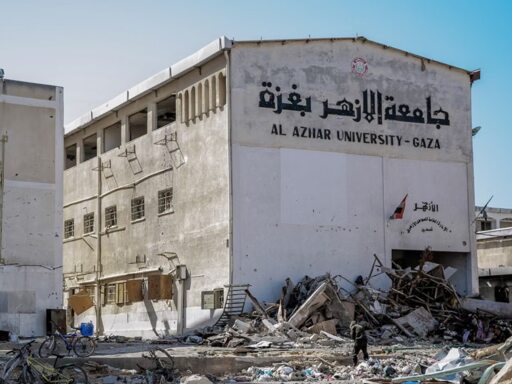
After October 2023, Israel destroyed all 19 higher education institutions in the Gaza Strip. This included the destruction of schools, the burning of libraries and archives, and the killing of educators, students and knowledge producers. This was not collateral damage; it was systematic destruction.
A recent report published by Friends of Palestinian Universities (FPU) documents what the United Nations now recognises as scholasticide in Gaza – a term coined by Palestinian scholar Karma Nabulsi during the 2008-09 Israeli assault on Gaza. Scholars Against the War on Palestine define it as:
a deliberate strategy aimed at annihilating the educational, intellectual, epistemic and cultural foundations of a people.
The physical loss is staggering: every campus, lecture hall, laboratory, and medical and research facility has been partially or fully destroyed by Israeli forces. Then there’s the human toll: 246 academic staff, including three university presidents; nine college deans; and more than 1372 university students killed. Faculty members, students, education workers and administrative staff have been injured, displaced or imprisoned in large numbers too.
Dr Chandni Desai, assistant professor at the University of Toronto, says that this war on knowledge is:
not incidental to genocide, it is constitutive of it. It constitutes direct evidence of genocidal intent under the 1948 Genocide Convention.
The FPU report elaborates:
Since the 1970s, these institutions have functioned not only as centres of learning but as institutions of national survival, preserving cultural heritage, sustaining political consciousness and producing the skilled professionals on whom Palestinian society depends. It is precisely this centrality to collective existence that has made higher education a systematic target. The destruction of educational institutions is not incidental to Israeli occupation and colonial violence: it is a deliberate strategy of erasure.
The near-total destruction is not just about wiping out the past; it is designed to cripple the future too. The systematic erosion of people, infrastructure, revenue streams and resources amid the broader collapse of Gaza, will create shortages of teachers, doctors, nurses, engineers and civil staff exactly when the population needs it the most.
The road ahead
Despite unimaginable conditions, educators and students remain determined to continue.
Despite living under bombardment, displacement, starvation and limited internet connection, Gaza’s students found ways to access some semblance of education. Emergency online portals were created so that education could continue online (even after Israeli forces hacked the electronic databases of Gaza’s universities to erase records). Medical training took place in makeshift emergency clinics or field hospitals.
Juhu insists there is “no other choice” but to adapt:
If students are required to stand in long queues for several hours just to reach the university and take a 15-minute test, they will do it. And if they have to switch to remote learning because access to the university is restricted, they will adapt to that as well.
Twinning partnerships, virtual fellowships, joint research and teaching partnerships, scholarships allowing students to remain enrolled in their own universities, and access to digital learning resources offer sustainable means of support, without bypassing Palestinian’s autonomy and self-determination.
But adaptation or resilience should not be mistaken for acceptance. The Emergency Committee of Universities in Gaza is calling on international institutions for immediate solidarity. Accountability for Israel’s crimes against education must also be sought.
Featured image via Le Monde
From Canary via This RSS Feed.