


A new report by Allianz SE says that the pressing issue of climate breakdown could be set to cost Europe €800 billion by 2030 — nearly the same as a pot of money for defence.
Allianz is a criminal company investing massively in the genocide economy of so-called ‘Israel’. However, the insurer’s climate analysis has been backed by experts such as Patrick Bresnihan, associate professor at the geography department of Ireland’s Maynooth University.
Writing for the Irish Times, Bresnihan called for:
…nothing less than the wholesale remaking of our infrastructure, built environments and economic systems.
Climate breakdown set to cost Europe €800 billion
Meanwhile, the European Union is continuing to push ahead with a sickening €800 billion of war spending as part of its ReArm Europe debacle.
Defenders of this spending often argue that it is necessary to counter a supposed Russian threat. This is despite Vladimir Putin’s army often struggling to make it more than a few hundred metres into neighbouring Ukraine. (Hardly an indicator of a force capable of conquering Europe.)
During World War II, many countries oriented almost their entire economies towards war production in the face of potential existential threats from the opponents.
Climate breakdown now poses a similar risk to people across the world, so Bresnihan’s case makes sense.
What the climate report says
The Allianz report assessed more than 40 countries based on the estimated cost of heatwaves between 2014 and 2024.
It found that “France, Italy and Spain are among the economies least able to absorb the resulting fiscal impact”.
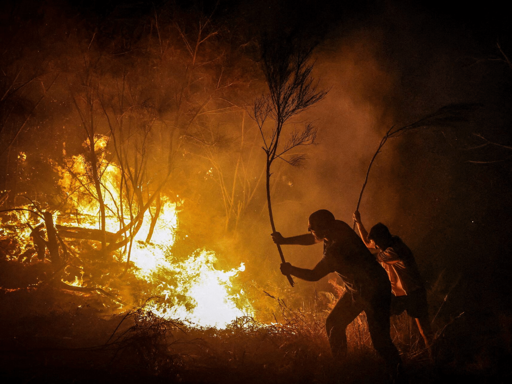
In the case of France, Bresnihan happened to evoke the global conflict of 80 years prior when pointing out that France’s recent wildfires resulted in “the worst damage experienced by the country since the second World War”.
Spain has also suffered devastating infernos, with at least 13 killed by the carnage. The deaths prove that looking at climate destruction as a security threat is an appropriate perspective to adopt.
Bresnihan pointed out:
The Spanish prime minister has already insisted that 15 per cent of Spain’s defence budget will be allocated to combating climate emergencies, a unilateral decision not welcomed by Germany and other EU member states.
The academic argued for the necessity of going beyond “emergency response”, however.
He decried the framing of climate action as being a matter of “personal responsibility”. There’s nothing wrong with doing your bit, but ultimately Bresnihan is right to say that solving these challenges through individual action “is as ridiculous as suggesting everyone can equip themselves to fight in war”.
Neoliberalism and individualism are deeply linked
Neoliberalism generally likes to back this notion of individualising problems.
Libertarian billionaires like Elon Musk are happy to support cuts to government programmes, thus leaving people to fend for themselves. They tend to shed their libertarian ideals when it comes to cuts on military spending.
One reason for that is they assume ploughing funds into the war machine safeguards their assets against damage or theft from foreign adversaries.
They can pay for their own healthcare and transport, so they’ve no issue with those being privatised. What they can’t (yet) do is buy a personal army sufficient to defend their factories and data centres.
Military spending accelerating climate disaster
Another reason they back war spending is that it’s state spending which fills their pockets, without doing anything to strengthen their workers’ bargaining power. That differentiates it from something like government investment in free healthcare for all.
When workers know they get ailments treated even when out of work, they’re less worried about losing their job. For bosses, that means less control over workers.
War spending, and the often fictitious foreign threat it relies upon, also keep workers distracted from their real foe: the ruling class at home. Spending on climate action has none of these advantages for the capitalist class.
Preventing the destruction of the natural world also reinforces the inconvenient idea that the government can actually do useful things for citizens, and that we can solve big problems collectively. That’s anathema to bosses, who’d rather have us imagine a useless state, and therefore one not worth taxing billionaires to pay for.
These plutocrats are still the people that control our politics, and hence we have an EU budget that, as Bresnihan points out:
…commits 12 times more money to militarisation (€131 billion) than it does to civil protection (€10.7 billion).
He goes on to highlight that this approach will “drive up emissions” yet further.
The planned expansion of military spending by Nato members will generate approximately 132 million tonnes of CO2.
So not only is military spending diverting money from solving climate breakdown, it’s actually pushing us further over the cliff edge. As Bresnihan explains, the current extreme weather events are one of the few opportunities we have to vividly make the case for a change of tack.
He rightly argues we must shout loudly during these moments in favour of dramatic climate action. If not, we will be drowned out by arms companies and their political slaves ceaselessly beating their war drum as we march towards self-destruction.
Featured image via Nacho Doce/ Reuters
From Canary via This RSS Feed.