

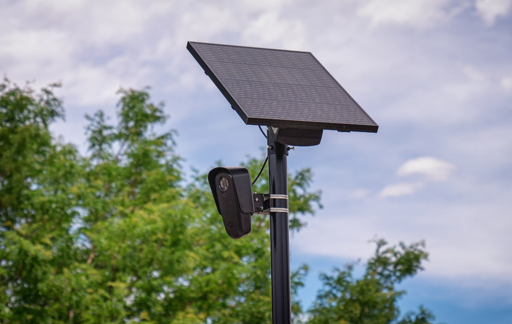
In 2017 Garrett Langley, along with two other fellow Georgia Tech graduates, designed a purpose-built surveillance camera on his dining room table. He received positive feedback from a Georgia police detective, which inspired him to create what would become the United States’ largest automated license plate reading (ALPR) surveillance company and positioned himself as CEO. Within seven years following its founding, Flock had a meteoric rise in popularity among local law enforcement, claiming to have hardware installed in over 6,000 municipalities and 4,000 cities, across 42 states. While they’re known predominantly for license plate camera readers, they also produce video cameras, mobile security trailers, gunfire recognition technology, and drones. They’ve even briefly attempted a partnership with Ring Camera, owned by Amazon, to create a dragnet-like network of doorbell cameras. While Flock is not the first company to produce surveillance technology, according to a 2024 congressional report, 90 percent of sheriffs’ offices with 500 or more sworn deputies used ALPRs in their line of work; of the police departments surveyed that serve over 1 million residents, 100 percent used ALPR technology.
Whether privately or publicly owned, technologies like Flock represent an expansion of the tools used to preserve the status quo: keeping wealth concentrated and the levers of power in the hands of capitalists.
Flock’s Growth
Flock explosive growth can be credited with three main factors: cost, installation, and artificial intelligence. Pricing data is hard to find for the Flock Falcon, their primary Flock ALPR camera, but a number of sources report that it can cost between $2,500 to $3,000 which represents roughly 60-80 percent less in up-front cost compared to traditional ALPR camera technology.
Further, traditional fixed ALPR camera systems require complex scoping, trenching, and internet connections which could result in weeks of installation. Flock’s cameras, however, consist of two simple parts — the camera and a solar panel/battery system; it uses LTE, the same technology that cell towers use, to instantly send data to the Flock Network. Flock also wholly owns the cameras they produce which allows them to bypass local legislative and council bodies. Forbes reported in 2024 that Flock failed to obtain valid permits for installing hardware in South Carolina, Texas and Illinois, with South Carolina containing over 200 unpermitted cameras alone which continue to operate and collect data. What’s insidious about this is that there’s no legal recourse; removal of them requires an act of the city council and coordination with the state’s department of transportation. This allows Flock to continue to collect data and maintain a wide network of cameras; at present it’s unclear how Flock is able to subsidize its own cameras when a locality pulls its funding.
Flock has made technical advancements in mass surveillance that enable the speed, scale, and usability of these devices. A subscription to their network enables access to all other connected Flock cameras which can seamlessly connect to other cameras and search or share data across the entire network — essentially a privately-held dragnet. Flock claims that customers — primarily police departments — are in full control of how the captured data is shared and used and police departments have the option of opting in or out of the network or sharing data with a list of agencies. Despite this, most agencies opt in since there is no incentive to keep this data private from other police agencies.
They use state-of-the-art artificial intelligence to power the cameras too. The Falcons themselves are special versions of a normal camera designed to capture objects, and an added layer of AI is used to process the data which can include vehicle fingerprinting, a model designed to catalog a vehicle by its physical characteristics such as make, model, and bumper stickers; “convoy analysis” which is technology that can flag vehicles that frequently travel together; and models designed to interpret simple phrases such as “white F-150 with a ladder in the back” into actual images captured by these cameras.
None of these features require a search warrant.
Flock’s Dominance
By design, deciphering how many Flock devices is opaque. Community created and crowd-sourced resources such as DeFlock are a great resource, but often undercount devices in areas where local activism isn’t empowered. Further, the largest US cities are often the least transparent with the amount of Flock cameras that fall within their jurisdiction. Finally, as discussed later in this article, Flock may elect to continue operating cameras after a county cancels their contract with Flock; a county may not use these cameras, but they still surveil people and cars.
Flock cameras under police jurisdiction are sometimes connected to publicly accessible portals. While there’s no prima facie evidence to suggest that the portals are deliberately obfuscated, the metrics used to calculate the totals have not been revealed. Using these portals, a community-led website aggregated the total number of cameras reported — 28,332 cameras nationally. However, this is nowhere near the real number of operating cameras. A recent FOIA request filed for this article revealed a single search in Chesterfield County, VA on March 18, 2025 returned two matches after searching 77,650 cameras nationally on behalf of Homeland Security Investigations (HSI). The subject of the email was titled “Mexican License Plate”, and all further details were redacted.
County police participation is not equal, and some localities have the infrastructure to surveil each resident more than others. Riverside County, California has some 1,766 cameras with a population of 2,560,000 residents, one camera for every 1,450 people. However, Emporia, VA is perhaps one of the most surveilled cities when measured per capita. As of July 2026, Emporia has 493 cameras with a population of 5,375, one Flock camera for every 11 people.
This data is actively being accessed. Riverside County, CA ran over 12,300 searches in a single month. Norfolk Virginia ran nearly 2,800 searches in a single month (for a population of 231,000). The Springfield, Oregon Police department does not have any Flock cameras installed under their jurisdictions, but this does not stop them from running searches of other cameras. As of July 2026 the Springfield PD ran 15 independent searches of 150-230 cameras across an unspecified jurisdiction. Access to this information is only logged in a database under the control of the police departments. Governance of this audit trail varies by county, has been abused, searches can include people instead of vehicles, and some states have passed laws making it explicitly illegal to release audit data pertaining to Flock with public transparency tools such as FOIA.
Flock does not just contract with police agencies. Lowe’s, Home Depot, Target, and other major retailers plug into this network by standing up cameras around their parking lots and buildings. Most insidiously, there is no public data on how these cameras are being used; there are no reported numbers on the amount of deployed cameras, nor are they auditable using tools like FOIA. They can also be searched by police departments directly if given access, which centralizes the police departments’ surveillance capabilities and lowers the barrier to entry for public resources to protect private capital owners.
Flock Pushback
While many cities have been in support of and signing onto Flock contracts, numerous cities all over the country have been cancelling their contracts with Flock. The company did not make clear to cities in signed contracts that it was sharing data at a national level so that other agencies in other cities could also access information about residents. In some instances, federal border officers had access to this network as well or had local departments search the data for them to track and detain immigrants. The office of Illinois Secretary of State, Alex Giannoulias, executed an audit last year discovering the company shared data of Illinois drivers with Customs and Border Protection. This occurred because of a lack of proper safeguards to protect data as well as a pilot program that Flock was running with CBP that it had not previously disclosed.
Other cities all over the country are reexamining their contracts with Flock because of their dishonesty and lack of safeguards around the data that customers supposedly have control over. In one instance, Evanston, Illinois cancelled their contract with Flock due to the company’s failure to disclose its participation in the federal pilot program. The company took cameras down then subsequently put them back up without saying anything. The city covered them with black trash bags until the company removed them.
As Flock grows in the number of deployed cameras, so does the toxicity of their brand. To acquire Flock cameras, many localities are starting to resort to methods that should be illegal to fully illegal. In Waltham, Massachusetts a city council meeting revealed they used asset forfeiture funds to pay for their Flock cameras. Asset forfeiture refers to money or other assets seized by police during raids, and these assets are subject to a separate legal process; assets themselves are technically considered guilty until proven innocent and remain with the locality, and can be abused as an off-the-books slush fund. In Pensacola, Florida a city council used $108,000 of opioid settlement money on Flock cameras. In Hartford, Connecticut a city official lied in their response to a FOIA request — a civil violation — by denying the existence of a Flock contract. It was later revealed that Hartford spent nearly $600,000 on a contract with Flock.
The Coercive Nature of Surveillance
Antonio Gramsci wrote about cultural hegemony and how the ruling class utilizes the state to manufacture consent in order to maintain wealth and power. This power is exercised in two forms: consensus and coercion. The implementation of consensus is through the use of schools and churches, while the coercive power is implemented using the military, courts, and police. The ruling class necessitates a state because it creates a veneer, or shell of legitimacy that allows it to continue to hide in plain sight. The very powers of this State — such as the police — have a variety of tools at their disposal for the constant upkeep of this veneer, surveillance being one of these many instruments.
And the reason Flock is so deeply embedded within our society is because it engenders the very principles that Gramsci wrote about. The coercive nature of surveillance tools is masked by the consensus forces in our State with constant propaganda campaigns, propelling stories and anecdotes about how Flock is essential in solving crimes in communities and acting as a deterrent for future ones. Devoid of any analysis of why crime actually happens, Flock is the perfect poster child for renewing our faith in this State’s ability to resolve the contradictions between classes, and the petite bourgeois politicians and other complicit parties are all too happy to inscribe this evolution of technology into our institutions.
Make no mistake: the broader picture is, and will always remain, the working class’s exploitation and the destruction this violence inflicts. Modern surveillance like Flock isn’t core to maintaining the oppression as opposed to more direct means such as controlling employment, food, and housing. Rather, regardless of whether modern surveillance is privately held or publicly owned, Flock represents an advancement in maintaining the status quo of capital’s accumulation upwards and the capitalist class’s continued ownership of the levers of power.
The post How Flock Is Building America’s Private Surveillance Infrastructure appeared first on Left Voice.
From Left Voice via This RSS Feed.