

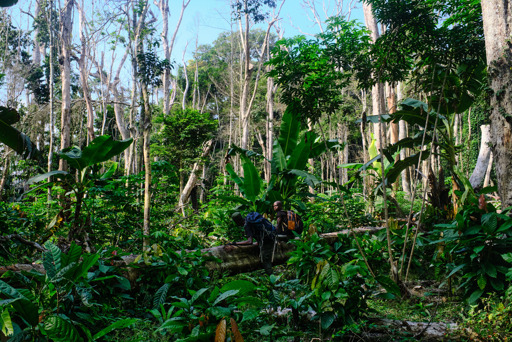
A cocoa boom in southeast Liberia is wiping out native forests and encroaching into a proposed national park. The would-be Kwa National Park, a dense tropical rainforest, is home to chimpanzees, forest elephants, pygmy hippos and pangolins. Kwa is partly located in Grand Gedeh county, one of the most densely forested regions in southeast Liberia. Commercial agriculture is banned across the 1,720 square-kilometer (664 square-mile) area set aside for the national park, reports Mongabay’s Ashoka Mukpo. Yet, during patrols, forest rangers from Liberia’s Forestry Development Authority (FDA) and community eco-guards, such as George Bowey with the Wild Chimpanzee Foundation, have discovered illegal cocoa plantations inside the park’s boundaries. Much of the forest around Kwa has already been cleared for cacao by people who live nearby. “At the end of 2023, we started seeing cocoa going closer to the park, but to enter the park it was last year,” Bowey said. Mukpo accompanied Bowey through the dense canopy of Kwa to reach a massive 100-hectare (250-acre) cacao plantation full of leafless, rotting trees and waist-high cacao saplings. On their way back to a ranger camp, Mukpo and Bowey passed other cacao plantations within Kwa, all showing signs of burns on trees. Cacao can be grown in one of two ways: Saplings can be intercropped with other tree species to form a diverse ecosystem; or gasoline can be poured at the base of trees and their roots set on fire, effectively killing trees to make way for cacao. It’s the second method…This article was originally published on Mongabay
From Conservation news via This RSS Feed.