

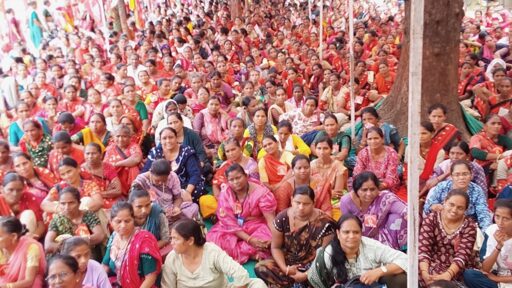

Hundreds of thousands of people marched on the streets across India, with thousands risking arrest in various parts of the country on Monday, August 10. The actions were part of a joint national call by peasant and worker unions opposing the proposed trade agreement with the US and raising other demands.
The protesters, which included farmers, informal and formal sector workers, students, youth and women, marched in several cities and towns in India to their respective government offices carrying banners and red flags, and raising slogans of peasant-worker unity against government policies.
At some places they also clashed with the security forces trying to block their marches and laid a temporary siege of the government offices.
The protesters demanded the withdrawal of the proposed Indo-US trade deal announced by the Donald Trump administration earlier this year, calling it antithetical to Indian agriculture. They published a detailed charter of the demand as well.
At various places large gatherings were organized where speakers reminded the audience of the failures of the Narendra Modi government in fulfilling major promises related to the welfare of the country’s farmers.
The speakers talked about how a series of legislation brought by this government has actually harmed the interests of the farmers and the country’s rural economy, which has long been in distress.
The speakers accused that by supporting a Free Trade Agreement (FTA) with the US, the ultra-right-wing government, led by the Hindu-supremacist Bharatiya Janata Party (BJP), has yet again exposed its subordination to imperialist dictates and its indifference to the country’s real interests.
A large number of protesters were seen on the streets of various Indian states, such as West Bengal, Kerala, Tamilnadu, Tripura, Rajasthan, Haryana, Assam, Maharashtra, among others.
The protest was jointly called by Samyukta Kisan Morcha (SKM) and Central Trade Unions (CTUs) along with the All India Agricultural Workers Association (AIAWA) and was supported by students, youth, and women’s unions.
SKM has issued a charter of demands and given the government until November 26, the sixth anniversary of the farmers agitation on the borders of Delhi, to fulfill those demands, warning of a larger indefinite movement otherwise.
Agricultural distress in India under Modi
The SKM and CTUs, representing millions of farmers and workers, have claimed the November 26 protests would be their joint attempt to “Save Agriculture, Save Industry and Save India.”
More than 40% of India’s workforce and nearly 60% of its population is still dependent on agriculture and related fields for their livelihood. Around 70% of Indians still live in rural areas.
Decades of neoliberal economic reforms have negatively impacted the rural economy and agriculture, causing massive agricultural distress with hundreds of thousands farmers committing suicide due to indebtness and the lack of an alternative means of living.
The distress has forced millions to abandon agriculture and migrate to cities seeking alternative sources of livelihood.
Instead of addressing their issues, the Modi government which came to power in 2014, farmers accuse, has adopted policies which have further harmed their interests. This has led to several rounds of mass protests in the last decade.
After over a year-long farmer protest at the borders of the capital, New Delhi, the Modi government was forced to sign an agreement with the SKM on December 9, 2021.
It agreed to withdraw contentious agricultural laws it had brought in 2019 and to enact a law for the legal Minimum Support Price (MSP) for agricultural products to address a long standing demand of farmers.
The SKM claims that, due to the absence of a legal MSP, farmers are often forced to sell their products at prices much lower than their actual cost of production, incurring huge financial losses every season.
However, five years later, farmers are alleging that none of the demands which the Modi government agreed to were fulfilled.
“The Narendra Modi government has failed to fulfill its promises of implementing a legal MSP and withdrawing cases against the protesters made during the farmers agitation five years ago,” Hannan Mollah, one of the leaders of the 2020-21 farmers agitation and leader of the All India Kisan Sabha (AIKS), a major constituent of the SKM, said in a message.
He accused the Modi government of enacting more policies which make the lives of farmers and workers in the country even more difficult.
The government has introduced more contentious legislation, including a bill for the privatization of electricity and the withdrawal of the National Rural Employment Guarantee Act (NREGA), a major relief for millions of peasants looking for some work during the period between two crops and signed several FTAs with countries like New Zealand, EU, and the UK.
Major demands
The proposed trade deal with the US has caused concern among millions of farmers about the possible tariff-free imports of American agricultural products.
The tariff-free entry of highly subsidized agricultural products from the US and other countries will make Indian agricultural products even more expensive for local consumers, the SKM claims. This will displace millions more from farming with no alternative means of living.
Apart from the withdrawal of all FTAs and the proposed trade deal with the US, there are six other major demands raised by the protesters;
- An MSP law on the basis of C2+50% (total cost of production+50% profit) for all agricultural products
- A comprehensive loan waiver to end rural indebtedness address suicides of peasants and daily wagers’
- The withdrawal of four labor codes and a national minimum wage of Rs. 31,000 (around $325 per month)
- The restoration of the NREGA and a minimum 200 days of guaranteed work for all
- The withdrawal of the electricity privatization bill
- An end to all forceful land acquisitions
AIKS, in a press release on Saturday, had called the protests a message to the government about the strong peasant-workers unity against “the brutal exploitation of farmers and workers by the corporate capitalist forces through the denial of minimum support price to farmers and minimum wage for a dignified life to workers and agricultural workers.”
The SKM and CTUs have been working in tandem for months now mobilizing against the anti-worker and anti-farmer policies of the Modi government. SKM had supported the national strike against the four new labor codes on February 12 in which an estimated 300 million Indians participated.
Read more: Anatomy of a general strike: how workers in the Indian state of Karnataka shut down production
SKM has warned that if the government fails to listen to the farmers and workers after the protests on Monday it will send a mass delegation to the prime minister of India on August 17 to submit the charter of its demands and begin preparing for the indefinite protests from November 26 by carrying out local level campaigns.
From BT News via This RSS Feed.
The problem in India under Modi government so far is that they go to any extreme to opress and depress dissent, like all media channels are bought by the government. Someone dares to do independent journalism and question the government their social media, financial accounts all those gets banned/audited.
There is a very famous interview of Modi with BBC post 2002 Gujarat riots where he admits the thing he failed was “media management”. Learnt his lesson, bought out media, sold out the country to two oligarchs, and now 1.2bn+ people are paying for it.
Further, there are some conspiracy theories that suggest India was arm twisted to agree to the new trade deal by threatening to audit Adani and try him in the US.
I hope all the billionaire class just rot in a makeshift sewer.
