

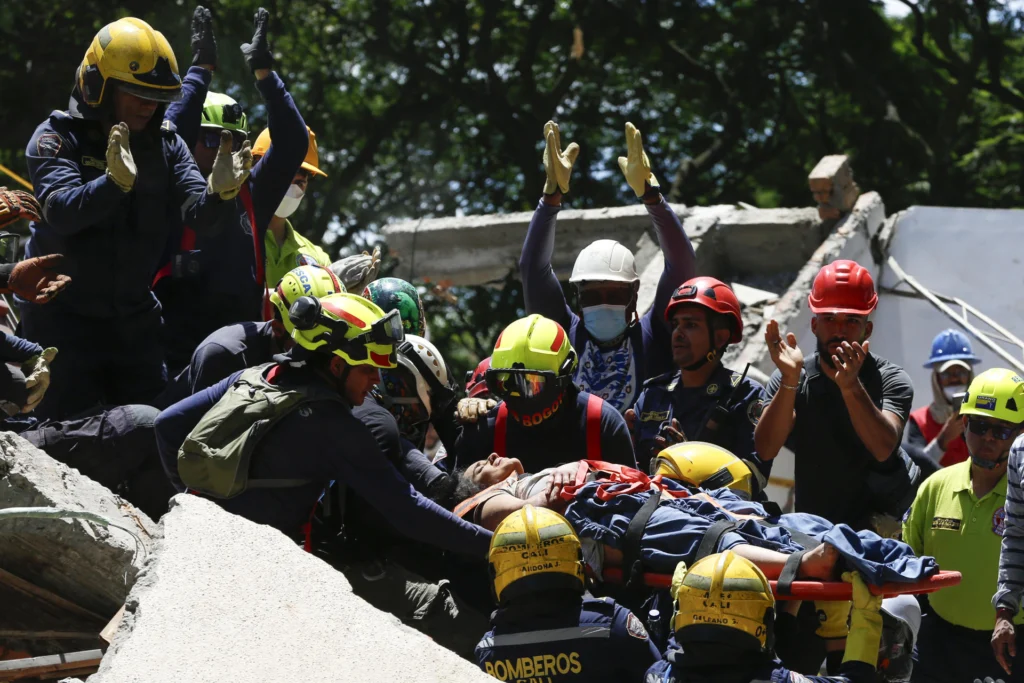
Emergency response teams and specialized brigades rescued 87 people alive in the city of Cali following the earthquake that struck several regions of Colombia on August 10.
From the Unified Command Post (PMU), local and national authorities continuously coordinate Search and Rescue operations, with the support of rescuers and technical teams arriving from different cities across the country to reinforce field work.
The preliminary balance issued by official bodies in the capital of the Valle del Cauca department counts a total of 95 people dead, 949 injured and 239 reported trapped under the rubble.
RELATED: Colombia Restores Flights at Three Airports After 7.4 Earthquake
Regarding the impact on the city’s infrastructure, technical evaluations record 45 structures that suffered total or partial collapse, in addition to another 93 buildings and homes presenting severe damage to their walls, columns and structural elements.
Within the rescue maneuvers, emergency teams placed special emphasis on the successful rescue of a citizen identified as Diana, who was located and extracted alive from the collapsed structures after intense hours of work involving rescuers, volunteers and medical care institutions.
Authorities and relief corps reiterated their commitment to maintaining uninterrupted deployment in affected areas to continue the search and care of each of the trapped people.
Ver esta publicación en Instagram
Una publicación compartida de teleSUR English (@telesurenglish)
Aftershocks Persist
In parallel, the seismological service recorded an aftershock of magnitude 4.1 with its epicenter in the department of Chocó. The event was felt in the city of Bogotá and caused the evacuation of buildings in the capital’s center.
This aftershock adds to nearly 99 secondary movements counted after the main earthquake of magnitude 7.4 that affected southwestern Colombia, with severe impact in departments such as Chocó, Valle del Cauca, Cauca, Risaralda and Caldas.
Facing the contingency, the Mayor’s Office of Bogotá arranged four collection centers distributed in different points of the city to gather donations destined for victims in Cali, Pereira, Manizales and the Chocó region.
Authorities prioritize receiving drinking water, non-perishable food, blankets, clothing, medicines, gloves and personal hygiene kits. For its part, the Ministry of Defense sent more than 100 personnel with canine units and photographic equipment to the most affected zones to support the location of people buried under the rubble.
The city of Cali remains the epicenter of the most intense rescue operations in the country, with hospitals and temporary shelters receiving a growing number of injured survivors. Local officials warned that the number of people trapped under debris could still increase as teams advance into the most inaccessible sectors of collapsed buildings.
Meanwhile, the continuous aftershocks complicate the work of the rescuers, who must periodically suspend operations when tremors threaten the stability of damaged structures. Despite these conditions, the relief corps maintain a 24-hour shift system to guarantee the continuity of the searches.
Ver esta publicación en Instagram
Una publicación compartida de teleSUR English (@telesurenglish)
The Colombian government deployed additional resources to the affected departments while the Unified Command Post in Cali coordinates the distribution of humanitarian aid and the transfer of the most serious cases to medical centers with greater capacity. The response to this emergency mobilizes the entire national system of disaster risk management, in what authorities describe as one of the largest rescue operations in the country’s recent history.
From teleSUR English via This RSS Feed.