

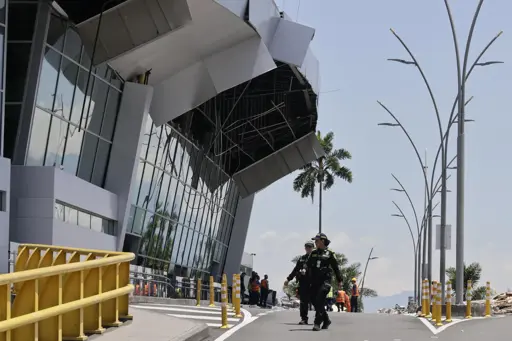
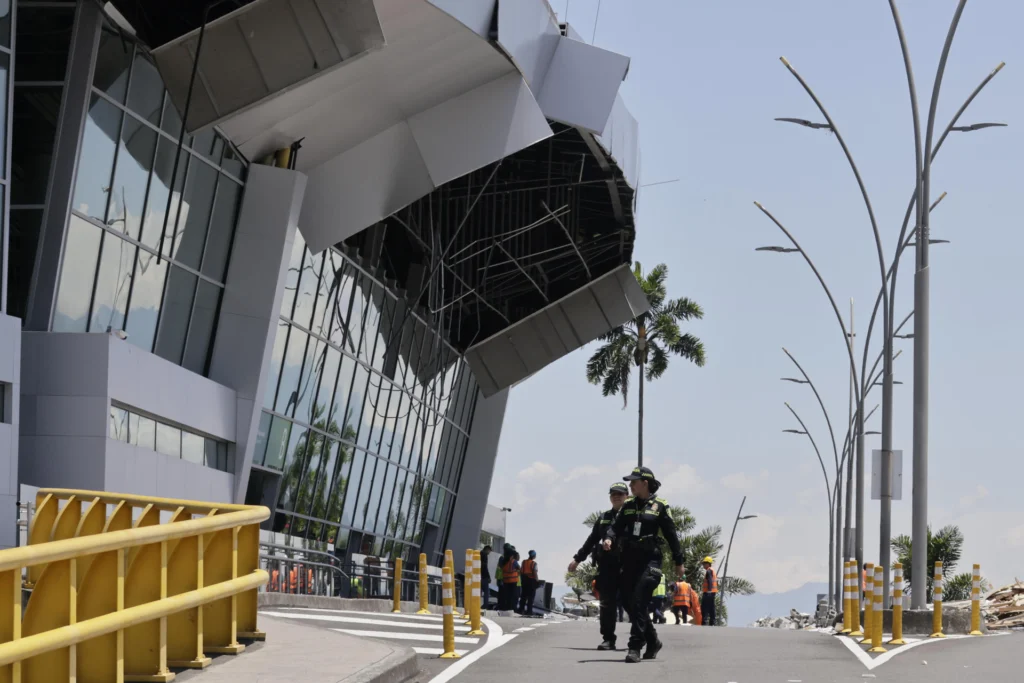
Colombia’s Minister of Transport, Elsa Noguera, announced this Tuesday that the international airports of Cali, Quibdó and Armenia have fully restored their operations after safety verifications of the systems and the resolution of failures in the power supply.
The announcement regarding Armenia contrasts with the report from the Civil Aeronautics (Aerocivil), which confirmed that flights resumed under a controlled modality, with a temporary restriction preventing the terminal from operating as an alternate airport.
The Colombian Minister also reported that commercial operations remain restricted at the airports of Pereira, Buenaventura, Cartago and Manizales due to structural damage affecting passenger terminals, control towers and navigation infrastructure.
RELATED: Colombian Presidency Counts 181 Deaths From Earthquake
Noguera highlighted that the runways of all affected terminals remain fully operational, which guarantees the arrival of state flights and the deployment of humanitarian assistance to address the emergency in the impacted regions.
The transport authority confirmed continuous coordination with the aeronautical authorities to repair physical damage and reactivate commercial flights as soon as possible. For its part, the aeronautical authorities issued a detailed assessment of the airport network following operational safety and infrastructure inspections carried out by technical personnel and the Aeronautical Firefighters Corps (SAR).
#Actualización l Informamos sobre el estado actual de aeropuertos en Colombia: pic.twitter.com/AFrV9xM2hC
— Aeronáutica Civil (@AerocivilCol) August 11, 2026
Text reads: “Update: We informed about the current state of airports in Colombia.”
The verifications confirmed the gradual return of commercial operations under specific conditions designed to protect users and maintain connectivity in the regions affected by the contingency.
Meanwhile, the airfields of Buenaventura and Manizales enabled commercial flights under the condition of uncontrolled airports. In Manizales, repairs are being executed on the control tower due to cracks and broken glass, while the runway remains in optimal condition.
Balance de los aeropuertos afectados por el sismo
El Aeropuerto Internacional Alfonso Bonilla Aragón de Cali ya opera con normalidad, luego de recuperar totalmente el servicio de energía y verificar las condiciones de seguridad de sus sistemas. Los aeropuertos de Quibdó y… https://t.co/InrsvnM8OV
— Elsa Noguera (@elsanoguerabaq) August 11, 2026

Text reads: “Balance of the airports affected by the earthquake: The Alfonso Bonilla Aragón International Airport of Cali is already operating normally, after fully restoring energy service and verifying the safety conditions of its systems. The airports of Chibdo and Armenia are also operational. In Pereira, Buenaventura, Cartago and Manizales, the runways are enabled, but commercial operation continues to be restricted by impairments in infrastructure, control towers, navigation systems or passenger terminals.”
Persistent Restrictions
In contrast, the Matecaña International Airport in Pereira and the Santa Ana terminal in Cartago maintain commercial aviation suspended, remaining exclusively available for state flights, medical missions, search and rescue tasks, and the transfer of humanitarian aid.
Pereira is undergoing reviews due to cracks in the runway, damage to the control tower and disconnection in the ATS communications systems.
Additionally, the Popayán terminal was closed preventively due to the presence of volcanic ash. The aeronautical authority confirmed that the navigability of the national airspace and radar systems operates with total normality, while deploying assistance teams to guide passengers.
In parallel, the Colombian Ministry of Transport reported through its social networks that the concessionaire Unión Vial Camino del Pacífico and the National Infrastructure Agency (ANI) deployed work crews on the Buga-Buenaventura corridor to remove landslide material and attempt to restore transitability.
Authorities indicated that recovering this axis is strategic for the national economy, as it mobilizes approximately 40% of the country’s international commerce. Despite achieving a partial opening of one lane at midnight, new landslides forced the closure of the artery again for safety reasons.
The gradual reopening of the three main terminals represents a significant step toward restoring air connectivity in a country where the earthquake of magnitude 7.4 has claimed more than 180 lives, according to the association of capital cities, and continues to demand a coordinated response from national institutions.
From teleSUR English via This RSS Feed.