

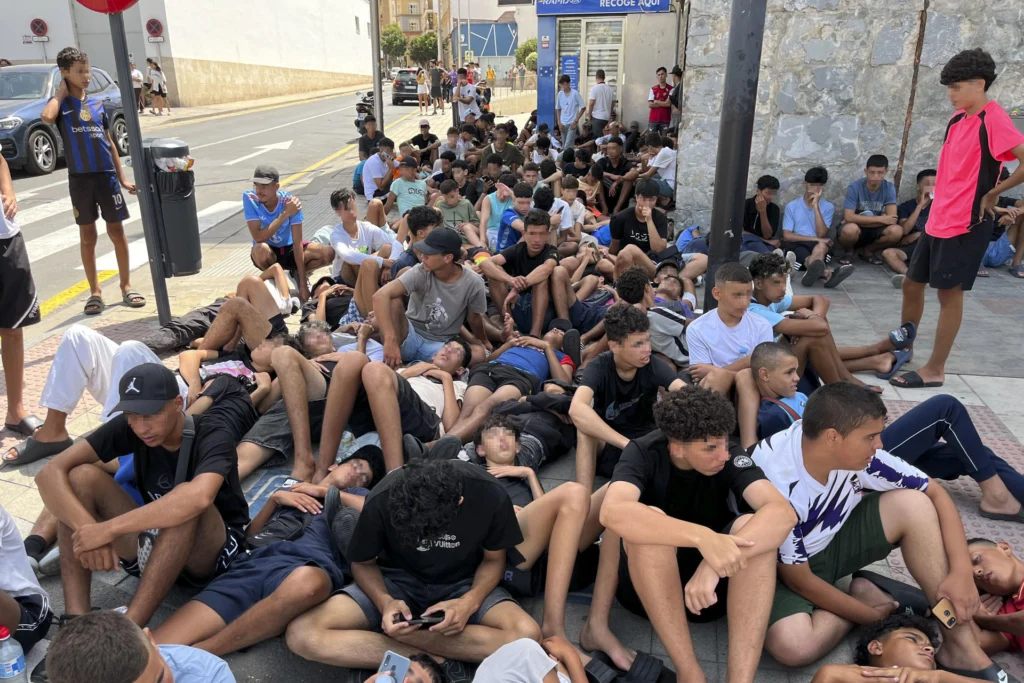
The mayor-president of Ceuta, Juan Jesús Vivas, demanded on August 11 that the Spanish government immediately repatriate 10,000 undocumented migrants who arrived during mass border crossings in late July.
The regional leader met in Madrid with the Spanish Minister of Foreign Affairs, José Manuel Albares, to address what he termed a severe migration crisis.
During the meeting, the mayor-president of Ceuta, Juan Jesús Vivas, asserted that the massive arrival of undocumented migrants directly violated Spain’s territorial integrity.
RELATED: Morocco Steps Up Security Deployment in Ceuta and Melilla Ahead of Calls for Mass Migration
Vivas criticized the central administration in Madrid for failing to adequately address the extreme pressure placed on local public services in the enclave and he insisted that the repatriation of these individuals remains the only viable mechanism to resolve the severe overcrowding currently affecting the city.
Furthermore, the Ceuta authority openly rejected any proposals to regularize the legal status of the migrants. Vivas argued that granting asylum or legal residency would only trigger a dangerous “pull effect” driven by online networks.
For its part, the regional government rejects granting asylum to thousands of undocumented migrants who crossed the border in late July, calling the local saturation an unsustainable national emergency.
Toca resistir. Ceuta necesita seguridad, firmeza y respuestas. Exijo al Gobierno de la Nación más agentes en nuestras calles, todos los medios en Extranjería para agilizar retornos y mantener la presencia del Ejército para transmitir tranquilidad a los ceutíes. pic.twitter.com/V2Y4bFySYQ
— Juan Jesús Vivas Lara (@JuanVivasLara) August 8, 2026
Text reads: “It’s time to resist. Ceuta needs security, firmness and answers. I demand from the Government of the Nation more agents in our streets, all means in Extranjería to expedite returns and maintain the presence of the Army to transmit tranquility to the Ceutis.”
Statistics released by the Spanish Ministry of the Interior indicate that approximately 72,000 people attempted to cross the border on July 30 and July 31. This massive influx was triggered by false information spread on social media.
Although the vast majority of those who attempted the crossing returned to Morocco voluntarily, thousands of migrants remain stranded in the enclave awaiting coordinated transfers. Currently, between 8,000 and 11,000 undocumented migrants live on the streets without permanent housing.
This figure represents approximately 12% of the total population of Ceuta. Vivas described this sudden demographic surge as “absolutely unsustainable, unassumable, and unacceptable” for the local administration, which has seen its temporary population spike by 10% in a matter of days.
Urgent State Intervention
To manage the ongoing border crisis, Vivas formally requested a comprehensive state plan from the central government. His proposal includes the immediate activation of a temporary detention center (CIE) to process expulsion files rapidly.
Additionally, he demanded the creation of a “single command” involving both national ministries and the autonomous government of Ceuta. He also requested the continued presence of the Spanish Army to secure critical infrastructure and public streets.
Vivas also demanded an immediate reinforcement of the city’s healthcare services, which are currently overwhelmed by the sudden population increase. He emphasized that transmitting a clear message of border security and legal order is crucial for the stability of the entire region.
Finally, the president of the enclave urged the central government to deploy additional personnel to key sectors, including justice, prosecution, foreign affairs, and the national police forces. Vivas also called for specific legislative reforms to accelerate the family reunification process in the countries of origin.
While acknowledging the need for diplomatic caution to preserve stable bilateral relations with Rabat, Vivas emphasized that the geopolitical future and sovereignty of Ceuta must never depend on the decisions of Morocco. The Spanish Foreign Ministry recently praised the diplomatic cooperation with Rabat for facilitating the initial returns.
From teleSUR English via This RSS Feed.