

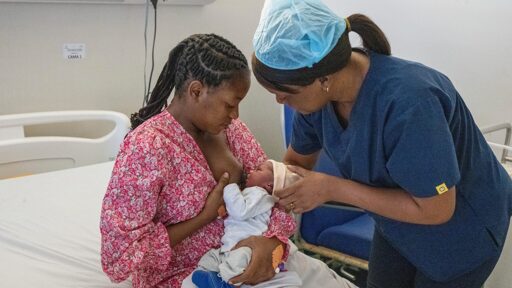

“Across the world, millions of families who want to breastfeed cannot, not because of a lack of will, but because the systems around them fall short,” the World Alliance for Breastfeeding Action (WABA) wrote ahead of World Breastfeeding Week, marked August 1-7. Despite widespread recognition of breastfeeding’s health benefits for both children and women, many countries still struggle to support it. Industry lobbying and limited labor protections persist as significant barriers.
Since 2020, exclusive breastfeeding rates for babies under six months have risen by 8 percentage points to 47% globally. However, other indicators, such as early initiation of breastfeeding, have moved in the opposite direction, WABA emphasized. These fluctuations should signal to governments that investments in breastfeeding measures and metrics must be ramped up. “The cost of not breastfeeding is borne by families, health systems and national economies alike,” WABA pointed out.
Read more: Childbirth under capitalism
Strengthening health systems is a crucial part of the solution. This means adequate staffing of midwives, nurses, and community health workers to support families in initiating breastfeeding must be secured, while also respecting maternity leave recommendations. “A systematic review of 35 studies from low- and middle-income countries found that paid maternity leave was associated with a 52% increase in exclusive breastfeeding,” the World Health Organization (WHO) noted.
The International Labor Organization (ILO) sets the baseline at 14 weeks of maternity leave, while the Global Breastfeeding Collective, echoing additional resolutions by the global labor agency, calls for countries to “mandate paid maternity leave for a minimum of 18 weeks, and preferably for a period of six months or more after birth.” Yet according to WABA, only 10% of countries worldwide meet ILO standards on this, with others falling behind on elements like guaranteed remuneration and duration.
This is not exclusive to low-income countries. Famously, the United States has no federal provisions that meet basic ILO criteria for paid maternity leave. And despite breastfeeding promotion appearing on the second Trump administration’s health priorities list, food and nutrition experts recently noted no action has been taken.
“Stronger laws are also urgently needed to restrict the marketing of breastmilk substitutes, including digital marketing, to ensure full compliance,” the Global Breastfeeding Collective stated in its 2025 scorecard. “Formula companies continue to exploit loopholes and engage in tactics that undermine global efforts to protect infant nutrition, health and development.”
Read more: Intergenerational hunger: the effects of Israel’s starvation of Gaza
Beyond investment in public health systems and effective regulation, networks participating in World Breastfeeding Week 2026 also warned of the impact conflicts and crises have on breastfeeding practices. International agencies have called for dedicated emergency response policies to be included in broader breastfeeding promotion plans.
Conditions in Gaza serve as a dire warning. At the end of July, Save the Children warned that obstructions to supply deliveries enforced by the Israeli occupation are – still – having a devastating impact on women and children’s health. “Some mothers are resorting to feeding their children water mixed with ground chickpeas or tahini, while others are stopping breastfeeding earlier than they would prefer, due to difficulties and lack of support,” the organization wrote.
“UN data from July 2026 shows that of the nearly 29,000 pregnant and breastfeeding women screened for malnutrition, more than 20,000 – or two of three – require targeted supplementary feeding.”
“In emergency situations like Gaza, infants who are not breastfed face significantly higher risks of illness and dehydration, malnutrition, and death,” Save the Children emphasized.
People’s Health Dispatch is a fortnightly bulletin published by the People’s Health Movement and Peoples Dispatch*. For more articles and to subscribe to People’s Health Dispatch, click* here.
From BT News via This RSS Feed.