


This article was originally published by Truthout on Aug. 10, 2026. It is shared here under a Creative Commons (CC BY-NC-ND 4.0) license.
Police in cities across the U.S. are rolling out a pro-drone PR blitz as hundreds of local police departments prepare to deploy autonomous, AI-driven surveillance drones. The drones are capable of following a single vehicle across an entire city, capturing footage through apartment windows, and generally recording daily life from the sky without being noticed.
As of February, more than 1,000 law enforcement and public safety agencies had received waivers from the Federal Aviation Administration (FAA) to operate autonomous surveillance drones as part of so-called “drone-as-first-responder” (DFR) programs, according to public records obtained by the Electronic Frontier Foundation (EFF) and released in July. While the list of waiver recipients includes fire departments and other first responders, the vast majority are law enforcement agencies, including police in cities large and small.
The automated drone push comes as resistance to mass surveillance by license plate-reading cameras goes viral. Residents are packing city council meetings across the country to demand restrictions on the data gathered by high-tech drones and cameras — or an end to mass surveillance altogether.
Scandals over digital stalking by police and other abuses are erupting as new surveillance tech empowers the state to violate privacy in entirely fresh ways. In response, people are taking direct action, sabotaging automated license plate readers (ALPRs) that are capable of building complex profiles of individual vehicles.
Flock Safety, a top surveillance tech firm, is the company most associated with ALPRs and is itself often at thecenter of controversy. But Flock also has a number of competitors, including Axon and Motorola Solutions. And business across the surveillance tech economy is booming.
In many cities, local cops have extra funding for surveillance from wealthy private donors, police foundations, and federal grants; surveillance companies also often offer police free trials and help with applying for grants and waivers. Those surveillance firms have expanded from offering singular technologies such as ALPRs or body-worn cameras to become one-stop shops for police seeking the latest surveillance setup — including advanced drones.
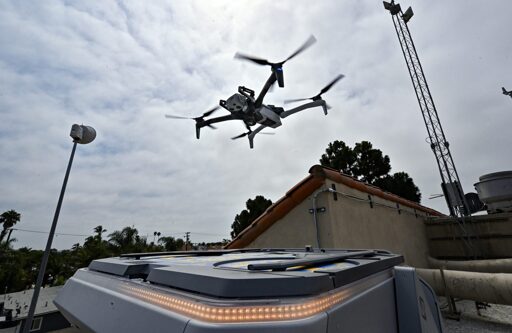
Unlike most consumer drones, which are controlled by an operator looking up from the ground, autonomous surveillance drones used for DFR programs are operated remotely, allowing police to send drones much longer distances and stream live video footage back to headquarters. Cops in many cities have launched camera-carrying drones for years, but autonomous drones guided by AI are capable of flying “beyond the visual line of sight” of the operator (also known as BVLOS drones) and can be managed from a central launch pad, freeing up police time and capacity.
“The human increasingly is not flying the drone; the drone is driven by artificial intelligence and just deployed from one spot to another spot.”
“The human increasingly is not flying the drone; the drone is driven by artificial intelligence and just deployed from one spot to another spot,” said Beryl Lipton, the senior investigative researcher at EFF, in an interview. “They don’t have a pilot, but there is often a human person who is there to manage the feed.”
Instead of attending a street parade and launching a drone overhead, for example, police can fly multiple drones with AI-driven navigation from a desk, as EFF writes:
FAA rules for police drones also required a human operator to manually fly the device to a scene, but DFR technology has become a more common and more automated police technology. DFR programs increasingly rely on artificial intelligence to automate drone flights from launchpads placed around the city, often atop municipal buildings, and make it possible for one drone operator to “fly” multiple devices at once.
Flying a BVLOS drone requires an FAA waiver. The agency streamlined the waiver process in April 2025 and approved more waivers for BVLOS drones between then and February 2026 than it had in the previous seven years combined, EFF reports.
Lipton said most law enforcement applicants are already deploying automated drones or are strongly considering a “drone-as-first-responder” program. Once police begin a relationship with a company such as Flock Safety or Axon, Lipton said, taxpayers can expect a push for purchases of additional gadgets, upgrades, and storage for video.
It’s also not surprising that these programs now seem ubiquitous. “There is a lot of this kind of peer pressure in law enforcement, you can really see it with Flock,” Lipton said. “One police department gets a new tool or signs off on Flock cameras, and then you see neighboring cities are now signing up for Flock to keep up with the latest new thing.”
Flock Safety boasts that its automated “first responder” drones carry ALPR cameras that can read license plates from above up to 2,000 feet away, allowing police to connect surveillance footage of individual vehicles to data captured on the street. Lipton said companies such as Flock and Axon bundle services like gadgets and processing software to help police compile data from multiple streams into easily searchable databases, including footage from body-warn cameras, ALPRs, automated gunshot detectors, and drones flying overhead.
While a corporate partnership between Flock Safety and Axon fell apart in early 2025, some of the most prominent companies selling drones to police departments, including Skydio,integrate their products directly with the software and data analysis tools sold by leading manufacturers of ALPRs. “People don’t realize that video analytics has really developed as much as it has in the past few years, no matter whether coming from a police body-worn camera, drones or ALPR,” Lipton said. “All of these can easily be analyzed and made searchable, and that is a really integral part of what Axon and Flock are doing.”
Amid widespread backlash to ALPRs, police across the nation are going into PR mode, releasing footage of drones in action along with statements casting the technology as a “first responder” that can arrive on the scene before police to establish “situational awareness,” help with search-and-rescue, and track down suspects and stolen property.
“It seemed much more palatable for a drone to be framed as a ‘first responder’ … But in practice it is plain old surveillance.”
“It seemed much more palatable for a drone to be framed as a ‘first responder’ going to a specific crime rather than a tool for surveillance that has a very abstract crime-fighting purpose,” Lipton said. “But in practice it is plain old surveillance.”
Audits of drone flight logs — from piloted or autonomous drones — tell a more complicated story. In places police are required to log flights, officers often record only vague justifications for launching drones without a warrant, often for what appear to be routine dispatches and training flights, the ACLU has noted. Even on mundane missions, such drones equipped with powerful zoom lenses or infrared sensors can capture significant data that can later be analyzed with AI-powered data processing and facial recognition technology.
On July 13, Wiredpublished an investigation into hours of drone footage from the San Franciso Police Department, providing an unfiltered look at automated drones in action. The footage was accidentally released on the open internet via the website for Skydio, the company providing the drones and software behind them. Discovered by security researchers Sam Curry and Maik Robert, the leaked footage itself raised serious privacy concerns.
“In the case of San Franscisco, they are doing a lot of locking onto license plates and, particularly, people, and the drone is able to navigate itself,” Lipton said.
The innocuous scenes captured by drones — police talking to a unhoused person, an arrest at a gas station by undercover officers, two men parking a car before joining a basketball game — also raised questions about the nature and breadth of the surveillance.
In one video, a response to an alleged “prowler” incident, the drone hovers over a young person wearing headphones and apparently having a private moment on the roof of a building. The drones have powerful zoom lenses, and footage captured of living rooms in the interior of apartments and people on private rooftops raise serious constitutional questions about the level of intrusion involved, according to Jay Stanley, a privacy analyst at the ACLU.
“It’s pretty clear that a police drone hovering, say, outside a 2nd story window in a suburban backyard would violate ‘reasonable expectations of privacy’ and thus the Constitution’s Fourth Amendment, but it’s less clear what the courts would find to be a reasonable expectation of privacy in a city, where people are already susceptible to Rear Window-type observation,” Stanley wrote in a blog post on July 17.
In some cities, police launched drone-as-first-responder programs with automated BVLOS drones with little or no oversight. The city council in Nashville, Tennessee, is considering placing restrictions on automated drones after learning that police had quietly launched a trial program without a vote or hearing by the city council. After public outcry, the Metro Nashville Police Department announced on August 6 that it would end its trial drone program.
New Orleans was among the cities that received the FAA waiver for an automated drone-as-first-responder program. Police plan to expand their existing drone program to launch drones in response to 911 calls from the historic French Quarter later this year. But residents were outraged after activists discovered that the city’s police department had changed internal rules to allow police drones to carry “weapons” with prior approval from the police superintendent, according to Edith Romero, an organizer withEye on Surveillance. Police claimed the change was only a proposal added to a draft policy, but as Verite Newspointed out, the file name for the “draft” document suggests the policy was meant to go into effect on June 21.
“Nobody knew; city council didn’t know, we had to announce it, and we mobilized people to start calling and start demanding that this be rescinded,” Romero told Truthoutin an interview.
Police ditched the policy on drones carrying weapons after public outcry. On August 6, the New Orleans City Council voted to require police to publicly publish regular drone flight logs and reports on usage and reasons for deployment. While the new ordinance addresses transparency, it does not place enforceable restrictions on drone use. Romero echoed residents who submitted public comments arguing the ordinance does not go far enough.
“We need to do an investigation of the policy violations that happened last year, and the change in policy that weaponized the drones before we can move toward an expansion,” Romero said, adding that there must be penalties for police who deploy drones for unapproved uses.
The city has become a testing ground for surveillance tech, including ALPRs and cameras equipped with facial recognition. Wealthy private interests have funded an expansion of policing in the French Quarter, and the nonprofit Project NOLA secretly supplied police with data from a network of facial recognition cameras in violation of local law.
Officials said the use of facial recognition was paused after a Washington Post investigationexposed the program in May 2025, but the ACLU reported in April 2026 that abuses continue. The ongoing controversy has left residents anxious about surveillance in a city where drones are already a common sight during parades and street festivals.
“We already have people coming to us saying, ‘I saw drone outside my window, we don’t know what to do, how can we even confirm that it was a police drone?’” Romero said. “But we don’t know who was manning the drone, and for what purpose.”
According to Skydio flight logs for 2025 obtained by Eye on Surveillance and reviewed by *Truthout,*piloted drones were overwhelmingly dispatched to respond to calls about minor incidents, including a subject who was “involved in a disturbance with the hot dog guy then fled the scene.”
Drones were twice dispatched in response to a “Black female” causing a “disturbance” on or near Bourbon Street, famously one of the rowdiest bar crawls in the world. While many entries for “Type of Incident” in the flight logs are left blank, in multiple cases, drones responded to calls about unhoused people and people with mental illness.
“This is really why they want the [drones-as-first-responder] drones in the French Quarter,” Romero said. “These business owners don’t want to see people that are houseless, and they want to harass people they think are suspicious.”
Romero said building a surveillance state is clearly not the solution to homelessness or the budget crisis facing city leaders, who may be tempted by lucrativefederal grants that require cities to build out surveillance infrastructure. Romero pointed to the Trump administration’s Model Cities Initiative, which offers $300 million to cities that invest in “proactive policing” and surveillance tech.
“If cities are building the surveillance infrastructure, the risks that our data will end up in the hands of the federal government or state government in our case are really high.”
“We have to take into consideration that the federal and the state governments are trying to use all the surveillance technologies out there. And so if cities are building the surveillance infrastructure, the risks that our data will end up in the hands of the federal government or state government in our case are really high,” Romero said.
Lipton said many questions remain about how police are actually using drones as “first responders,” and advocacy around restrictions and transparency is critical. Drones are not as immediately visible to the public as traffic cameras. But as anger continues rise over the automated license plate readers sold to police by Flock and Axon, Lipton expects a similar backlash to automated drones once more people learn about the technology.
“The adoption of these tools has outpaced the public’s awareness that they exist,” Lipton said. “License plate readers have been around for a very long time at this point, but we are seeing a moment where everybody — even people who are not tech-savvy — understand what it means that these systems are accessible in real time and interconnected.”
From The Real News Network via This RSS Feed.
Next it’ll be Kamikaze drones.
