

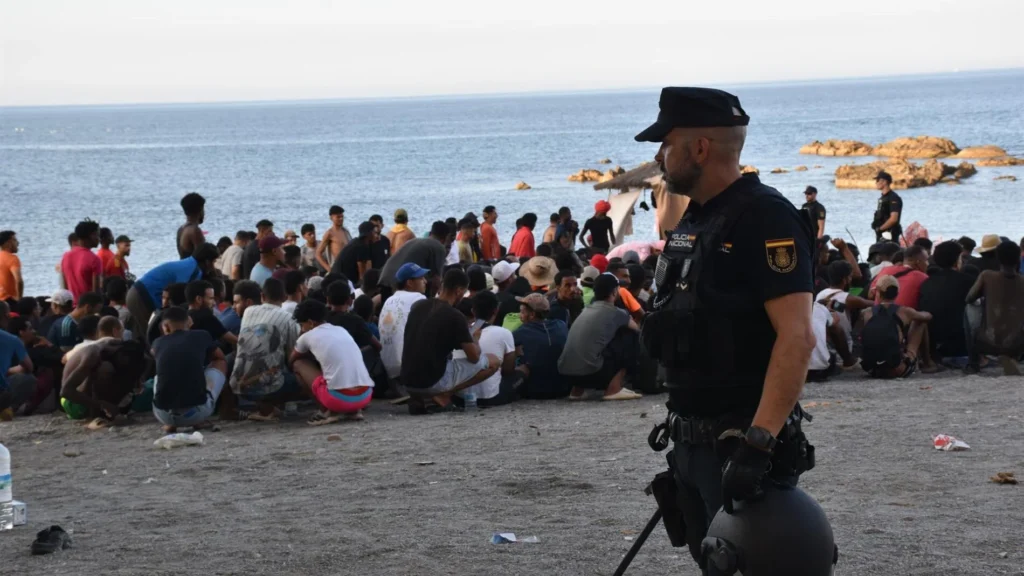
On Tuesday, Moroccan authorities have intensified police checks and security deployments in areas near Ceuta and Melilla to intercept would-be irregular migrants. This move comes in response to calls circulating on social media urging a new mass attempt to enter both Spanish cities on August 15.
RELATED:
Death Toll in Ceuta and Melilla Migrant Surges to 141
With four days remaining until that date, Moroccan security services are intercepting individuals daily on roads leading to the border zones and returning them to their home cities. Police and Gendarmerie forces have reinforced checkpoints at the entrances to nearby towns, where they search vehicles and check travelers’ identities.
Journalist Ahmed Biyuzan, a migration specialist based in Fnideq (near Ceuta), explained that “when they spot would-be migrants, they intercept them and send them back to their home cities by bus.”
The Nador province, which borders Melilla, is also seeing a significant deployment of various security forces, with police checkpoints set up at the approaches to the city of Nador itself.
#World | The Moroccan Association for Human Rights (AMDH) raised the death toll to 141 in the recent migrant surges recorded along Morocco’s borders with the Spanish autonomous cities of Ceuta and Melilla.https://t.co/V3dZ5nWaKI
— teleSUR English (@telesurenglish) August 10, 2026
Allegations of Forced Transfers
Said Haddad, president of the Nador branch of the Moroccan Association for Human Rights (AMDH), stated that the transfer of migrants out of Nador province is a practice that has been going on since even before recent events.
Haddad pointed to the existence of “unofficial sites where intercepted young people are held before being moved out of the province”—a practice regarding which they had already written to the Moroccan Public Prosecutor’s Office.
The AMDH official noted that forced transfers to cities like Casablanca and Beni Mellal do not end in the city centers but rather several kilometers away, “with the aim of exhausting” the migrants. “Meanwhile, arrests and operations to transfer individuals out of the province are continuing throughout the day,” he added.
Despite a heavy police presence, calls to attempt another mass entry into Ceuta and Melilla continue to proliferate on Moroccan social media. In response, the Spanish Embassy in Morocco issued a statement clarifying that entering Ceuta or Melilla irregularly grants no right to remain in Spain or to access the rest of Europe. The diplomatic mission emphasized that “any information to the contrary is false.”
The recent surge in migration—which peaked on July 30 and resulted in dozens of deaths—led to the irregular entry of tens of thousands of people into Ceuta from Morocco. More than 70,000 subsequently returned to Morocco, while the remainder stayed on Spanish territory.
Rather than analyzing the causes of the method derived from precarity, the recent migration assessment in Ceuta, within European rights theories, portrays the arrival of people as an “invasion.”
The Spanish authorities counted 50,000 migrants who arrived from Morocco, of whom… pic.twitter.com/fEISSY92zc
— teleSUR English (@telesurenglish) July 31, 2026
From teleSUR English via This RSS Feed.