


A new analysis published by the Jerusalem Post suggests that Israel may seek to deepen its strategic partnership with India in response to a defense pact signed last week by Saudi Arabia, Turkey and Pakistan.
Analysis: In retrospect, the seemingly out-of-the-blue Netanyahu-Modi phone call on Thursday looks more like an early glimpse of the counter-alignments that the Mecca Pact may produce.
Written by: @HerbKeinon https://t.co/yKv4nDPwXW— The Jerusalem Post (@Jerusalem_Post) August 9, 2026
Ali Shihabi, a Saudi commentator close to the royal court, told the Financial Times that the military alliance, which was signed between the three nations — Saudi Arabia, Turkey, and Pakistan — on Friday:
…reflects a recognition that American deterrence has been significantly weakened and that the Iranian threat will increasingly need to be managed by regional powers…
Herb Keinon, of the Jerusalem Post, said that the pact represents one of the most significant structural shifts in the Middle East’s security architecture in years, and that both Israel and India have reason to be alarmed.
He said:
This new trilateral alliance, though ostensibly a bulwark against Iran, is as much a concern for India – Pakistan’s bitter enemy – as it is for Israel. The combination of Saudi money, Turkish defense manufacturing capabilities, and a nuclear-armed Pakistan is causing just as much alarm in New Delhi as it is in Jerusalem.
However, a strategic response to the Mecca Pact may ultimately deepen an already troubling alliance between Hindutva and Zionism.
Israel alarmed?
The Times of Israel also agreed that the “agreement complicates the American vision of a regional security architecture linking Israel and the Arab Gulf states,” and is likely to curb efforts at Saudi-Israeli normalisation.
Ynet News quoted an unnamed Israeli official saying that the agreement was aimed at Israel and that it was troublesome.
He was quoted as saying:
Israel needs to build alternative alliances, especially with the Hellenic axis, Greece and Cyprus, together with India and the United Arab Emirates.
Modi-Netanyahu phone call
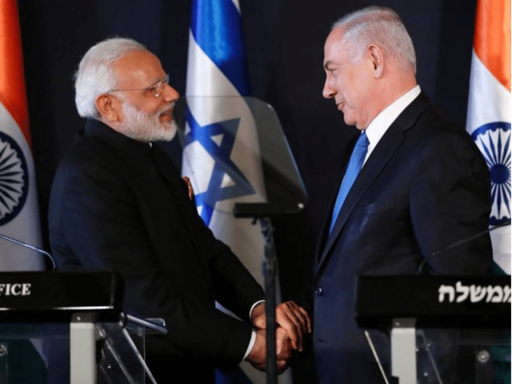
The Post’s Keinon said that it is “difficult to imagine that the looming pact was not a major focus” of the recent phone call between Benjamin Netanyahu and Narendra Modi. He said that both Jerusalem and New Delhi would almost certainly have been aware that a significant regional realignment was in the works.
The phone call between Modi and Netanyahu took place on 6 August, one day before the Mecca Pact was signed.
Both leaders posted about the phone call on X.
תודה ידידי, ראש ממשלת הודו נרנדרה מודי.
ביחד אנחנו ממשיכים לחזק את הקשר בין ישראל להודו.
— Benjamin Netanyahu – בנימין נתניהו (@netanyahu) August 7, 2026


The call, which appeared “out of the blue” at the time, in retrospect “looks more like an early glimpse of the counter-alignments that the Mecca Pact may produce,” Keinon concluded.
India and Israel forge stronger relationship
A recent report by Amnesty International said that India has forged a “close partnership with the Israeli defence sector over the years”.
It said:
India has become a significant actor in the supply chains enabling Israel’s military operations, including those that Amnesty International, the UN and local NGOs have determined amount to genocide.
Several media reports have shown how the Indian-Israeli partnership in the defence sector has grown over the years, and how Indian weapons have been used by Israeli armed forces in the Gaza Strip.
Using publicly available shipment-level trade data, Amnesty traced hundreds of thousands of weapons components shipped from Indian factories to Israeli military suppliers between 7 October 2023 and 30 November 2025. This included 390,516 small arms parts for military-grade weapons.
Hindutva-Zionism
As Vikram Visana, a lecturer in political theory at the University of Leicester, wrote in the Conversation in 2024, Hindu nationalism and Zionism are “ideological cousins”.
Hindutva’s founder, Vinayak Damodar Savarkar, openly praised Zionism as the perfection of ethno-nationalist thinking, a model for how to blend ethnic attachment to a motherland with religious attachment to a holy land.
The concerns about deepening India-Israel ties extend beyond ideology and geopolitics; there is a significant economic dimension as well.
“Hindutva’s rise is inseparable from neoliberal capitalism,” Shayan Shaukat wrote in the Transnational Institute’s February 2026 analysis.
Rather than rejecting market fundamentalism, the BJP-RSS combine fuses it with majoritarian authoritarianism.
However, the deepening of an already troubling alliance between Hindutva and Zionism is likely to enrich corporate interests and empower exclusionary nationalist movements in both countries.
Featured image via Usanas Foundation
By The Canary
From Canary via This RSS Feed.