

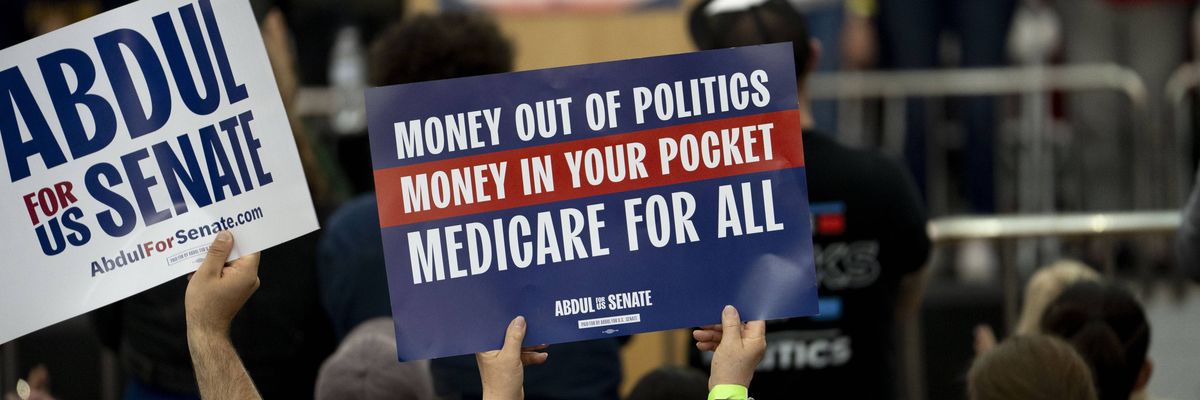
The investigative outlet Sludge published an analysis on Monday showing that the health insurance industry is among the corporate donors to Third Way, a think tank that is reportedly preparing to pour $15 million into an effort to combat the rise of candidates who support Medicare for All and other progressive policies.
Third Way, which has long been hostile to the progressive wing of the Democratic Party and Medicare for All in particular, does not publicly disclose its donors. But Sludge’s David Moore uncovered some of the group’s benefactors by examining corporate tax filings, which revealed that the private insurance industry group Better Solutions for Healthcare (BSFH) donated $50,000 to Third Way’s advocacy arm in 2024.
Among BSFH’s members are the Blue Cross Blue Shield Association and the health insurance industry trade group AHIP. Moore noted that BSFH is “run out of the offices of leading Republican digital and strategy firm Targeted Victory in Arlington” and was founded by GOP operative Alexander Schriver.
Sludge’s review of corporate tax filings showed other healthcare industry donors to Third Way, including CVS Health and Johnson & Johnson.
“Another corporate lobbying heavyweight, the Business Roundtable (BRT), gave $50,000 to Third Way in 2024, up from the $25,000 it gave in 2023 and down from the $75,000 it gave in 2022,” Moore reported. “Each year in 2019, 2020, and 2021, BRT gave $50,000 to Third Way. The CEO group’s health insurance members include the heads of UnitedHealth, Cigna, Elevance (formerly Anthem), CVS Health—all members of AHIP (formerly America’s Health Insurance Plans), save for UnitedHealth—as well as healthcare company Centene and many Big Pharma firms like Johnson & Johnson.”
NEW: Who’s funding the dark money Third Way, dug up in most recent tax filings:
- Republican-run insurance industry front group
- Health insurance giant
- Big Pharma
- More insurance lobbyists
…as it fights the Democratic left and Medicare for All:https://t.co/w787PVhxsH
— David Moore (@ppolitics) August 11, 2026
Moore’s reporting came days Third Way president Jonathan Cowan told The New York Times that his organization is “preparing for the next war that is coming.”
Cowan said that “it is deeply troubling to see radical, far-left candidates winning in places that are potentially presidential swing states”—a comment published two days after progressive epidemiologist Abdul El-Sayed, a vocal supporter of Medicare for All, won the Democratic primary for a critical US Senate seat in Michigan.
The Times story characterized Third Way as “a leading centrist Democratic group,” without mentioning the organization’s corporate ties.
“Post El-Sayed’s win, Third Way has done media hits in NYT, CNN, WaPo, Vox, and not one of these outlets has mentioned who funds Third Way historically or bothered to ask who their current donors are,” journalist Adam Johnson wrote in a social media post on Tuesday, praising Sludge’s review of tax records.
“Journalists are, in principle, supposed to do what David did here: investigate ulterior motives, follow the money, dig deeper,” Johnson wrote. “Alas what mainstream outlets have done for Third Way this past week is credulously take them at their word they are merely ‘concerned about electability.’”
Earlier this year, Third Way published a memo attacking Medicare for All and its purportedly “astronomical cost.” (The memo does not mention research showing that a Medicare for All system would cost less than the status quo, while providing comprehensive universal health coverage and saving tens of thousands of lives per year.)
A recent study by Yale University researchers found that a Medicare for All system would reduce US national health expenditures by more than $1 trillion a year and “save over 114,000 lives annually.”
Dr. Ed Weisbart, the national board secretary of Physicians for a National Health Program, told Sludge that “anybody who chooses to attack [Medicare for All] is putting themselves out of step with what I think most people in our country see as the solution.”
“People want this, even when they understand that of course it’s going to mean a change in their taxes—but they also understand that for 95% of people or so, the change in taxes is smaller than the amount that they would save by not having premiums, not having co-pays, not having deductibles,” said Weisbart. “People are getting that. And if you try to market a political view that’s opposite, people see right through that."
From Common Dreams via This RSS Feed.