

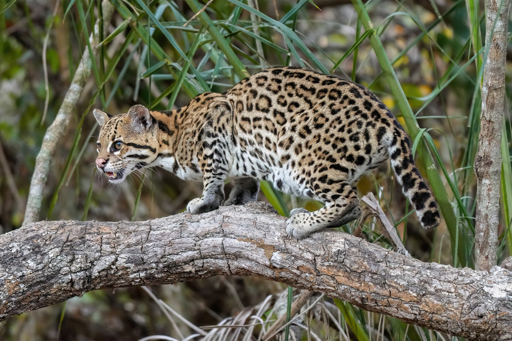
Every day, millions of Brazilians recall how rich the country’s feline biodiversity is when they reach into their wallets: Since entering circulation in 2010, the ‘50 real’ notes have carried a printed drawing of a jaguar (Panthera onca), the largest feline in the Americas. In Brazil, one can even trace the animal that inspired the design of the popular banknotes: It is the jaguar called “Gabi,” a 2002-born female that lived in the old Rio de Janeiro Zoo (today Rio’s BioParque). The “model” Gabi died in 2022, but she remains alive in the imagination of Brazilian consumers in every day-to-day cash transaction. Despite the tribute, alongside species such as the puma (Puma concolor), the ocelot (Leopardus pardalis), and the jaguarundí (Herpailurus yagouaroundi) or gato-mourisco, as it is known in Brazil, the jaguar faces a common crisis among Brazilian species: Its existence is threatened by problems ranging from illegal wildlife trafficking to the accelerated degradation of its habitats across different biomes. Also, there is a silent emergency that places these wild felines in a threatening environmental context: Diseases that affect domestic animals. “There is a risk for all feline species. Especially for our native species and for those that are endangered,” said Flavia Tirelli, a doctor in zoology and coordinator of the Geoffroy’s Cat Working Group, an international network fighting for the conservation of Leopardus geoffroyi and other wild felines. According to the specialist, who also acts as a researcher at the Laboratory of Evolution, Systematics, and Ecology of Birds and…This article was originally published on Mongabay
From Conservation news via This RSS Feed.