

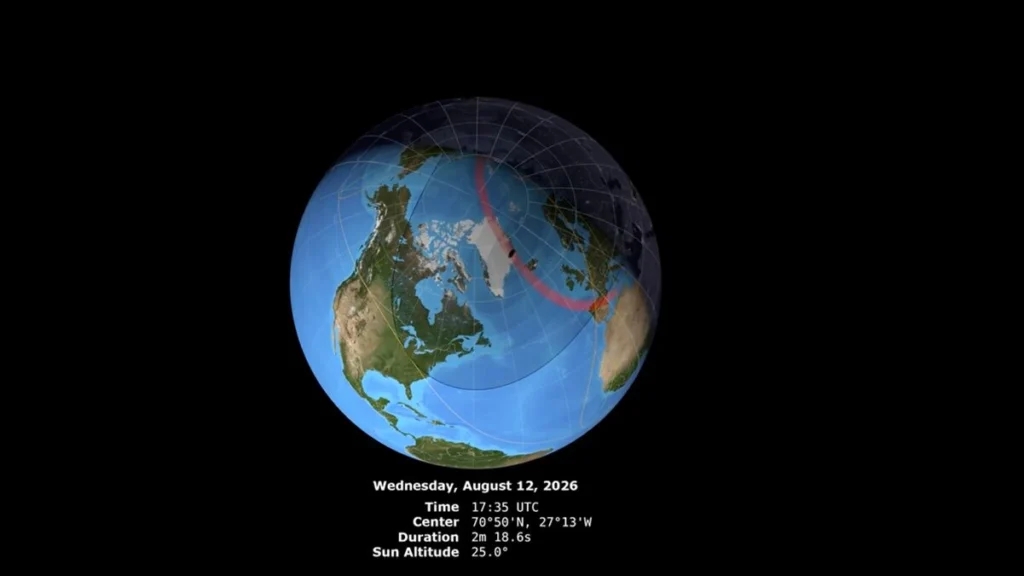
The Aug. 12 eclipse will be visible from Spain, Greenland, Iceland, the Atlantic Ocean, Siberia, and Portugal.
On Tuesday, about 30 researchers from the National Aeronautics and Space Administration (NASA) and the Exploratorium in San Francisco were stationed in Villalibado, a village in the province of Burgos in northern Spain, to observe the solar eclipse.
RELATED:
20 More Years to Witness Another Total Solar Eclipse
After arriving at the site on Sunday, the scientists installed their equipment and computers inside a 12th-century Catholic temple, the Church of San Salvador, which is located on an elevated terrace.
Dr. Desire Whitmore, of the Exploratorium in San Francisco, said they chose Villalibado because they needed a place with few people who could interrupt their work and from which the eclipse could be observed well.
They have installed three telescopes with different filters that are collecting data on the sun and tracking its evolution over 24 hours, Whitmore said, noting that what is rare about the eclipse is that it begins in Greenland but will be visible in Spain at sunset.
In addition, on Aug. 12, a screen will be installed on one side of the church and will receive a direct signal from the telescopes. The eclipse will be visible from an area set aside for the public, although it will be away from the researchers so they can work without interruption.
SOLAR ECLIPSE! This Wednesday, August 12th, the path of totality will go across Russia, Greenland, Iceland and Spain. Totality lasts about 1-2 minutes when the moon blocks the sun…leading to temporary darkness. Btw, the next total solar eclipse in the *contiguous* United States… pic.twitter.com/xacnwYSRa5
— Matt Devitt (@MattDevittWX) August 10, 2026
16 Total Solar Eclipses Have Occurred Since 2000.
So far in the 21st century, the world has experienced 16 total solar eclipses, phenomena in which the moon completely blocks the sun. During its occurrence, the eclipse can only be observed by those who are in the so-called “Path of Totality.”
The Aug. 12 eclipse will cross Spain from Galicia to the Balearic Islands and will also be visible from parts of Greenland, Iceland, the Atlantic Ocean, the northern tip of Siberia and a small corner of Portugal. In other areas of the Northern Hemisphere, including the U.S., Canada, Europe and Africa, people will be able to witness a partial solar eclipse.
The duration of the Aug. 12 eclipse will be 264 minutes, according to the National Astronomical Observatory (OAN). In Spain, the duration of the totality phase depends on the location but will not exceed two minutes.
The longest total solar eclipse since 2001 was on July 22, 2009, reaching 6 minutes and 38.86 seconds and crossing India, Nepal, Bangladesh, China, and the Pacific. The following are the dates and places where total solar eclipses have been seen during the 21st century:
-. Asia: March 29, 2006; Aug. 1, 2008; July 22, 2009; Nov. 13, 2012; March 20, 2015; and March 9, 2016. The path crossed Turkey, Russia, Mongolia, China, India, Indonesia and East Timor.
-. Africa: June 21, 2001; Dec. 4, 2002; March 29, 2006; and March 20, 2015. They were observed in Angola, Zambia, Mozambique, Libya, Egypt, Gabon, Congo and Uganda.
-. South America: March 29, 2006; July 11, 2010; July 2, 2019; and Dec. 14, 2020. Brazil, Chile, including Easter Island, and Argentina were the places where they could be observed.
-. North America: Aug. 1, 2008; Aug. 21, 2017; and April 8, 2024, including Canada, the United States and Mexico.
-. Oceania: Dec. 4, 2002; July 11, 2010; and Nov. 13, 2012, covering Australia and areas of the South Pacific.
-. Europe: March 20, 2015, in the Faroe Islands and the Svalbard archipelago in Norway, and Aug. 12, 2026, in Spain as a privileged location and in areas of Iceland, Greenland, the northern tip of Siberia, the Atlantic Ocean and a small portion of Portugal.
-. Antarctica: This astronomical spectacle has so far been enjoyed on Nov. 23, 2003, and Dec. 4, 2021.
Two solar eclipses considered hybrid should also be mentioned during this century. In other words, they changed from annular to total as the moon’s shadow moved across the planet. They occurred on Nov. 3, 2013, and April 20, 2023.
teleSUR/ JF
Source: EFE
From teleSUR English via This RSS Feed.