

Bullets:
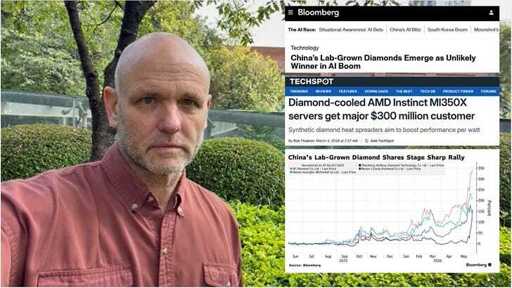
Newest-generation semiconductors have a heat dissipation problem.
Copper and aluminum are insufficient to cool the stacks of superfast GPU’s, so chipmakers are turning instead to manmade diamonds.
China produces two thirds of all the lab-grown stones in the world, and has strict export controls on the capital equipment to manufacture them.
The high demand from the Artificial Intelligence industry has placed a floor under prices for manmade stones, and the shares of Chinese diamond makers are surging.
Meanwhile, the natural diamond industry is collapsing, as jewelry buyers opt for lower-priced stones, which also come without the “blood” or “conflict” stigmas.
Inside China / Business is a reader-supported publication. To receive new posts and support my work, consider becoming a free or paid subscriber.
Report:
Good morning.
China produces more man-made diamonds than the rest of the world combined, and their artificial diamond fabs in Henan province have blown up markets for the makers of natural stones. The prices for diamonds—natural and man-made—have collapsed over the past decade.
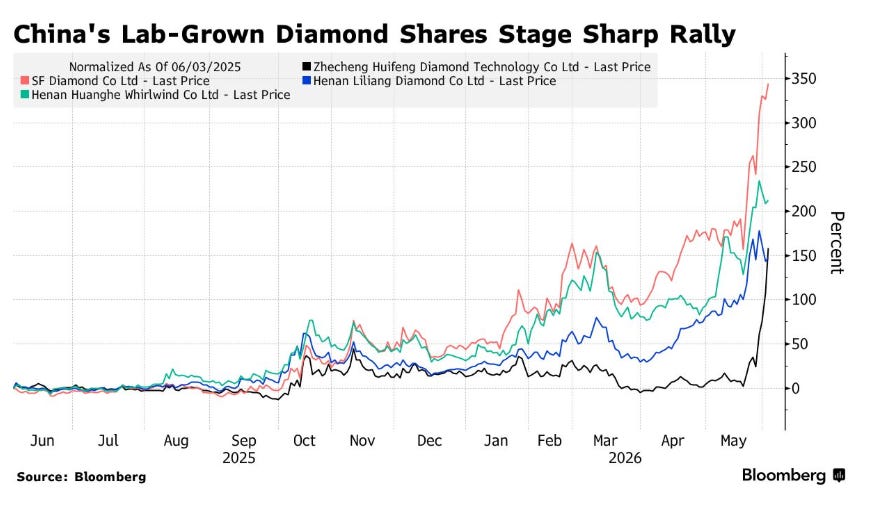
But China’s artificial diamond industry is doing fine, thanks to demand from industrial sectors. And that is especially true, and recently, in semiconductors and Artificial Intelligence. The shares of the Chinese companies that make lab-grown diamonds are up 90% year to date, and that’s because artificial diamonds are suddenly critical to the performance of the latest-model semiconductors. Nvidia’s latest GPU’s run over 2,300 watts, and its engineers are racing around to find new heat dissipation materials.
Diamonds are the only materials available on the market, for chips running over 1400 watts. Diamonds have the highest known thermal conductivity; five times that of copper. What’s more, the density of diamonds is about a third that of copper, so that allows for lighter equipment racks.
China produces about two thirds of the world’s total supply of man-made diamonds, and now that companies with all the money in the world need Chinese diamonds to make their semiconductors work, stock prices are going up. Nvidia announced that the Vera Rubin chips will combine diamond composites and liquid cooling, and came to China to find suppliers.
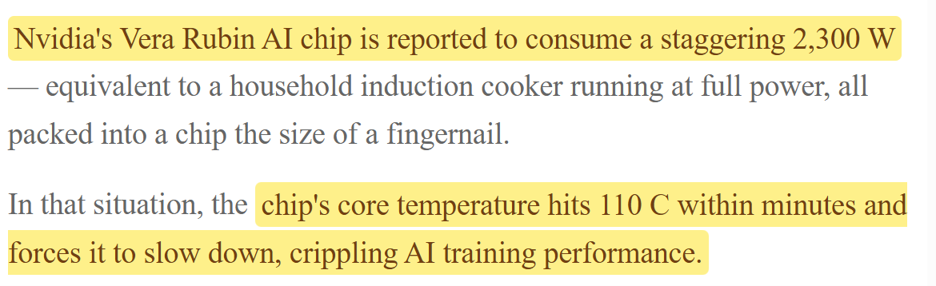
This is coming at an ideal time for Chinese diamond manufacturers, who are victims of their own success. Industry profits were in steep decline. Then along came the superfast-- but also superhot-- computer chips, and the “heat dissipation crisis” in the AI industry. Nvidia’s Rubin chip runs 2,300 watts. 110 degrees centigrade is more than enough to boil water, the system overheats and slows down, so the CEO’s of the richest companies on earth were booking flights to China.
That’s because diamonds are the only way out of that problem. They move that heat away from the CPU’s 5.5 times faster than copper, and 11 times faster than aluminum. Without Chinese diamonds, the chips don’t run, so the hardware companies are hitting hard ceilings. Advanced Micro Devices has the same problem, and diamonds offer the same solution. AMD just sold $300 million dollars in AI servers, also cooled with artificial diamonds.
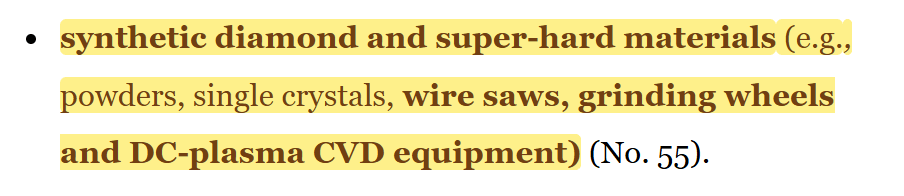
We need to clarify here that China does have export restrictions on superhard materials for dual-use applications. Beginning in November of last year, Chinese companies needed export licenses from the Commerce Ministry. Some exports are permitted in certain materials, rare earth metals, and magnets, at least to foreign companies building products for civilian markets; non-defense. But there remain strict export bans on the technologies, and the equipment and tools to produce, in this case, artificial diamonds. The specialty saws, grinding wheels, and the Chemical Vapor Deposition machines—the capital equipment to make artificial diamonds is all staying here:

Meanwhile, Chinese exports of the diamonds themselves are up two thirds from the same period a year ago, and those sales were powered by the AI construction boom. Lab grown diamonds are past the proof-of-concept phase—they work to get the heat away from the CPU’s, and foreign companies are placing large orders, and the stocks are going up. “Industry consensus” is that AI data centers are moving to diamonds, and investment funds are snapping up shares in the strongest companies.
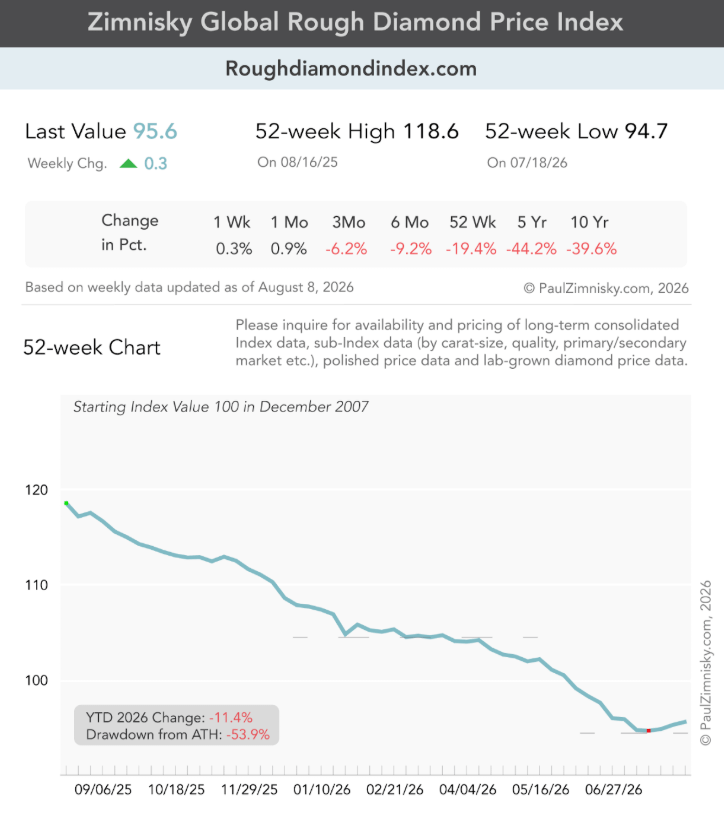
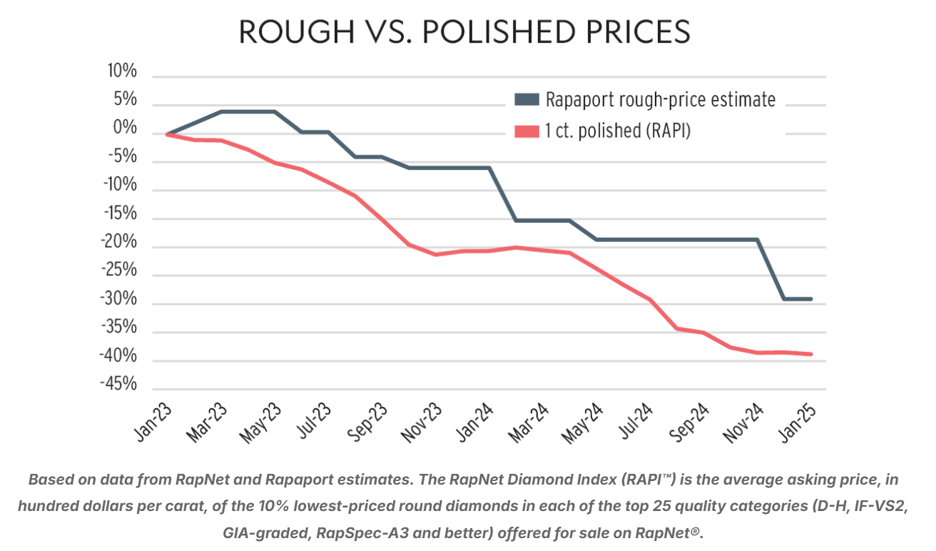
Things continue to get worse, though, in the natural diamond industry. Above, is the one-year chart for rough diamonds. Since 2022, the index for natural diamonds has dropped by over half. So there’s not much need to go looking for new natural stones; insiders expect this year’s production of natural diamonds to be the lowest in 40 years. And here we see the damage done to the natural diamond industry, by artificial diamonds pouring out of China: this is the index of finished diamonds, which is now down by more than two-thirds since its high:
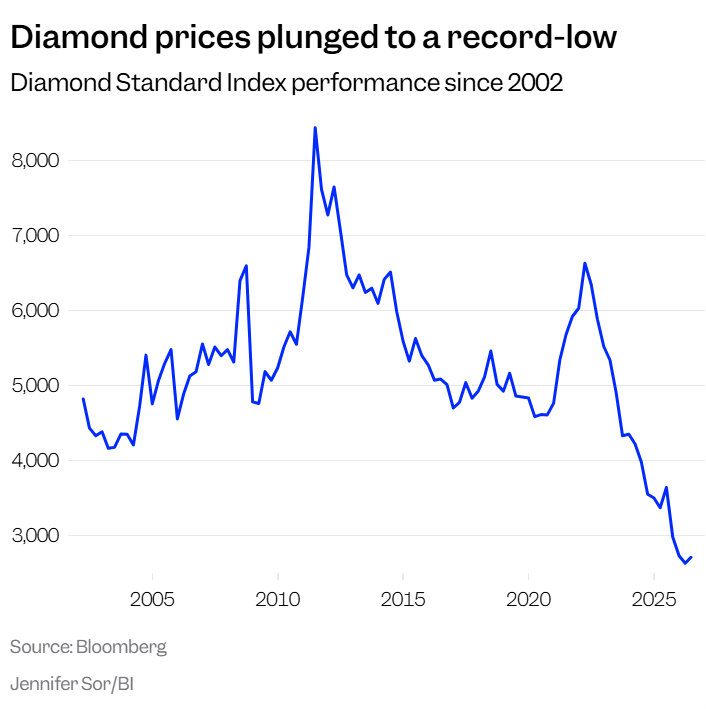
The negative momentum there came long before China took over the market, though. Middle-class buyers of diamonds were moving toward artificial stones because of price, but also because of the “Blood Diamond” problem. Lab-grown diamonds have ethical advantages over stones sourced from countries fighting civil wars, or from companies running open-pit mines with hazardous chemicals.
The ‘blood diamond” label is also being applied to the conflict in Gaza. Diamond trading generates billions of dollars in export revenues for Israel, and major PR efforts are underway by critics who point to the industry’s indirect support of the Israel Defense Forces, to the tune of about a billion US dollars per year.
It’s hard to quantify exactly the impact of those campaigns, but they can’t be helping sales of natural stones any. Last year lab diamonds were 61% of engagement rings in the United States, which is up over 3 times in six years.
So natural diamond producers have a big price problem, a big China problem, and a big image problem, which are hitting their top and bottom lines all at once. DeBeers announced a new initiative in Sierra Leone, whereby local miners can connect with global buyers in “a fairtrade scheme for buyers.”
Generally though, there is no good news for the natural diamond industry, and little reason to think recovery is coming soon. China’s manmade diamonds are sweeping up markets for industrial users, and that puts a floor under lab-grown diamonds, and the prices of them.
The most important diamond buyers aren’t kids from rich families making wedding plans. They are the tech companies, who need Chinese diamonds to build GPU’s.
Be Good.
Resources and links:
Jensen Huang Sparks AI Cooling Revolution as China’s Henan Lab-Grown Diamond Army Charges Into a Trillion-Yuan New Frontier
https://finance.biggo.com/news/BMLje54BmHHDnbgyKAKv
Diamond-cooled AMD Instinct MI350X servers get major $300 million customer
https://www.techspot.com/news/111561-diamond-cooled-amd-instinct-mi350x-servers-get-major.html
The Resurgence of Lab-Grown Diamonds
https://eu.36kr.com/en/p/3828329830912641
AI adds sparkle to synthetic diamond sector
https://www.chinadaily.com.cn/a/202607/29/WS6a6957f7a310986e2b467e0c/_1.html
China’s lab-grown diamonds get an AI boost as industry rides demand for chip cooling
https://www.scmp.com/economy/china-economy/article/3363310/chinas-lab-grown-diamonds-get-ai-boost-industry-rides-demand-chip-cooling
China announces artificial diamond export curbs set to take effect day before US tariff truce deadline
https://www.reuters.com/sustainability/boards-policy-regulation/china-announces-artificial-diamond-export-curbs-set-take-effect-day-before-us-2025-10-09/
China Suspends Export Controls on Certain Critical Minerals and Related Items
https://www.pillsburylaw.com/en/news-and-insights/china-suspends-export-controls-certain-critical-minerals-related-items.html
China’s Lab-Grown Diamonds Emerge as Unlikely Winner in AI Boom
https://www.bloomberg.com/news/articles/2026-06-02/china-s-lab-grown-diamonds-emerge-as-unlikely-winner-in-ai-boom
China’s Lab-Grown Diamonds Aid Chipmaking in AI Boom
https://humanprogress.org/chinas-lab-grown-diamonds-emerge-as-unlikely-winner-in-ai-boom/
What’s behind the diamond downturn?
https://www.marketplace.org/story/2026/07/30/why-mined-diamonds-are-losing-value
The diamond market has been upended by the lab-grown craze. Some fear it may never recover.
https://www.businessinsider.com/diamond-market-prices-record-low-lab-grown-stones-marquise-cut-2026-7
ROUGH DIAMOND PRICE INDEX
https://www.paulzimnisky.com/roughdiamondindex
Could a diamond wafer as wide as a basketball be China’s trump card in AI race?
https://www.scmp.com/news/china/science/article/3357157/could-diamond-wafer-wide-basketball-be-chinas-trump-card-ai-race
BBC, ‘By the grace of God’: Miners dig on as lab-grown diamonds change market
https://www.bbc.com/news/articles/czx2jqvwp7go
Bloody Diamonds: How Your Engagement Ring Helps Fund a Genocide in Gaza
https://www.unz.com/article/bloody-diamonds-how-your-engagement-ring-helps-fund-a-genocide-in-gaza/
The Hidden Cost of Jewelry
https://www.hrw.org/report/2018/02/08/hidden-cost-jewelry/human-rights-supply-chains-and-responsibility-jewelry
China and Africa are destroying the DeBeers diamond cartel
youtube.com/watch?v=V7tGZzwe4mQ&feature=youtu.be
Bloody Diamonds: How Your Engagement Ring Helps Fund a Genocide in Gaza
https://www.unz.com/article/bloody-diamonds-how-your-engagement-ring-helps-fund-a-genocide-in-gaza/
The 2024 Diamond Crisis: An Industry at Its Breaking Point
https://rapaport.com/magazine-article/the-2024-diamond-crisis-an-industry-at-its-breaking-point/
U.S.-Israel Trade Is Dominated By Diamonds
https://www.forbes.com/sites/kenroberts/2017/05/22/for-first-time-in-25-years-israel-not-no-1-provider-of-u-s-diamonds/
Inside China / Business is a reader-supported publication. To receive new posts and support my work, consider becoming a free or paid subscriber.
From Inside China / Business via This RSS Feed.