

Campaigners have hailed the completion of the physical demarcation of land in Brazil belonging to the Kawahiva. They’re one of the Amazon’s most vulnerable uncontacted peoples and it’s a full 27 years since authorities confirmed their presence on the land.
Now that the Rio Pardo Kawahiva Territory has been mapped out on the ground, only president Lula’s signature is required for the territory to be officially created.
Threats to the Kawahiva
The uncontacted Kawahiva are critically threatened by land grabbers and loggers who have pushed for access to the territory. They have aggressively opposed the recognition of the Kawahiva’s lands, with violence and arson attacks, as well as political lobbying.
The Kawahiva are nomadic hunter-gatherers who rely totally on their forest. They are the survivors of attacks and disease which killed their relatives, and they are resisting in their forest, avoiding contact with outsiders.
Jair Candor, the renowned FUNAI official in charge of protecting the territory from invasions, told Survival:
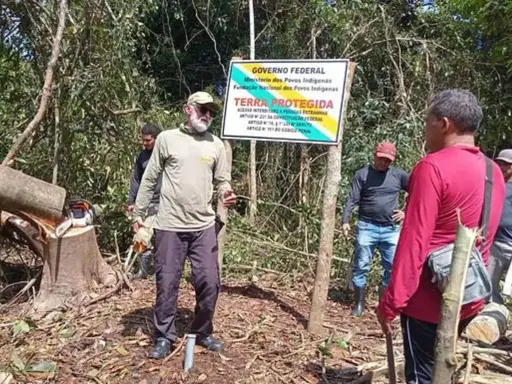
The physical demarcation … provides greater security because that is how people will begin to understand that this is real: the boundary markers and signs are now there.
It is another milestone we have achieved, but the battle continues because now comes the [final] approval process. And this is vital for the survival of the Kawahiva.
For me, it is a matter of honor to begin and complete this work, which will secure the future of this uncontacted Indigenous people.
A statement from the FUNAI Land Demarcation Department said:
Physically marking the boundaries strengthens territorial monitoring and protection efforts… to combat invasions and illegal activities such as wildcat mining, logging, and the expansion of cattle ranching.
This measure is particularly significant given the history of conflict and the difficulty of accessing the region.
Survival International’s director Caroline Pearce said:
The uncontacted Kawahiva have been under threat in their own forest home for decades, while simply trying to exercise their right to live as they choose without contact.
Now, finally, we are just one step away from their territory being recognized and protected. It is essential that President Lula quickly takes the final step of full legal recognition – this is the only way to secure the Kawahiva’s future.
That we have reached this point at all is a tribute to the fierce commitment of the Kawahiva’s allies inside and outside Brazil, in the face of violent opposition from colonizing land-grabbers and their political allies. Now the Brazilian authorities must see it through.
For over two months, Candor and his team traversed the Kawahiva territory, driving posts into the ground along its borders and installing signs to warn off intruders. Now that demarcation of the territory is complete, a presidential decree is the last step of the process to create the Indigenous territory.
Demarcation alone, however, will not protect the Kawahiva. There is a constant need for government teams on the ground to monitor the territory and prevent invasions and land theft.
Survival has campaigned for the land rights of the Kawahiva for decades, alongside Indigenous organisations. These include:
- COIAB (Coordenação das Organizações Indígenas da Amazônia Brasileira).
- FEPOIMT (Federação dos Povos e Organizações Indígenas de Mato Grosso).
- The Indian Law Resource Center.
And allies:
- OPAN (Operação Amazônia Nativa).
- Opi (Observatório dos Povos Indígenas Isolados).
Silvano Chue, acting president of FEPOIMT, said:
Every territory that advances in the demarcation process is a source of joy for our institution, which seeks to ensure that the rights of the Indigenous peoples of Mato Grosso state are upheld. Indigenous peoples are the true owners of these territories.
A statement from Indigenous rights group Opi said:
Opi welcomes with great joy the news that another fundamental step towards protecting the uncontacted Kawahiva Indigenous people has been completed.
(See the full statements here.)
Featured image via FUNAI
By The Canary
From Canary via This RSS Feed.