

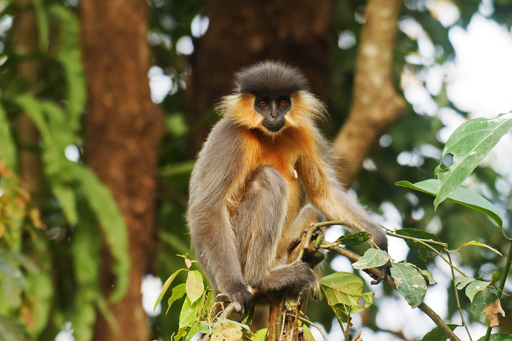
As Bangladesh is rapidly being urbanized, more and more forests are getting fragmented, resulting in the construction of more roads, which means more wildlife are being killed in collisions with vehicles. To address these wildlife deaths, the Forest Department’s Tangail Divisional Office has recently facilitated a low-cost solution. At a total cost of 625,000 takas (around $5,000), ropeway bridges have been installed in northern Bangladesh at five locations along an 8-kilometer (5-mile) stretch of the Mymensingh-Tangail Highway N401, which slices through the reserved forest of Madhupur National Park, where heavy-duty vehicles regularly collide with wildlife, especially primates. “These ropeways are expected to protect rhesus macaques, capped langurs, Indian civets and small carnivores like fishing cats from roadkill,” Tangail divisional forest officer Abu Naser Mohsin Hossain told Mongabay. According to a 2018 study, the 8,436-hectare (20,845-acre) Madhupur National Park, the largest deciduous forest of Bangladesh, supports 151 wildlife species belonging to 23 orders and 62 families. According to available data that the Forest Department has from local sources, rhesus macaques (Macaca mulatta) are most frequently killed in road accidents during the day. However, none of the roadkill in Madhupur can be documented, because the forest dependent Indigenous community here consumes the carcasses soon after an accident, said Md. Mossarrof Hosain, a deputy ranger at the Madhupur National Park. Naser said that the nylon-rope bridges are expected to provide safe aerial corridors for arboreal animals, both nocturnal and diurnal. Each is 30 meters (100 feet) long and almost 1-meter (3-feet) wide and…This article was originally published on Mongabay
From Conservation news via This RSS Feed.