

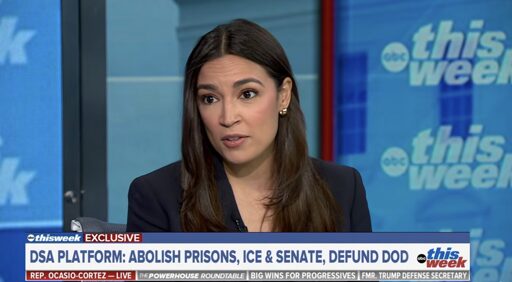
In the latest episode of “This Week,” ABC host Jonathan Karl confronted Alexandria Ocasio-Cortez (AOC) with a series of demands from the Democratic Socialists of America’s (DSA) recently adopted program: defund the Department of Defense, close U.S. military bases overseas, abolish the police and prison system, abolish the Senate, and establish public ownership of essential corporations and industries. Republicans have already seized on these positions to portray the socialist left as an existential threat; Democratic moderates, meanwhile, have launched their own 15 million dollar campaign against DSA organized through the group Third Way, warning that its growth represents a “mortal danger” to the party.
Karl asked AOC whether she supported the positions he had just listed. “No,” she answered. People were free to organize around such ideas, she said, but her job as an elected official was to guarantee healthcare and focus on the immediate economic problems facing working people.
What made the answer particularly striking was what she said only minutes earlier. Earlier that week, Abdul El-Sayed defeated Haley Stevens in Michigan despite heavy outside spending and backing from major sections of the Democratic establishment. Karl also presented DSA-backed Francesca Hong as the frontrunner heading into Wisconsin’s gubernatorial primary. These victories express a real shift to the left, but one still unfolding largely through Democratic primaries and therefore within the limits of a party tied to capital and U.S. imperialism. AOC does not treat that contradiction as something to overcome; she presents it as the path forward, turning socialist and progressive energy into a force for the “renewal” of the Democratic Party and its November coalition.
The contrast condenses one of the central contradictions facing the socialist movement today. Even as AOC tries to position herself on the side of Palestine — recently pledging during NYC-DSA’s re-endorsement process to oppose all U.S. military aid to Israel — she maneuvers around the broader anti-imperialist and anti-capitalist conclusions those struggles increasingly raise. DSA’s electoral victories register a real shift among workers and young people, but AOC proposes turning those forces toward the “renewal” of the Democratic Party, while the demands that most clearly exceed progressive liberalism become increasingly dispensable.
This shift in consciousness did not originate at the ballot box. The years since the first Sanders campaign have been marked by experiences that have repeatedly brought new layers into confrontation with institutions they were taught to regard as immovable: above all, the George Floyd rebellion and the mass questioning of the police. It was precisely in response to Karl’s reference to the 2020 demands to abolish prisons and the police that AOC dismissed the period by saying “Woke 1 was crazy” — reducing demands born out of a historic mass uprising to the excesses of a political discourse. The comment immediately provoked backlash from figures like Briahna Joy Gray and Alex Colston, who stressed that 2020 was not simply a moment of rhetorical radicalism but the product of millions entering the streets against racist police violence.
That process continued through a resurgence of strikes and union organizing, the movement for Palestine and its confrontation with bipartisan support for Israel and U.S. imperialism, resistance to ICE and deportations, the housing and cost-of-living crisis, and now the war with Iran, which has once again exposed capitalism’s recurring tendency toward war in defense of imperialist interests, whatever the human and social cost.
These struggles are beginning to register politically in DSA’s electoral advances, even as those advances remain mediated through the Democratic Party. AOC still confronts the establishment on important issues, but increasingly plays the role of managing the tensions between a radicalizing socialist base and the Democratic Party, seeking to contain those tensions within a project of party “renewal.”What it means to manage rather than deepen this contradiction is visible in AOC’s own electoral practice.
From Socialist Momentum to Democratic Party Revival
She entered Congress by defeating Joe Crowley, one of the most powerful Democrats in the House; eight years later, she now refuses to endorse some progressives attempting similar challenges. When she explained that “politics is also a workplace,” she was essentially saying that she does not want to antagonize her congressional colleagues — people like Hakeem Jeffries, who recently opposed cutting billions in U.S. military aid to Israel even as opposition to that aid has grown sharply among Democratic voters and within the party itself.
This is more than congressional pragmatism. AOC increasingly treats the aspirations expressed by movements for Palestine, healthcare, and stronger unions as a basis for rebuilding the Democratic Party’s authority. Her electoral ambitions toward 2028 are part of this project, but subordinate to the more immediate task of restoring the party’s credibility among layers radicalized over the past decade.
And this is happening precisely when the pressures are moving in the opposite direction. Even a Wall Street Journal op-ed warning that democratic socialism represents a danger to the country is forced to acknowledge the depth of the discontent feeding its appeal: fewer than half of Americans believe capitalism is working even relatively well, two-thirds believe the system is rigged in favor of the wealthy, and only one-third believe the American Dream is still alive.
Large sections of the population are questioning the two-party system, support for an independent or third party remains historically high, and Democratic voters have moved dramatically against unconditional support for Israel. These shifts do not yet constitute an independent working-class alternative, but they show that millions are asking questions that go well beyond the political horizon AOC offered in the interview. Those same pressures are beginning to register even in DSA’s program, which increasingly raises the Pentagon, public ownership, imperialism, and the undemocratic institutions of the regime more directly. The striking thing about AOC’s retreat is that it comes at a moment when the socialist movement has more room to push those questions further.
Taking DSA’s Radical Program Seriously Means Confronting Capital
This is where the controversy over DSA’s program becomes important — but not because the program itself offers a finished answer. It raises demands like defunding the Pentagon, public ownership, and dismantling undemocratic institutions without resolving how to build the independent working-class power capable of imposing them, or how to overcome the contradiction between a radical program and an electoral strategy still tied to the Democratic Party. But neither is it accidental that Republicans and Democratic centrists focus their attacks on precisely these demands. They begin to pose questions that ordinary progressive politics tries to avoid: not simply how government should distribute resources, but who controls those resources, what social interests the state defends, and whether institutions built to reproduce capitalist rule can be transformed without confronting the class power behind them.
In the middle of the war with Iran, the demand to defund the Pentagon is hardly abstract. Later in the same broadcast, Karl’s interview with former Defense Secretary Mark Esper turned to depleted Patriot and THAAD stocks and the push to accelerate weapons production. That discussion revealed what lies behind the Pentagon budget: not simply federal spending, but an entire military-industrial apparatus made up of arms manufacturers, finance, technology, vast supply chains, and workers whose labor is organized around the requirements of permanent war. If “defund the Pentagon” is to mean more than shifting numbers in a budget, it has to confront the material power that sustains that apparatus.
To fight seriously to dismantle the war machine means more than electing politicians with a less belligerent foreign policy. DSA’s program itself points toward nationalizing key industries, but that only sharpens the contradiction with a strategy centered on transforming the Democratic Party. How can the Pentagon be defunded and U.S. militarism dismantled without confronting the arms corporations, banks, and strategic industries whose private profits depend on it? And how can we oppose imperialism while leaving intact the debt, sanctions, and financial mechanisms through which the United States disciplines other countries? Taking these demands seriously points toward expropriating key corporations under workers’ control, converting military production toward social needs, and canceling the debts imposed on oppressed and dependent countries.
This is not about replacing immediate demands with the most radical possible slogan. It is about following those demands through to the obstacles they encounter. The fight against war runs into the military-industrial complex; Medicare for All runs into private insurers; housing struggles run into landlords and finance. Socialists distinguish themselves from progressives not by refusing to fight for healthcare, housing, wages, or peace, but by refusing to stop when those fights encounter the property and power of the classes that stand in their way.
This leaves us to square with the fact that achieving the demands in DSA’s Workers Deserve More program and going for more cannot be done by relying on electoralism and the means of the bourgeois state. AOC’s dismissal of the program as “academic” is proof enough of that; our demands — and even demands like universal healthcare that AOC herself is promising — will be won through struggle from below, through the creative organization of workers, together with students and activists determining their own path forward.
For years, the weakness of socialist politics in the United States could be invoked as an argument for adaptation and moderation: the forces were too small, the working class too disorganized, socialist ideas too marginal. DSA’s growth, the victories of insurgent candidates, the increased presence of socialists in labor, and the radicalizing experiences of the past decade show that this terrain has begun to change.
This makes AOC’s retreat all the more revealing. The greater influence she has accumulated has not become a lever for raising working-class political expectations, but another mechanism of adaptation to the Democratic Party and the imperialist state it serves. This is not merely an individual failure of nerve, but the predictable pressure exerted by a strategy that subordinates socialism to one of the principal parties of U.S. capitalism.
DSA has more members and electoral positions than it had in 2018 when AOC was elected, but that strength will not automatically produce greater independence so long as its electoral strategy remains tied to the Democratic Party. In fact, the 2021 crisis around Jamaal Bowman, Iron Dome, and Palestine already showed how remaining tied to the Democratic Party can generate disillusionment, internal crisis, and a crisis of membership.
On the other hand, if struggles against war, deportations, corporate power, and the cost of living are pushing people to question institutions that appeared untouchable only a few years ago, the task of a socialist movement is to develop those experiences toward an independent politics of the working class rather than translate them back into the limits of a party that exists to preserve the capitalist order. The task is therefore not simply to strengthen DSA as it exists, but to fight for the forces gathering around socialist politics to break from the Democratic framework and develop toward an independent politics of the working class.
This requires more than defending the radical phrases in a program. It requires building the social force capable of giving them content: workers organized independently in their workplaces and unions, movements organized from below capable of acting outside the electoral calendar, and a socialist organization whose representatives are subordinated to the struggles and program of that movement rather than to the class interests and institutions that stand against them.
This is the deeper significance of AOC’s interview. The emerging socialist movement in the U.S. itself has accumulated greater influence, while the struggle over what those forces will be used for has become sharper. Will that growing strength provide the Democratic Party with the left wing it needs to renew itself after years of crisis, while socialism is gradually reduced to a more “progressive” administration of the existing imperialist order? Or can the forces now gathering around socialist politics begin to break from that logic, developing the questions already posed by class struggle into an independent political movement capable of confronting capital and imperialism? AOC’s interview offers one answer. The growing base of the socialist movement makes another answer more possible than before.
The post AOC’s ABC Interview and the Fight Over What Socialism Will Mean appeared first on Left Voice.
From Left Voice via This RSS Feed.