

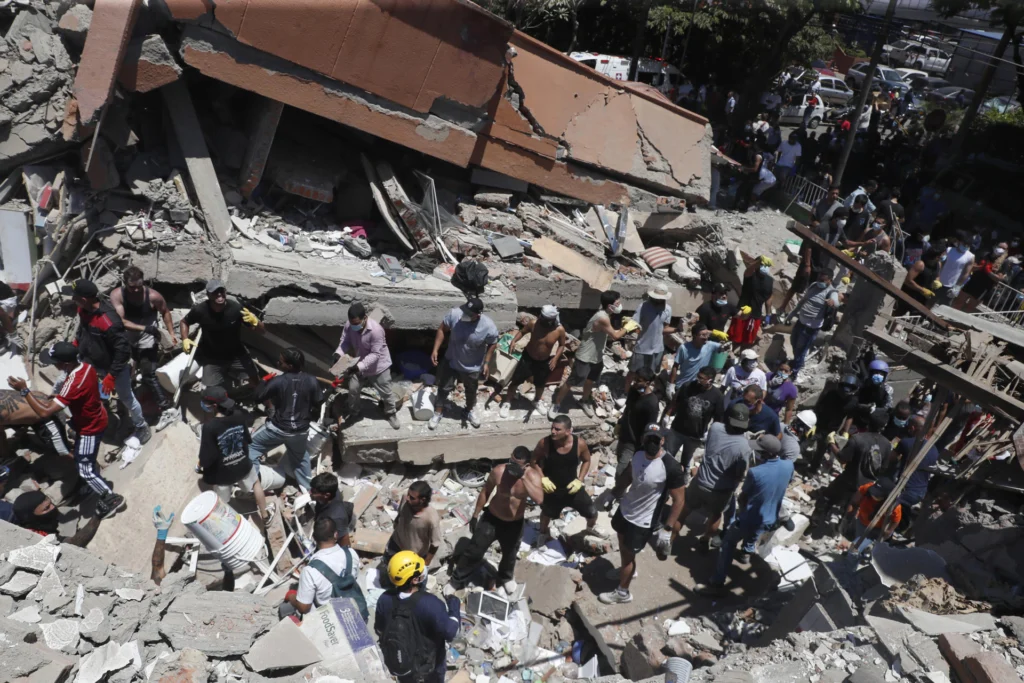
Colombia is coordinating the arrival of international rescue teams after a 7.4 magnitude earthquake struck the Pacific region, leaving 111 people dead and dozens of buildings collapsed across several departments.
The Government of Colombia activated its diplomatic channels to receive urgent technical and humanitarian assistance following the earthquake with its epicenter in Chocó.
President Abelardo De La Espriella assumed direct command from the unified command post, while the Military Forces began transporting medical supplies to isolated mountainous areas to assist affected communities.
RELATED: Colombia Declares National Disaster After Earthquake Kills at Least 111
The Colombian Association of Capital Cities consolidated the official death registry. According to Governor Juan Diego Patiño, Risaralda concentrated 40 fatalities, with 37 registered exclusively in Pereira, where Mayor Mauricio Salazar Peláez reported severe damage to multiple residences. Manizales added two deaths and 12 destroyed buildings in its urban area, while the National Unit for Risk Management documented one additional death in Quibdó.
Mayor Alejandro Eder confirmed the collapse of 30 structures in Cali, another of the most affected cities. The municipal administration documented damage to seven healthcare centers in the capital of Valle del Cauca, forcing doctors to transfer intensive care patients to clinics with certified structures.
#AEstaHora I Desde la Sala de Crisis Nacional de la UNGRD, inicia el Comité Nacional para el Manejo de Desastres, presidido por el presidente de la República, Abelardo de la Espriella, para analizar las afectaciones ocasionadas por el sismo registrado en la mañana de este lunes… pic.twitter.com/5BbLyTWNyy
— UNGRD
(@UNGRD) August 10, 2026
Text reads: “From the National Crisis Room of the National Disaster Risk Management Unit (UNGRD), initiates the National Committee for Disaster Management, chaired by the President of the Republic, Abelardo de la Espriella, to analyze the impacts caused by the earthquake recorded on the morning of this Monday, August 10 and define response actions. From this space are articulated the capacities of the National System for Disaster Risk Management (@SNGRDColombia) to deploy and coordinate the necessary aid at national level, in attention to affected communities and territories.”
Central authorities deployed 16 specialized units to inspect compromised foundations without machinery. These technical groups evaluated the physical stability of the city’s most densely populated sectors. For its part, La Alameda neighborhood reported a residential collapse with occupants trapped in the basement next to a vehicle.
The Colombian Geological Survey located the main rupture of that earthquake in the subduction of the Nazca plate. The constant friction between these continental masses accumulated energy and released it through abrupt failures. The entity recorded a 4.6 magnitude replica in Nóvita minutes after the main event. Another 4.8 magnitude movement shook San José del Palmar at 88 kilometers deep.
Ver esta publicación en Instagram
Una publicación compartida de teleSUR English (@telesurenglish)
Regional Solidarity Grows
The structural collapse of buildings also paralyzed regional air connectivity. The Alfonso Bonilla Aragón Airport suspended operations, and six additional terminals closed their runways. This logistical interruption forced emergency teams to travel roads with landslides toward the Pacific coast. For its part, aviation regulators assessed damage to control towers before authorizing reopenings.
Following this, the Foreign Ministry opened diplomatic channels to channel external assistance amid this geological and logistical emergency.
Venezuela expressed deep solidarity and fraternity with the Colombian people and offered its civil protection mechanisms to support rescue efforts on the shared border, reinforcing cooperation ties between sister nations of the region.
The Cuban government offered full medical and technical readiness to treat the injured, meanwhile President Luiz Inácio Lula da Silva expressed concern from Brasilia over the magnitude of the disaster and confirmed Brazil’s logistical support for the families of the victims. “I express my solidarity with the Colombian people, especially the families of the victims and all those affected by the tremors. Brazil remains at the disposal of Colombia to provide the necessary support,” Lula said.
“We offer you our USAR team: 47 rescuers, specialized dogs and teams with autonomy to operate for 7 days. We are ready to mobilize when required,” the Ecuadorian President Daniel Noboa offered.
In the same vein, El Salvador President Nayib Bukele said that he was closely following the aftermath of the powerful earthquake. “Our prayers are with the families of those who lost their lives, with the wounded and with all the Colombians who are going through difficult times today”, he wrote on his social media. “Colombia has emergency and rescue teams in the affected areas, and we trust their ability to respond to this emergency. However, from El Salvador we are in communication and ready to immediately support with our rescue teams, doctors, paramedics, supplies or any other help that our Colombian brothers consider necessary”, he added.
The Andean Community, which includes Bolivia, Colombia, Ecuador and Peru, issued a statement in which it affirmed that the cooperation mechanisms for disaster relief have already been activated.
Ver esta publicación en Instagram
Una publicación compartida de teleSUR English (@telesurenglish)
The Mexican government contacted Bogotá to send structural engineers. President Claudia Sheinbaum reiterated the availability of her experienced urban rescue brigades. Mexican officials confirmed the absence of affected nationals.
For her part, the governor of Puerto Rico, Jenniffer González, also offered support. “We will be attentive and available to collaborate, within our capabilities, in everything that can contribute to the recovery of our Colombian brothers”, she said.
The Latin American nations applied regional integration protocols to accelerate the deployment of foreign contingents, demonstrating that solidarity and cooperation remain the strongest response to natural disasters in the region.
From teleSUR English via This RSS Feed.