

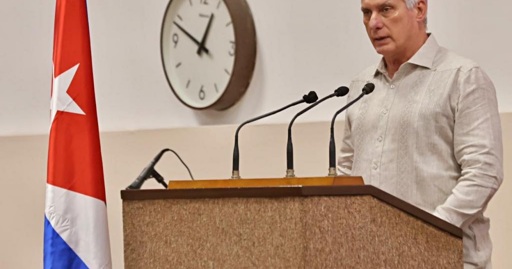

Cuban President Miguel Díaz-Canel delivered a forceful closing address to the 24th International Meeting of Communist and Workers’ Parties (IMCWP) in Havana, denouncing the deepening crisis of capitalism, the resurgence of fascism, the U.S. economic war against Cuba and the urgent tasks facing the international communist movement.
Speaking in the context of the centenary of Fidel Castro’s birth, Díaz-Canel described Cuba as an “island of dignity and historical resistance” against imperialism and fascism, warning that humanity is passing through one of its most uncertain and dangerous periods in decades.
The Cuban leader pointed to the extreme sharpening of capitalism’s contradictions: the concentration of wealth in fewer hands, widening inequality, environmental destruction and wars over markets, resources and spheres of influence. He stressed that Marxist-Leninist analysis retains its full validity precisely because these crises are not accidents, but consequences of the laws governing monopoly capitalism and imperialism.
Díaz-Canel linked this reality to the wars in Eastern Europe and the Middle East, the genocide in Gaza, structural hunger, the climate crisis and the crushing external debt imposed on the peoples of the Global South. At the same time, he sounded the alarm over the re-emergence of fascism, expressed through racial supremacy, xenophobia, territorial conquest, population displacement, ideological persecution and attacks on civil liberties.
A major part of his speech was devoted to Washington’s economic war against Cuba.
Díaz-Canel described the U.S. blockade as a policy of collective punishment intended to exhaust the Cuban population, generate despair and social fracture, and ultimately destroy the country’s socialist project. He branded as “criminals and fascists” those who design an energy siege against an entire nation while knowingly depriving its people of medicines, food, electricity, water, transportation and other basic necessities.
He presented stark figures on the blockade’s impact. Cuba, he said, has around 1,400 megawatts of distributed electricity-generating capacity standing idle for lack of fuel, turning what could otherwise be three-hour blackouts into outages lasting twenty hours or more. He added that 98,500 patients are awaiting surgery, among them 12,000 children, while tens of thousands of cancer patients face inadequate access to treatment and only 30 percent of the country’s basic medicines are currently available.
Ambulance availability, he said, has fallen to just 22 percent, while Cuba’s infant mortality rate, once consistently between four and five per thousand live births, has risen above 9.8.
Calling the blockade a “meticulously calculated genocide,” Díaz-Canel said that whenever a possibility of relief emerges, Washington seeks to tighten the noose once again. The Cuban population, he argued, is treated as an instrument to be pushed toward desperation and revolt against its own government — an objective that, he stressed, has been embedded in U.S. policy for more than six decades.
The Cuban president also accused Washington of conducting a high-intensity unconventional war through digital subversion, financing of internal mercenaries, media campaigns and influence operations presented under the guise of “humanitarian aid.” He pointed to recent reports of increased CIA operations against Cuba, describing them as part of a deliberate campaign of psychological warfare.
Referring to recent statements by the U.S. Secretary of State that sanctions against Cuba would continue to tighten and that there would be “no escape valves,” Díaz-Canel said such language amounts to an open acknowledgement of the intention to deepen the suffering caused by the economic war until the Cuban people submit.
He also ridiculed Washington’s accusations portraying Cuba as a center of espionage or “radical left terrorism.”
“Cuba does not have to indoctrinate anyone. It does not have to export ideas. History is what teaches lessons.”
History itself, Díaz-Canel argued, demonstrates how far imperial powers are prepared to go in pursuit of domination and control over the material and human resources of other nations.
The Cuban leader reserved sharp criticism for those governments, companies and political forces that submit to Washington’s pressure.
“The blockade of the United States only works because of the complicity of those who fear Washington’s power more than the judgment of history” he said, warning that every government which accepts illegitimate U.S. sanctions weakens the principle of non-intervention and every company driven away from Cuba by fear of retaliation strengthens what he called the “economic dictatorship” of a single power.
Díaz-Canel further warned of a revived McCarthyism with an increasingly international reach, aimed not only at Cuba but at criminalizing solidarity, silencing dissent and attacking those who challenge the global order imposed by imperialism. He rejected the portrayal of the left as a threat to humanity, stressing that progressive forces stand for social justice, workers’ rights, equality, peace, environmental protection and international solidarity.
“Only fascism can see such a danger in the left”, he declared.
Referring to Gaza, Venezuela and Cuba, Díaz-Canel warned that no people can afford indifference in the face of imperialist aggression and fascist reaction. “Tomorrow any nation can end up being Gaza or Cuba if fascism is not confronted,” he said, arguing that the decisive answer lies in popular consciousness, mobilization and international unity.
Despite enormous shortages, Díaz-Canel insisted that Cuba has not capitulated. The Cuban people’s response, under the leadership of the Communist Party, has been one of “firm and creative resistance,” defense of the Revolution’s achievements and adaptation to enormously difficult conditions without abandoning socialist principles.
Addressing Cuba’s economic reforms directly, the president rejected any suggestion that they amount to capitalist restoration. The changes, he stressed, are intended to dynamize the economy, “not to establish capitalism.” There will be no wholesale privatization, the fundamental means of production will remain in the hands of the people, and national sovereignty and the social achievements of the Revolution will be preserved.
The Communist Party of Cuba, he added, remains responsible for guiding and controlling this process and must continue to act as the guardian of the interests of the people, the working class and social justice.
Díaz-Canel then delivered one of the most categorical ideological statements of his address: “Socialism remains the only realistic and humane alternative to capitalist barbarism.”
He connected this conclusion directly to scientific Marxism and rejected the capitalist claim that no alternative social order is possible.
Invoking Fidel Castro’s legacy, Díaz-Canel stressed that Marxism-Leninism cannot be treated as a “dead doctrine” or a catechism, but as a living method and instrument for addressing concrete problems.
The final section of the speech was directed squarely at the international communist movement.
Díaz-Canel urged communist and workers’ parties to move beyond declarations and take a “qualitative leap” in international coordination. He called for effective networks of solidarity, stronger action against the blockade of Cuba, efforts to break the media siege surrounding Cuba and Palestine, mobilization in trade unions and social movements, and deeper theoretical work on socialism under the new conditions created by digitalization, changing forms of work and the ecological crisis.
He also issued a clear call for self-criticism.
“It is not enough to condemn the empire.”
Communists, he said, must build popular power from below, win the streets, neighborhoods, factories and schools, and organize, politicize and mobilize the working class under the complex conditions of contemporary capitalism. Unity, he emphasized, cannot mean uniformity, but rather a common determination to struggle and win.
The Cuban president called on communist parties to act as a genuine vanguard not merely in elections or institutions, but above all in the organization and mobilization of workers and popular sectors. He urged the strengthening of the international communist movement while maintaining strategic clarity against imperialism, fascism and monopoly capital.
“Despite the military power of the United States, the international communist movement is not intimidated; it resists and stands its ground”, Díaz-Canel declared.
Calling for renewed international action in defense of Cuba, he presented that struggle as inseparable from resistance to racism, xenophobia, supremacism, colonialism and imperial domination.
“Let us not settle for surviving,” Díaz-Canel told the delegates. “Let us aspire to build together a world where the word ‘solidarity’ is not an ornament, but the driving force of everything.”
The meeting closed with calls of “Hasta la victoria siempre!”, “Long live Fidel!”, “Long live the unity of the communists!” and “Long live the struggle of our peoples!”.
From In Defense of Communism via This RSS Feed.