

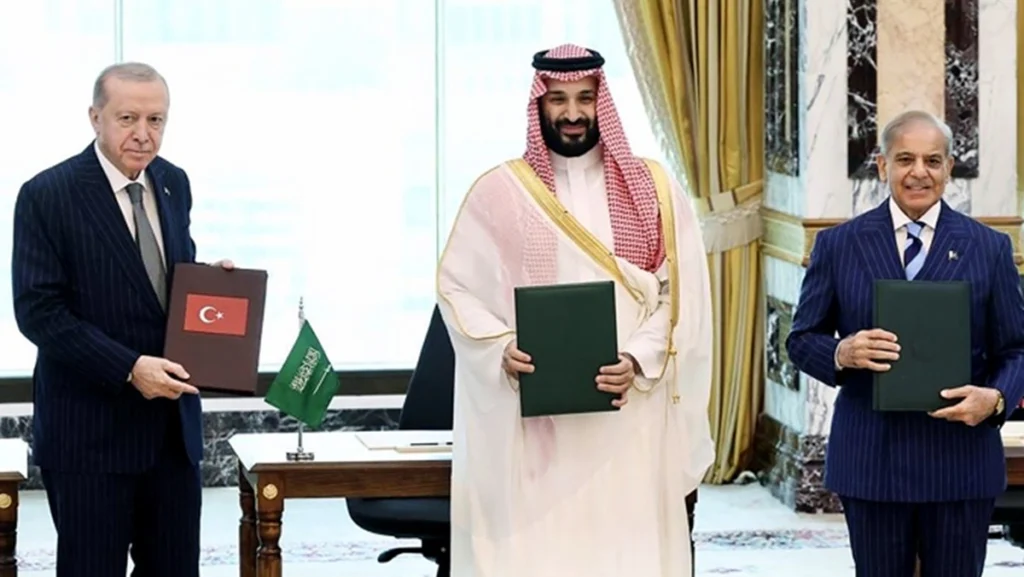
Tehran Says It Has No Reason for Concern, While Pakistan Stresses Pact Is Not Directed Against Any Country.
On Monday, Iranian Foreign Ministry spokesperson Esmaeil Baghaei said the newly signed trilateral defense deal between Türkiye, Saudi Arabia and Pakistan indicates a shift in regional security perceptions.
RELATED:
Iran Rules Out U.S. Negotiations as Long as Washington Violates Memorandum
He made the remarks at a weekly news conference in the Iranian capital, Tehran, while commenting on Iran’s stance and strategy toward the “Makkah Joint Defense Agreement” signed in the Saudi city of Makkah on Friday.
“This development is a sign of a change in the perception of the countries of the region. Given the developments over the past two or three years, regional countries have realized that security is not a commodity that can be purchased from dealers of false security,” Baghaei said.
He emphasized that Iran sees no reason to be concerned about the deal, given its “deep” religious, historical, and civilizational bonds with each of the deal’s signatories.
Historic Makkah Joint Defence Agreement
Three Nations. One Faith. One Shield of Peace. #SaudiPakistanTürkiye pic.twitter.com/lHYtjiqUlZ— Government of Pakistan (@GovtofPakistan) August 9, 2026


The Makkah Joint Defense Agreement stipulates that any armed attack against one of the three countries would be considered an attack against all of them. The timing of the signing has been widely seen as inseparable from the heightened tensions in the Middle East.
On Saturday, Pakistani Foreign Minister Ishaq Dar said the Makkah Joint Defense Agreement “remains open to any country in the region willing to defend its fundamental principles and resolve differences through mutual respect, cooperation and peaceful means.”
He also confirmed that the treaty establishes that “any external armed attack against any of the three countries will be considered an attack against all,” in accordance with the right to self-defense established in Article 51 of the United Nations Charter.
However, Dar emphasized that the trilateral agreement “is not directed against any country,” but is the culmination of years of discussions to address regional security challenges. He also clarified that its entry into force does not annul or replace any other existing bilateral or multilateral commitments.
teleSUR/ JF
Sources: EFE – Xinhua
From teleSUR English via This RSS Feed.