

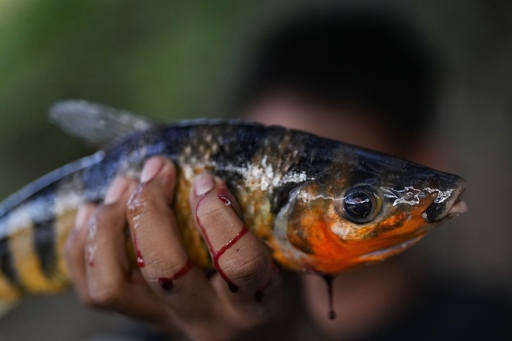
This is the second story in a special three-part series on microplastics in the Amazon. Read the first part here. MANAUS, Brazil — In Amazonian waters, the pirarucu lives between two worlds. In the oxygen-depleted waters typical of floodplain lakes, this giant fish rises to the surface to breathe air. Over an evolutionary history spanning at least 100 million years, it developed a modified swim bladder that functions as a primitive lung. This rare adaptation has allowed it to thrive in environments that are too harsh for other fish species. Today, however, the very adaptation that ensures its survival makes it vulnerable to a new threat: Microplastic pollution. “Amazonian environment is already highly challenging,” said Adalberto Val, a biologist and head of the National Institute of Science and Technology for Adaptations of Aquatic Biota of the Amazon (INCT-Adapta). “Here we have high temperatures, low oxygen levels in the water … Organisms already respond to these challenges as they learned during the evolutionary process. Then we start adding new challenges, like plastic.” When breathing becomes a risk Pirarucus (Arapaima gigas) cannot survive for more than 10 minutes without surfacing for air. They rely on an air-breathing organ connected to their modified swim bladder, a necessity that puts them in direct contact with microplastics floating at the surface. Drawing on established knowledge about the species, Val and researchers from the University of British Columbia in Canada published an article outlining the dangers of this exposure. When microplastics enter the pirarucu’s air-breathing organ,…This article was originally published on Mongabay
From Conservation news via This RSS Feed.