

Bullets:
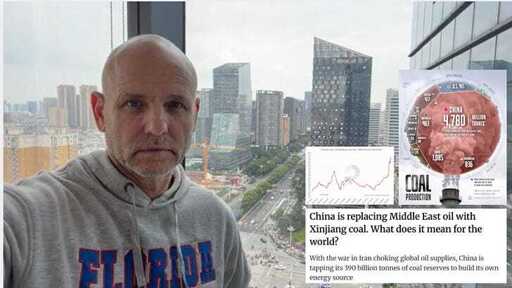
Analysts are confounded that the severely negative impacts to China’s energy and food stocks have not materialized, after months of Middle East war.
But China was far better prepared to handle disruptions in key supply chains than most understood.
Energy shipments from the Persian Gulf to China continue, along with imports from Russia and Brazil.
China has also developed vast capacity in coal-to-liquids technologies, that allow for conversion of their massive coal reserves into fuel, plastics, and fertilizers.
That industry now yields millions of tons of liquefied coal products every year, and even allows for high volumes of urea exports to friendly countries.
Inside China / Business is a reader-supported publication. To receive new posts and support my work, consider becoming a free or paid subscriber.
Report:
Good morning.
We got an email last week from Rich Beil, who is retired from the Marine Corps. And LTC Beil points out a problem here that Western experts have missed. Conventional wisdom is that China is dependent on the flow of oil from the Persian Gulf to keep the lights on. And it’s only because China has enormous stockpiles of crude already socked away, and which are now being drawn down, that they can keep the trucks on the road and the planes in the air.
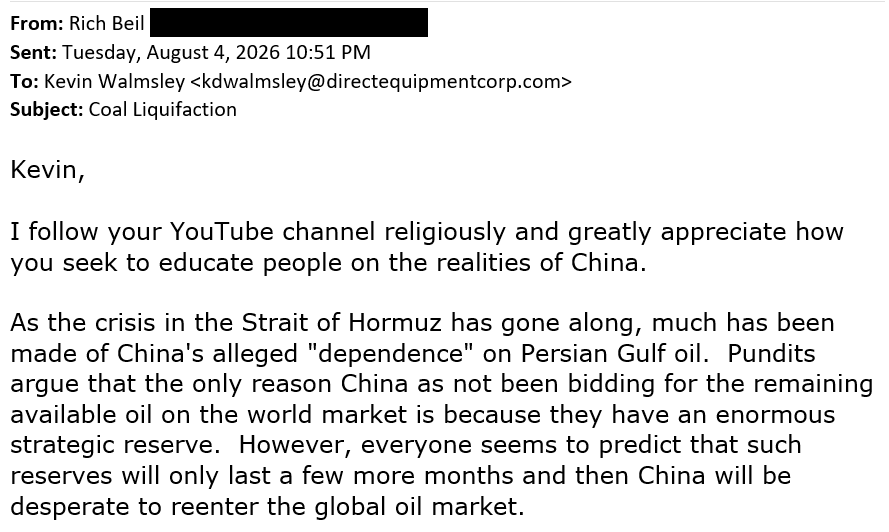
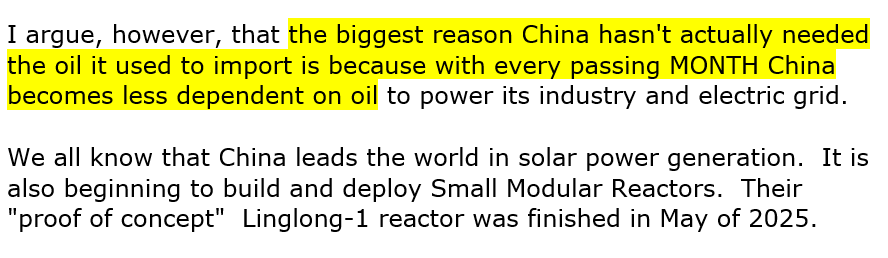
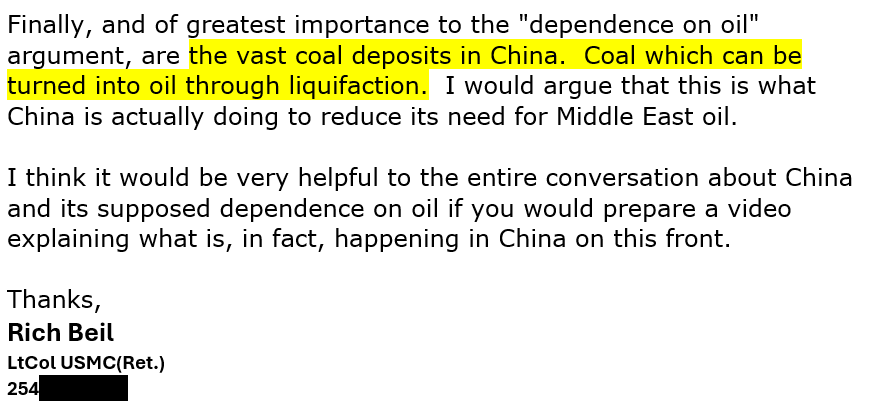
But that will end soon enough. He is arguing, instead, that China is probably not nearly as reliant on Middle East energy as most believe, and it might be that Chinese advances in coal liquefaction are displacing energy imports.
His message came at a good time, now that we can step back and assess why things that turned out very differently than policymakers in Washington or the Pentagon had planned for. It is true that half of China’s oil imports go through the Strait of Hormuz, and these analysts from Columbia University are pointing to China’s oil stockpiles as a buffer that can last 120 days while the Hormuz is closed off.
But the war has lasted longer than that. Now we do understand that the Strait of Hormuz was shut to almost everyone, except China. Chinese tankers were allowed to pass through. The Houthis closed the Red Sea and the Suez transits – again – yet Chinese ships were allowed passage there too. So Europe is running low on energy, and other countries here in Asia immediately were rationing fuel, but China’s refineries always had crude cargoes on the water, enroute here.
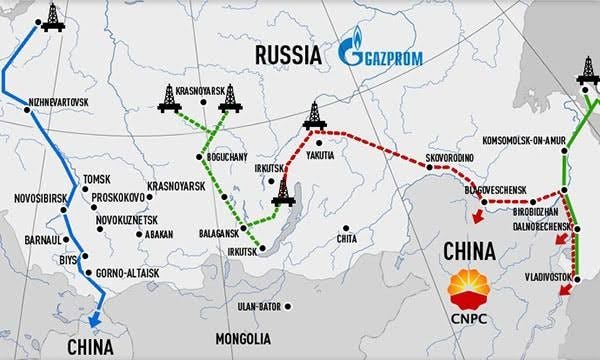
China and Russia also do a lot of energy trade that is outside our banking systems, and our analysts can only make educated guesses as to what the volumes of those imports are. The pipelines and terminals, though, are enormous, and as those came online China’s dependency on the Middle East would have fallen still more, as more energy can be sourced from fields in Russia:
But China is not content with swapping one dependency with another, and the objective of Beijing’s Five-Year Plans is to build self-sufficiency just about everywhere, and particularly so in food and energy. China doesn’t have nearly enough crude oil, so they are hard at work to exploit the other resources that they do have. The war on Iran is “an unprecedented opportunity” for the Chinese coal industry. The Zhundong Development Zone is in Xinjiang, and is one of four primary bases for coal to chemical production, which involves converting coal into liquid fuels, gas, plastics, and fertilizers. The war is a “window”, an opportunity to pivot China’s energy sector from one that is built on oil, to one that is based on coal.
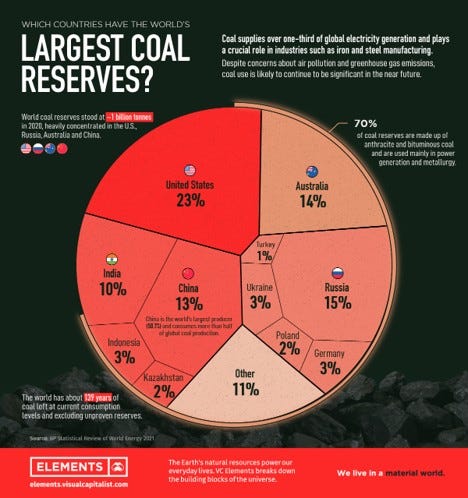
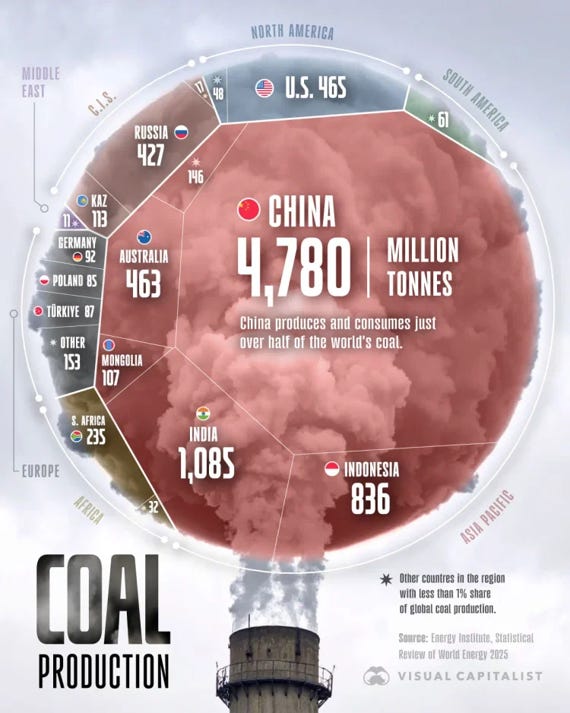
This is a long-term effort by China, begun decades ago. China has a lot of coal; 13% of the world’s proven reserves of coal are here. Only the United States, Russia, and Australia have more. But China’s production and consumption of coal is more than the rest of the world, combined, at 4.7 billion tons per year:
China also has a deeply developed coal liquefaction industry. This report is from 2010, and Chinese engineers had by then already performed over a decade’s worth of Research and Development in the liquefaction of coal. “Coal to Liquid” breaks down the molecules of coal, then adds hydrogen to build liquid products. There are other giant centers for that CTL industry here in China—besides Xinjiang, they’re active in Ningxia and in Inner Mongolia.
Coal already provides vast power supplies; just that one field in Xinjiang is sufficient to meet Chinese electricity demand for a hundred years. But China is doing a lot more with that coal than just hauling it out of the ground, and setting it on fire to make electricity. They’re liquefying it and making other critical products that previously came from oil, sourced from somewhere else.
To make that possible, just having a lot of coal in the ground isn’t enough. China also needs hundreds of thousands of top scientists and engineers, who are trained in geosciences and chemical engineering. So they built the institutions for that. These are the global rankings from the US News and World Report for geology, petroleum geology, geophysics–China has 2 of the top 3 universities in the world, and 7 of the top 10.
Best Global Universities for Chemical Engineering: Chinese universities are 10 out of the top 10. China is 20 out of the top 20. Scrolling down, there is MIT, sandwiched in between Tianjin Polytechnic and Qingdao University of Science and Technology:

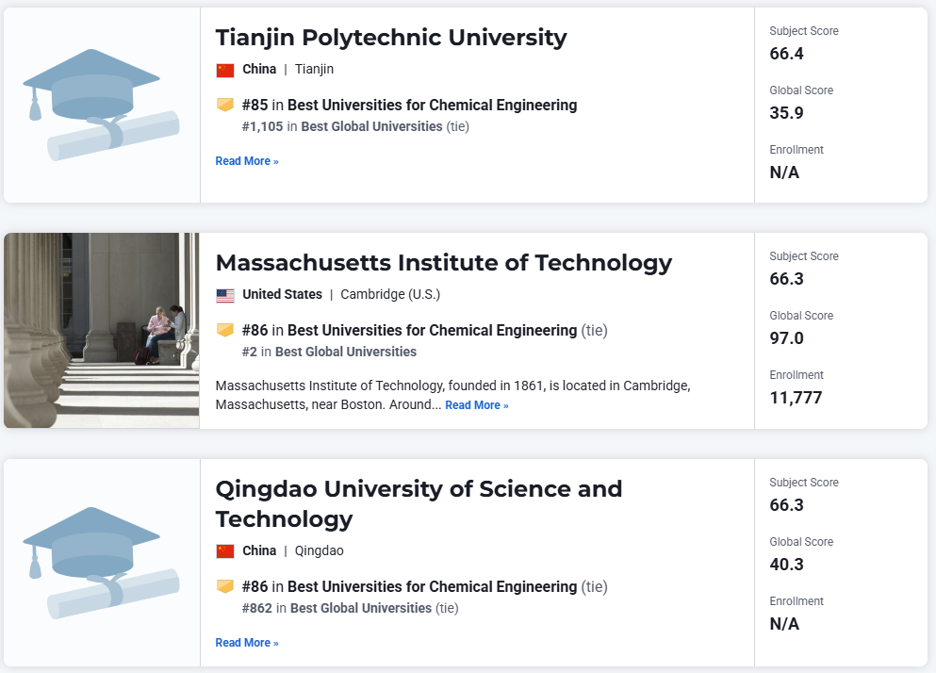
We’ll leave it up to parents to decide if it’s worth $92,000 per year to send your kids to the 86th best Chemical Engineering program in the world, and what jobs might be waiting for them after graduation, given that the world’s chemical industries have mostly already moved to China.
Today, China’s Coal-To-Liquids Industry today yields millions of tons a year, and all those hundreds of thousands of graduates from dozens of universities and decades of heavy investment in CTL, mean there are large moats—cushions—against disruptions in China’s energy supply chains.
Coal liquefaction allows for industrial-scale production of plastics, and other chemical engineers have learned that the chemistry of coal lends itself to breakthroughs in medicine and pharmaceuticals.
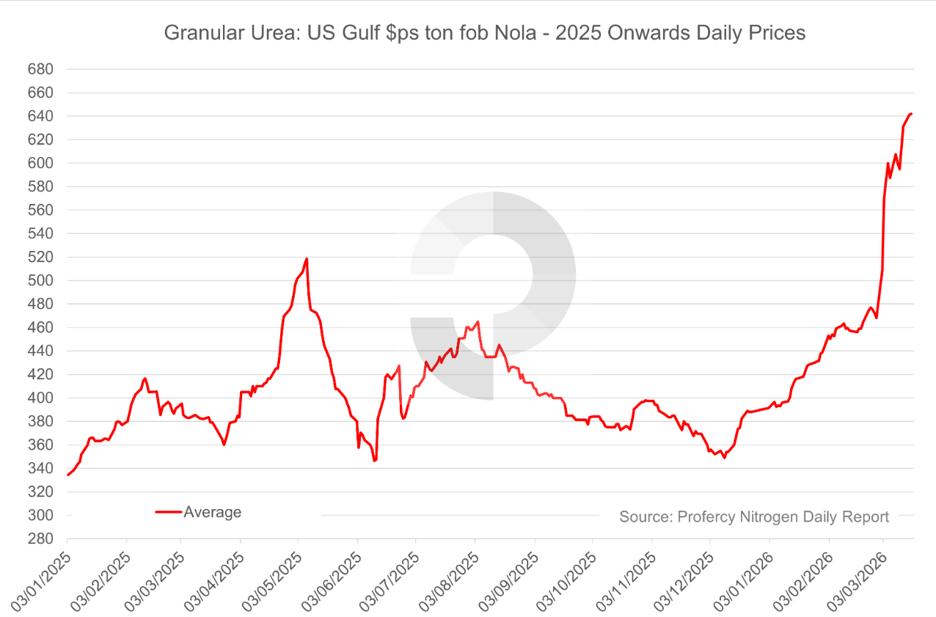
But we’ve also learned that Chinese coal is being transformed into fertilizers. In the opening days of the war, Iran blew up the Ras Laffan refinery in Qatar with missiles and drones. That immediately took down over 5 million tons of urea, which is over 10% of the world’s demand. Qatar canceled outstanding fertilizer contracts, and Urea prices went vertical:
But in China, fertilizer prices held steady. Russia and the Middle East use oil and natural gas to produce urea. But 80% of China’s urea is sourced from domestic coal, and China also exports 5 million tons of urea a year, including to India and Brazil.
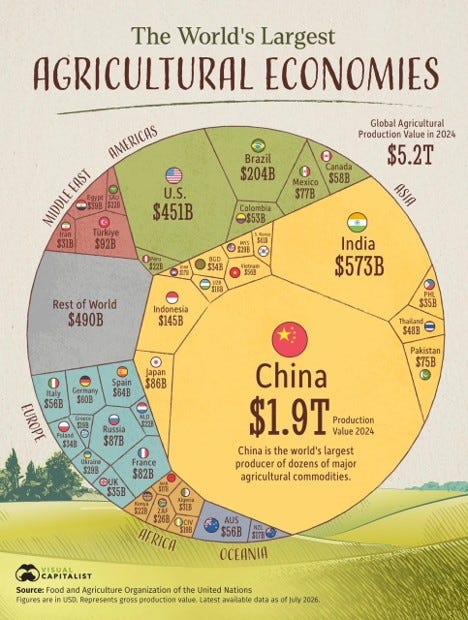
In other words, the BRICS bloc has again created a closed loop, and nobody noticed. China is the world’s largest producer of food, and Chinese farms are dependent on urea fertilizers, which now come mostly from domestic coal. India is the world’s second biggest farming economy. Brazil’s is the biggest in South America.
Under the radar, quietly, China’s coal industry produces the fertilizers sufficient for their own farms, with enough left over to export as much urea as Qatar previously did. Much of that is shipped over to farmers in Brazil, to grow food that is sent right back here.
Be Good.
Inside China / Business is a reader-supported publication. To receive new posts and support my work, consider becoming a free or paid subscriber.
From Inside China / Business via This RSS Feed.