

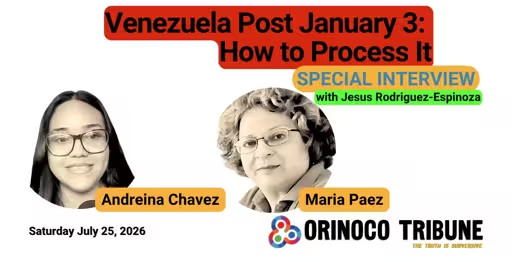
Caracas (OrinocoTribune.com)—Venezuelan journalist Andreína Chávez Alava and sociologist María Páez Victor rejected allegations that Acting President Delcy Rodríguez and the Chavista leadership betrayed President Nicolás Maduro following the January 3 US attack, arguing that the theory ignores both Venezuela’s coercive circumstances and the position of the Chavista popular base.
During a special Orinoco Tribune interview hosted by editor Jesús Rodríguez-Espinoza, the participants distinguished legitimate criticism from calls—frequently issued from abroad—for Venezuelans to abandon their leadership. Rodríguez-Espinoza warned, however, that the argument of a strategic retreat cannot become indefinite: Chavismo must preserve its anti-imperialist character and the unity of its base, particularly if Washington eventually forces an election under occupation-like conditions.
Extortion, not treason
Chávez said any analysis must begin with US military encirclement, control over Venezuelan oil exports and revenues, and the standing threat of renewed bombing. She cited a Financial Times calculation that Washington had collected more than $13 billion from Venezuelan oil sales, while Venezuela initially confirmed receiving only $300 million through the US-controlled arrangement.
Páez Victor rejected the word “cooperation” for this relationship. “This is extortion,” she said, noting that Washington holds Venezuela’s oil income while keeping President Maduro and First Lady and Congresswoman Cilia Flores hostage. She challenged accusers to present a viable “Plan B” that would not amount to collective suicide in the face of overwhelming force.
She also recalled Rodríguez’s revolutionary formation and the murder of her father, Jorge Antonio Rodríguez, under the pre-Chávez political order. Chávez added a political argument: Rodríguez’s stated objectives—strengthening production, reducing import dependence, defending sovereignty and maintaining Chavista unity—follow the program Maduro outlined before his kidnapping, rather than representing a new pro-US project.
Both speakers argued that Washington kept the Chavista state intact because its regime-change operation failed. It could not govern Venezuela through María Corina Machado or another opposition figure lacking a comparable mass base. US oil interests required stability, and Chavismo remained the only force capable of providing it.
The base supports—and criticizes—the leadership
Speaking from Caracas, Chávez said she had seen no evidence that the Chavista base considers Rodríguez a traitor. Communes, communal councils, social movements and popular leaders reject calls to divide Chavismo or declare war on its political leadership. They understand the Venezuelan government as a necessary barrier against the destruction Washington has inflicted elsewhere, even while rejecting specific decisions.
This critical unity was visible after the controversial visit of an “Israeli” delegation following the June 24 earthquake. Chávez called the visit a mistake and “a heavy blow” for Chavistas committed to Palestine, but rejected claims that it proved the Venezuelan government had embraced Zionism.
She pointed to the Anti-Imperialist Front’s demonstration in Caracas, where participants burned US and “Israeli” flags and images of Trump, Marco Rubio and Benjamin Netanyahu while declaring solidarity with Palestine, Iran and Cuba. The Front’s founding document rejects the claim that Rodríguez is a traitor and opposes calls for Chavistas to turn against the Venezuelan government.
The protest, Chávez stressed, was criticism from within the Bolivarian process—not an uprising against it—and took place freely because Venezuela retains an anti-imperialist government.
The earthquake response supplied another rebuttal to depictions of Venezuela as a failed state. Páez Victor highlighted the coordination of communes, PSUV brigades, communal councils, the popular militia and the civic-military union. Rather than social collapse, she argued, the catastrophe exposed the organizational and solidaristic culture built during 26 years of Bolivarian Revolution.
Solidarity or external tutelage
The interviewees differed most clearly over international activists’ right to criticize. Chávez recognized their right to criticize Venezuela—or even distance themselves—but drew a line at ultimatums and instructions to overthrow the Chavista leadership. Such behavior violates the same principle of non-intervention the international left claims to defend and reproduces imperial assumptions that foreigners know better than Venezuelans.
Her recommendation was to follow the line demonstrated by Venezuela’s popular movements: support the Venezuelan government while criticizing decisions that merit rejection, and keep the principal enemy in view—the US empire enforcing the blockade, controlling oil revenue and threatening further war.
Páez Victor adopted a harder position. She said this is not the moment for outsiders to criticize a leadership facing existential coercion, but for active international pressure: demand the immediate release of Maduro and Flores, end the sanctions, return Venezuela’s seized assets and gold, and remove US forces from the country.
Venezuela: Political Leaders Call for Inclusive and Sovereign Dialogue
Rodríguez-Espinoza closed by combining both positions: international allies may understandably be confused as events move rapidly, just as Venezuelan Chavistas themselves confront uncertainty. Confusion, however, does not justify destructive social-media attacks stripped of context. Solidarity activists should examine what they have failed to do in their own countries to restrain imperialism—and direct their pressure there.
Special for Orinoco Tribune by staff
OT/JRE/XX
From Orinoco Tribune via This RSS Feed.