

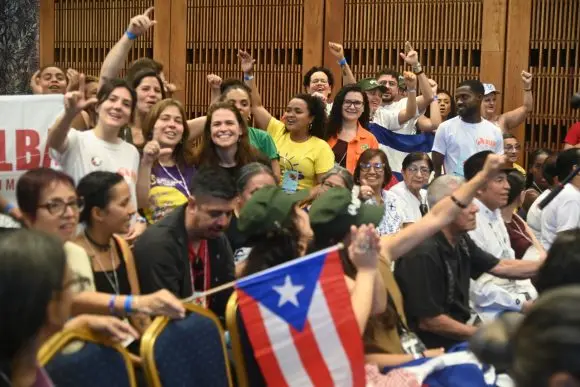
ALBA Movimientos Assembly concludes in Havana with 190 delegates from 27 countries debating socialism, regional sovereignty and the rise of the far right.
Related: ALBA Movements Reaffirm Socialist Commitment at Havana Assembly
ALBA Movimientos Assembly Concludes in Havana
The ALBA Movimientos Assembly concluded in Havana on Sunday after bringing together 190 delegates from 27 countries and representatives of more than 400 popular organizations.
Held in Cuba for the first time, the fourth continental assembly focused on the current geopolitical situation, the rise of the far right and the advance of what organizers described as neofascist forces across the region and the world.
The event took place from August 6 to 9 under the slogan “For Socialism, One Hundred Years Walking With Fidel,” a reference to the centenary of the birth of Cuban revolutionary leader Fidel Castro.
The gathering was organized by ALBA Movimientos, a continental platform that brings together social and popular organizations from Latin America, the Caribbean, the United States and other regions.
The opening activities took place at the University of Havana, while Cuban President Miguel Díaz-Canel Bermúdez later received the delegates at the Palace of the Revolution.
During the official reception, Díaz-Canel thanked the participants for traveling to Cuba and expressing solidarity with the island amid increasing pressure from the administration of US President Donald Trump.
“Thank you for being in Cuba and with Cuba,” Díaz-Canel told the representatives, emphasizing the political significance of their presence.
The Cuban government presented the meeting as an expression of international support for the country and its Revolution. Organizers, meanwhile, described the assembly as a space for coordinating popular struggles and developing a common political agenda.
According to the organizers, the workshops and discussion panels sought to update common struggles, formulate strategic proposals toward a socialist horizon and strengthen the political position of the Latin American and Caribbean left.
The assembly also examined the international economic and political crisis, the role of social movements and the challenges facing governments and organizations that oppose neoliberal policies.
The meeting concluded at a time of heightened tensions between Washington and several Latin American and Caribbean governments. Cuban authorities have repeatedly denounced the US blockade and what they describe as a broader campaign to isolate the island economically and politically.
The assembly’s presence in Havana was therefore presented not only as an organizational event but also as an act of solidarity with Cuba.
ALBA Movimientos Assembly Sets Regional Agenda
ALBA Movimientos | Cuban News Agency
The ALBA Movimientos Assembly served as a platform for discussion among organizations working in areas such as labor rights, food sovereignty, rural development, anti-imperialist mobilization, feminism, Indigenous rights and environmental defense.
The platform is linked to the political and social project associated with the Bolivarian Alliance for the Peoples of Our America, or ALBA. That initiative was promoted by Cuban leader Fidel Castro and Venezuelan President Hugo Chávez as an alternative to US-led integration projects.
ALBA Movimientos operates independently of governments, although it maintains relationships with political authorities and regional integration initiatives. Its central objective is to promote popular participation and coordination among social organizations.
The fourth assembly addressed the crisis of capitalism, the expansion of the far right and the political consequences of global conflicts. Organizers argued that social movements must develop strategies capable of responding to economic inequality, political polarization and foreign intervention.
The meeting also examined what participants described as a new version of the Monroe Doctrine. The phrase “Monroe Doctrine 2.0” was used in the assembly’s agenda to refer to renewed efforts by the United States to influence political developments in Latin America and the Caribbean.
Delegates discussed how sanctions, trade restrictions, diplomatic pressure and security agreements affect the sovereignty of countries in the region.
The issue was especially relevant to Cuba. The island has faced a comprehensive US economic embargo for decades, and the Cuban government says the measures have intensified under the Trump administration.
Washington maintains that its policy is intended to pressure Havana to improve political freedoms and human rights. Cuba rejects that argument and describes the restrictions as an illegal form of economic warfare.
The assembly’s organizers said that social movements should respond by strengthening regional cooperation and resisting policies that deepen dependence on the United States and international financial institutions.
The discussions also included the need to defend food, energy and digital sovereignty. These issues have gained importance as countries confront inflation, supply-chain disruptions, external sanctions and the growing influence of large technology companies.
The cultural and ideological dimension of the debate was also prominent. Participants argued that the political struggle is not limited to elections or government policy but also involves media, education, public memory and popular culture.
A panel held during the assembly examined socialism as a political and social horizon. Delegates debated how to update left-wing programs and connect long-term political objectives with immediate demands from workers, communities and social movements.
Another central concern was the growth of extreme-right parties in Latin America, Europe and other parts of the world. Participants said these forces have used economic frustration, migration and insecurity to expand their influence.
The assembly characterized the rise of the far right as a threat to democratic rights, social protections and popular organizations. At the same time, delegates discussed the need to develop more effective forms of communication and political organization.
From Debate to Continental Coordination
University of Havana | ALBA-TCP
The ALBA Movimientos Assembly was also intended to move from political analysis to practical coordination.
Organizers said the event would produce a continental work plan to transform the discussions into a unified agenda of struggle. The plan is expected to address political education, international solidarity, communication, mobilization and cooperation among popular organizations.
The assembly brought together representatives from countries with different political realities. Some delegates came from governments that identify with the left, while others represented grassroots organizations operating in opposition to their national authorities.
That diversity gave the meeting a broad political character, but it also created challenges for coordination. Social movements in the region face different priorities, ranging from land and labor conflicts to environmental disputes, Indigenous rights and opposition to austerity measures.
The final discussions focused on how to develop common campaigns without eliminating the specific demands of each country.
The organizers said unity should be built around shared principles, including anti-imperialism, social justice, popular sovereignty and opposition to fascism.
The meeting also emphasized international solidarity. Delegates expressed support for Cuba and for peoples facing sanctions, military intervention or foreign occupation.
The war in Gaza, conflicts in Africa and tensions between major powers were included in the broader geopolitical discussion. Participants linked those conflicts to what they described as the expansion of militarism and the weakening of international law.
The assembly’s agenda reflected the view that Latin America and the Caribbean should avoid becoming an arena for rival geopolitical powers. Delegates called for a regional policy based on peace, independence and the right of nations to determine their own political and economic systems.
At the organizational level, ALBA Movimientos plans to strengthen coordination among its more than 400 affiliated groups. The platform also seeks to involve younger activists, expand women’s participation and improve the use of digital communications.
The discussions on communication were particularly relevant because social movements face growing competition from corporate media and social media platforms. Delegates argued that popular organizations need their own channels to circulate information and counter what they consider to be disinformation campaigns.
They also highlighted the importance of connecting local struggles with international campaigns. A labor conflict, land dispute or environmental protest can gain greater visibility when supported by organizations in other countries.
The assembly’s organizers described this international coordination as essential for confronting transnational companies, foreign sanctions and policies that affect multiple countries simultaneously.
Geopolitical Context
The ALBA Movimientos Assembly took place during a period of increasing polarization in the Western Hemisphere. The return of a more confrontational US policy toward Cuba and other governments has encouraged left-wing movements to strengthen political and organizational ties.
For Cuba, the event offered an opportunity to demonstrate that it retains international support despite economic difficulties and pressure from Washington. The presence of nearly 200 delegates from 27 countries provided a visible display of solidarity.
For the participating movements, Havana represented both a political symbol and a practical meeting place. Cuba remains an important reference for groups that support socialism, anti-imperialism and public ownership of strategic sectors.
The assembly may also influence future debates over regional integration. While governments negotiate through institutions such as ALBA-TCP and other regional organizations, social movements seek to develop an independent popular agenda.
The challenge will be to turn declarations of unity into sustained cooperation. Regional movements have frequently expressed opposition to neoliberal policies, but their ability to coordinate across borders has been limited by political divisions, financial constraints and repression.
The conclusions of the Havana meeting could shape campaigns against sanctions, foreign intervention and the expansion of far-right forces. They may also guide mobilizations in support of Cuba and other governments confronting US pressure.
The event did not resolve the political differences within the Latin American left. However, it created a space for movements from different countries to compare experiences and develop common proposals.
By closing in Havana, the fourth assembly reaffirmed its commitment to regional sovereignty, international solidarity and a socialist political horizon. Its next test will be whether the proposed continental work plan produces concrete actions beyond the meeting itself.
Díaz-Canel recibió en La Habana a delegados de la IV Asamblea Continental ALBA Movimientos: “Gracias por estar en Cuba y junto a Cuba”. Reafirmó el compromiso con la integración regional frente al bloqueo de EE.UU. #Cuba #ALBA #IntegraciónRegional #teleSUR pic.twitter.com/0GI2SqfL3E
— teleSUR TV (@teleSURtv) August 9, 2026
From teleSUR English via This RSS Feed.