

Rio helicopter crash kills four during a sightseeing flight over Tijuca National Park, prompting calls for stronger safety checks across the city.
Related: Bomb Cyclone Alert in Southern Brazil Triggers Severe Weather Warnings
Rio Helicopter Crash Kills Four in Tijuca National Park
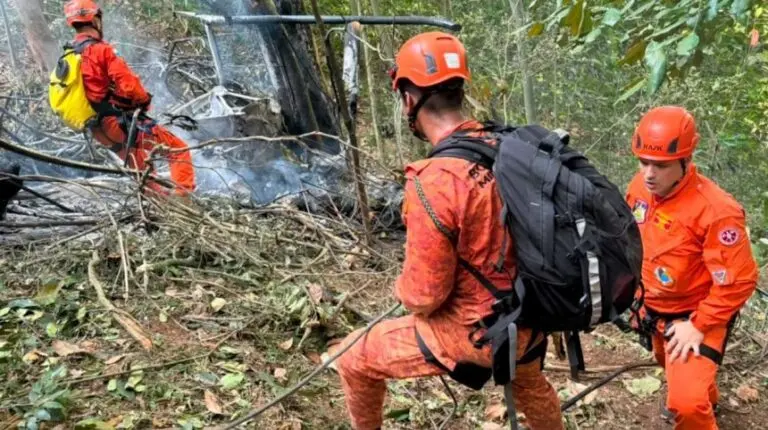
The Rio helicopter crash occurred Saturday morning during a sightseeing flight over Rio de Janeiro, killing four people after the aircraft went down in a forested area of Tijuca National Park.
The helicopter crashed near Vista Chinesa, a well-known lookout point in the Alto da Boa Vista area that attracts tourists because of its panoramic views of Rio de Janeiro, the coastline and the surrounding mountains.
The victims were identified as pilot Alessandro Rocha and three Colombian tourists: Rocío Cubillos, 59; Sofía Murillo, 17; and Wendy Manrique, 37.
The three passengers were members of the same family, according to Colombian diplomatic officials and media reports. The group had traveled to Rio de Janeiro to celebrate the 15th birthday of one of the family members.
The family had arrived in the city the previous Monday and had booked a panoramic helicopter flight costing approximately 4,400 Brazilian reais. Because the aircraft could accommodate only three passengers from the group at a time, the family divided the flight into two turns.
The three women boarded the helicopter that later crashed, while the other members of the family remained behind waiting for their return.
The aircraft was a Robinson R44 operated by Voos Rio Panorâmico e Serviços Aeronáuticos Ltda., a company that offers sightseeing flights over Rio de Janeiro.
Authorities received the emergency alert at approximately 11:11 a.m. local time. The response involved 40 military personnel, 11 vehicles and four operational teams.
The aircraft came down in dense vegetation on steep terrain, making access difficult for rescue workers. Firefighters had to secure routes to the crash site, extinguish the fire and recover the bodies from the wooded area.
The bodies were recovered through a combination of lifting equipment and a zip-line operation before being transferred to the Institute of Legal Medicine.
Emergency teams reported that the victims suffered fatal burns. Investigators are expected to examine the wreckage and other evidence to determine what caused the helicopter to lose control and crash.
A camera found inside the aircraft was also recovered. Authorities will analyze the device to determine whether it contains visual records of the moments before the impact.
The footage could help investigators establish the helicopter’s flight path, weather conditions, possible mechanical problems and the sequence of events immediately before the crash.
Rio Helicopter Crash Raises Safety Concerns
Brazil’s National Civil Aviation Agency—ANAC | Brazil’s Aeronautical Accident Investigation and Prevention Center—CENIPA
The Rio helicopter crash has renewed concerns about the safety of commercial sightseeing flights in a city where aerial tours have become increasingly popular among domestic and international visitors.
Rio de Janeiro’s rugged landscape makes helicopter flights attractive to tourists. The aircraft offer views of landmarks such as Sugarloaf Mountain, Christ the Redeemer, Copacabana Beach, Ipanema and Tijuca National Park.
However, the same geography creates operational challenges. Flights take place over mountainous terrain, dense vegetation and urban areas. Sudden changes in wind, reduced visibility, mechanical failure or navigation errors can make emergency landings extremely difficult.
Rio Mayor Eduardo Cavaliere called for immediate action by Brazil’s National Civil Aviation Agency, known as ANAC. He said the city had contacted the agency and requested measures to reinforce oversight of helicopter operations.
Cavaliere also raised the possibility of temporarily suspending sightseeing flights for one or two weeks, or for as long as necessary to conduct a more extensive inspection of helipads, aircraft and maintenance procedures.
“This cannot be considered normal,” the mayor said, according to the report. He added that ANAC would have to evaluate the situation and issue a decision regarding the continuation of panoramic flights in Rio de Janeiro.
The proposal would not necessarily amount to a permanent ban. Instead, it could establish a temporary pause while operators undergo additional inspections and regulators review the safety conditions of the flights.
Possible checks could include aircraft maintenance records, pilot qualifications, flight planning, passenger manifests, emergency equipment and the condition of helipads used for tourist operations.
Investigators may also examine whether the helicopter was operating within the approved weather and visibility conditions for the flight. In mountainous areas, weather can change rapidly and affect the aircraft’s ability to maintain stable flight.
The crash occurred less than two months after another deadly helicopter accident in Rio de Janeiro. On June 14, two helicopters collided in midair over the Recreio dos Bandeirantes neighborhood, killing all six people aboard. apnews
The two incidents have intensified calls for stronger controls over helicopter operations in the city. Officials are expected to assess whether the accidents resulted from unrelated causes or whether they reveal broader weaknesses in oversight and safety practices.
The June crash involved two aircraft operating in the same airspace, while Saturday’s accident involved a single sightseeing helicopter. The circumstances are therefore different, and authorities have not established a connection between the incidents.
Nevertheless, the short interval between the two accidents has increased public concern. Residents and tourists are questioning whether the growth of aerial tourism has been matched by sufficient regulatory supervision.
The Brazilian aviation system includes several agencies responsible for different stages of an accident investigation. ANAC regulates civil aviation and operators, while CENIPA is responsible for investigating aviation occurrences and identifying factors that could prevent future accidents.
A technical investigation does not necessarily seek to assign criminal responsibility. Its primary purpose is to establish what happened and recommend measures to prevent similar incidents.
Investigation Focuses on Flight and Operator
Tijuca National Park | Colombian Foreign Ministry
The Rio helicopter crash took place inside Tijuca National Park, one of the world’s largest urban forests and one of the most visited natural areas in Rio de Janeiro.
The park’s dense vegetation and steep slopes complicated the response. Firefighters had to secure access routes before reaching the wreckage and recovering the victims.
Vista Chinesa, the site near the crash, is a popular observation point located in the forest. The area receives tourists, cyclists, hikers and other visitors attracted by its views of the city.
The presence of visitors and outdoor athletes makes emergency planning especially important. A crash in a remote section of the park can delay rescue operations and make it difficult to transport injured people or recover victims.
Investigators will likely review the helicopter’s maintenance history and determine whether it had been inspected in accordance with Brazilian aviation regulations.
They may also examine the pilot’s qualifications, the company’s operating procedures and the information provided to passengers before takeoff.
The Robinson R44 is a light four-seat helicopter frequently used for training, private flights and tourism. As with all aircraft, its safe operation depends on regular maintenance, qualified pilots and compliance with operating limitations.
Authorities have not announced a preliminary cause for the crash. It remains unclear whether the aircraft experienced a mechanical failure, encountered adverse weather or was affected by another factor.
The camera recovered from the helicopter could provide important evidence. Investigators may compare its images with flight-tracking data, radio communications and witness accounts from people near Vista Chinesa.
They will also examine the wreckage for signs of engine failure, structural damage, fire before impact or other mechanical problems.
The Colombian Consulate in Rio de Janeiro has been assisting the victims’ relatives and coordinating with Brazilian authorities. The identification process and the transfer of remains will involve both countries.
The deaths have generated grief among the Colombian community in Brazil and among relatives who were traveling together as a family. The fact that three victims belonged to the same group has added to the emotional impact of the tragedy.
Geopolitical Context
The Rio helicopter crash carries implications for Brazil’s tourism sector and for relations with the countries whose citizens visit the city. Rio de Janeiro is one of South America’s main tourism destinations, and helicopter flights are promoted as a premium way to experience its landmarks.
Any temporary suspension of sightseeing flights could affect tour operators, pilots, maintenance companies and tourism workers. At the same time, authorities face pressure to demonstrate that tourist attractions are operating under reliable safety standards.
The accident also highlights the need for cooperation between Brazilian regulators, local authorities, tourism companies and foreign consulates. International visitors depend on clear safety information and effective emergency responses when accidents occur.
For Colombia, the deaths of three citizens will require diplomatic and consular support during the investigation and repatriation process. For Brazil, the case may lead to broader scrutiny of air-tourism regulations in Rio and other cities.
The immediate priority is to determine the cause of the crash and provide assistance to the victims’ relatives. The longer-term challenge is to ensure that the growth of sightseeing flights does not outpace the country’s ability to supervise them.
Until investigators complete their work, authorities have not established responsibility for the accident. However, the mayor’s call for inspections reflects a growing concern that passenger safety must take priority over the expansion of tourist aviation.
From teleSUR English via This RSS Feed.