

Venezuela power grid recovery advances after June’s twin earthquakes, with Corpoelec restoring 450 MW and repairing key transmission infrastructure.
Related: Venezuela: Acting President Names New Electricity Corporation Head
Venezuela Power Grid Recovery Continues After Twin Earthquakes
Venezuela power grid recovery efforts continue more than one month after two major earthquakes damaged key generation and transmission facilities across the country.
Engineers, technicians and workers from the National Electric Corporation, known as Corpoelec, have maintained a continuous deployment to repair infrastructure affected by the seismic events of June 24.
The central, western and southwestern regions remain the areas most affected by service disruptions. The damage was concentrated in strategic facilities responsible for generating and transmitting electricity across the national system.
In a report on the recovery, Electric Energy Minister Rolando Alcalá described the scope of the damage and the progress made by state technicians.
The minister said the earthquakes caused severe structural damage at the Termocarabobo power plant and affected all the transformers connected to its four generation units. Repair teams have already restored two of those units.
In the coming days, authorities expect to recover a third unit. Its return would add 450 megawatts to the national electricity system out of the 600 megawatts lost after the earthquakes.
The figure represents a significant step toward stabilizing supply in the affected regions. However, the recovery of the remaining equipment will depend on structural repairs, transformer rehabilitation and technical testing before the units can safely return to service.
Alcalá said workers were continuing without interruption to reinforce damaged structures and reconnect the transformers associated with the two generation units that remain offline.
The minister’s account was broadcast by Venezolana de Televisión and later reported by regional media. He also confirmed that Corpoelec teams, engineers and technical personnel had been working around the clock since the earthquakes occurred. orinocotribune
The government’s objective is to restore the system progressively while limiting the risk of further failures. Electricity authorities must balance the need to reconnect generation capacity with the requirement to maintain network stability.
A sudden return of damaged equipment could create additional stress if power flows are not properly synchronized. For that reason, engineers are assessing each plant and transmission route before increasing the amount of energy sent into the grid.
Venezuela Power Grid Recovery Targets 600 Megawatts
Venezuelan Ministry of Electric Energy | Corpoelec
At Planta Centro, another major power facility in Carabobo state, the main focus is the comprehensive rehabilitation of generation Unit 6.
The unit has an installed capacity of 600 megawatts and is considered a strategic component of Venezuela’s electricity network. Its return to the National Electric System is projected for the coming months.
Although the unit will not be restored immediately, large-scale technical work is already underway. Crews are preparing the equipment and structures required to return the plant to service and improve the reliability of the national grid.
The recovery of Planta Centro is particularly important because the facility is connected to a broader transmission corridor that links central Venezuela with western and southwestern regions.
The earthquakes also damaged the Planta Centro–Yaracuy transmission line, a high-voltage route that connects the Planta Centro substation in Carabobo with the Yaracuy substation near San Felipe.
The 400-kilovolt line extends for approximately 152 kilometers and serves as a major interconnection corridor. It carries large volumes of electricity from the Simón Bolívar Hydroelectric Complex, commonly known as Guri, to residential and industrial areas in central and western Venezuela.
Three transmission towers collapsed during the earthquakes. Their failure immediately reduced the system’s ability to transfer power by approximately 100 megawatts and contributed to instability across the network.
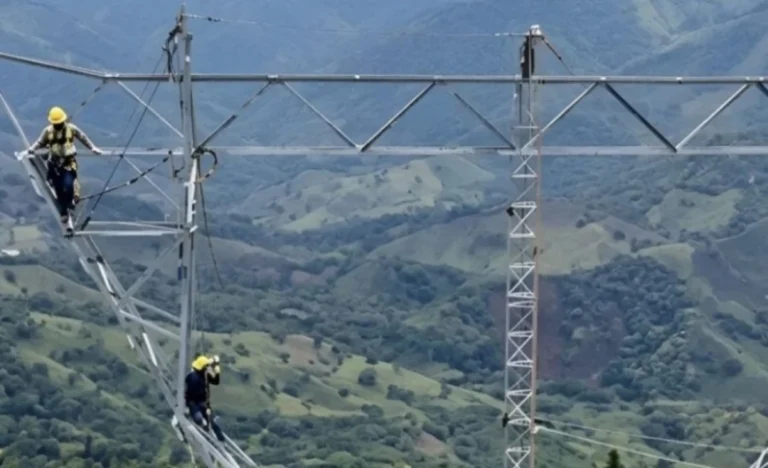
Specialized crews are working day and night to repair the damaged structures. Their tasks include rebuilding the collapsed towers, inspecting the remaining supports and improving the insulation systems along the line.
The transmission corridor contains 336 metallic support towers, all of which must be inspected and, where necessary, reinforced. Even towers that did not collapse may have suffered structural stress or damage to their foundations and electrical components.
The work requires coordination among engineers, electricians, crane operators, safety personnel and emergency teams. Crews must also operate in difficult terrain while ensuring that the line remains isolated during repair operations.
According to the latest report, one of the three towers brought down by the earthquake has already been recovered, while work continues on the other two. orinocotribune
The government has described the line as vital to the restoration of power flows between the Guri complex and the country’s central-western regions.
The Guri complex is Venezuela’s main hydroelectric source and one of the largest electricity facilities in Latin America. Its output is distributed through high-voltage corridors that connect distant regions to the national grid.
Damage to a single transmission route can therefore affect several states even when generation capacity remains available. Without functioning lines, electricity produced at a power plant cannot reach homes, hospitals, businesses and industrial facilities.
The recovery of the Planta Centro–Yaracuy line is consequently as important as the rehabilitation of the generating units. Authorities must restore both parts of the system to achieve a stable and reliable supply.
Infrastructure Damage and Energy Stability
United Nations Office for Disaster Risk Reduction | International Energy Agency
The earthquakes exposed the vulnerability of Venezuela’s electricity infrastructure to large-scale natural disasters. The damage affected generation, substations, transformers, transmission towers and other facilities essential to the operation of the National Electric System.
The Venezuela power grid recovery program is therefore being carried out on several fronts at the same time. Corpoelec is repairing power plants, restoring transmission lines and reinforcing equipment that suffered structural damage.
The government has not described the work as a simple return to pre-earthquake conditions. Officials have said the repairs must also strengthen the system’s reliability and improve its ability to withstand future emergencies.
In the short term, the central, western and southwestern regions may continue to experience interruptions or fluctuations while damaged equipment remains out of service.
Power disruptions affect more than household lighting. They can interrupt water distribution, telecommunications, refrigeration, transportation, medical care and industrial production.
Hospitals and emergency services require backup generators during outages, while water systems often depend on electrically powered pumps. Small interruptions can therefore produce wider consequences in communities already dealing with the impact of the earthquakes.
The rehabilitation of the system also has economic implications. Stable electricity is necessary for factories, food-processing facilities, ports, commercial centers and public institutions to resume normal activity.
Energy officials are seeking to restore the lost 600 megawatts of generation capacity and recover the approximately 100 megawatts of transmission capability affected by the collapse of the three towers.
These figures refer to different parts of the system. The 600 megawatts represent generation capacity damaged at Termocarabobo and Planta Centro, while the 100-megawatt reduction reflects the immediate transfer limitation caused by the damaged transmission line.
Restoring generation without repairing transmission would leave some available electricity unable to reach demand centers. Conversely, repairing the line without recovering generation would not provide enough additional power to stabilize the network.
The simultaneous work at Termocarabobo, Planta Centro and the Yaracuy transmission corridor is intended to address both problems.
Geopolitical Context
The Venezuela power grid recovery has regional implications because electricity infrastructure is directly connected to national development, public health and economic sovereignty.
Venezuela’s energy system has faced years of pressure from aging equipment, maintenance challenges, financing difficulties and repeated service interruptions. The earthquake damage adds a major emergency to those longstanding problems.
The recovery effort may encourage technical cooperation with international partners in seismic engineering, grid modernization and disaster preparedness. It may also prompt neighboring countries to review their own emergency systems for power plants and high-voltage transmission corridors.
The crisis is especially important for Venezuela because the country depends heavily on the Guri hydroelectric complex and a limited number of major transmission routes. A failure at one strategic point can affect large distances and millions of consumers.
Rebuilding the network could improve long-term resilience if repairs include stronger foundations, upgraded insulation, modern monitoring equipment and better emergency communication systems.
The recovery also demonstrates the importance of protecting critical infrastructure during natural disasters. Electricity networks support every other part of the response, from search-and-rescue operations to telecommunications and the distribution of food and medical supplies.
The immediate objective is to restore the full 600 megawatts of lost capacity and stabilize electricity delivery across Venezuela. Achieving that goal will depend on the successful rehabilitation of the three damaged transmission towers, the return of additional generation units and the completion of work at Planta Centro.
For now, engineers and technicians remain deployed around the clock. Their work is aimed not only at bringing damaged facilities back online but also at preventing a localized earthquake impact from becoming a prolonged national energy crisis.
El ministro para la Energía Eléctrica, ingeniero Rolando Alcalá, ofreció un balance sobre la recuperación del Sistema Eléctrico Nacional (SEN) luego de las afectaciones provocadas por el reciente doblete sísmico e informó que se está trabajando continuamente las 24 horas desde… pic.twitter.com/5NnhWYU3sZ
— Ministerio de Comunicación e Información (@mippci_ven) August 8, 2026
From teleSUR English via This RSS Feed.