

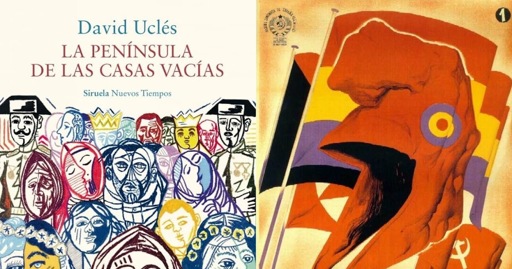

The following article - book review was originally published in Rizospastis, Organ of the CC of the Communist Party of Greece (KKE), on 8-9 August 2026, under the title “A Publishing Phenomenon of “Equal Distances”. Real below the English translation:
David Uclés’s novel has become a genuine publishing phenomenon. More than 400,000 copies have been sold in Spain, translations have appeared in dozens of languages, and the book has been embraced by critics and readers alike as a major literary fresco of the Spanish Civil War. Precisely because its influence is so extensive, it deserves to be approached critically—not in terms of its literary technique, but of its political content and the way in which it shapes collective memory of one of the most decisive events of the twentieth century.
The book’s more than 800 pages could easily have provided room for a substantial political analysis of the period. One might have expected a narrative showing how the Spanish Civil War became the prelude to the Second World War, how the imperialist powers of the time intervened in it, how it became a field of confrontation among capitalist states—above all between the fascist Axis and the USSR—and how developments on the Iberian Peninsula were inseparably linked to the global conflict that followed.
Instead, Uclés chooses to tell a family tragedy detached from its broader historical context, as if the events were unfolding in a political vacuum.
Fascism as a “psychological phenomenon”…
The book’s central problematic point concerns its interpretation of the rise of fascism.
The support and strengthening of fascist forces was a choice made by the bourgeois classes of Germany, Italy, Spain and other countries, as what they regarded as the most effective means both of preparing for participation in the new imperialist war and of confronting the communist movement, while, of course, exploiting the economic and social conditions that followed the crisis of 1929. At the same time, the rise of fascism was not opposed by the “democratic” capitalist states either, since they saw in it the possibility of creating a fighting force against the USSR.
The author, by contrast, resorts to an exclusively psychological explanation. The dictators of the period became what they became because they had not received love and affection in childhood!
Nor does he stop there. He reproduces the familiar logic of totalitarianism—that is, the attempt to equate fascism with communism.
The book characteristically states:
“As for his character, those who knew him say he was affable, though somewhat aloof. Those who suffered under him, however, describe him as harsh and deeply insecure. The latter is a common trait among modern dictators: a sense of failure and childhood trauma, together with a serious lack of affection. Stalin suffered abuse at the hands of an alcoholic and authoritarian father. Hitler, who wet the bed as a child, was similarly ridiculed by his father and rejected by the Academy of Fine Arts. Mussolini was raised in an atmosphere of hatred, after the family doctor categorically diagnosed him as intellectually disabled. Franco likewise grew up in the shadow of a vicious father, who beat his pregnant wife, broke his eldest son’s arm when he caught him masturbating, and mocked Franco himself for his effeminate voice, calling him ‘Paquita’.”
This is an extremely dangerous, old-fashioned and unscientific approach. By reducing fascism to individual psychological trauma, the book disconnects it from capitalism itself—the system that gave birth to it and made use of it at critical moments. Politics is completely severed from economics, and historical developments are presented as the result of some transcendent, almost metaphysical factor rather than as the product of concrete class interests and conflicts.
Even more troubling is the ease with which the author places Stalin on the same level as Hitler and Mussolini, essentially adopting the ahistorical “two extremes” theory, which he then reintroduces through the back door throughout the rest of the novel. It is a narrative choice that, however “balanced” it may appear, in reality always ends up exonerating one side: the fascists.
Bourgeois democracy, within whose framework fascism was born and came of age—we should remember that the Nazis in Germany and the fascists in Italy came to power through parliamentary procedures and elections—is presented without its class content: not as a form of capitalist power, a “first cousin” of fascist dictatorship, but as some eternal, classless democracy, a democracy for everyone, supposedly threatened by “totalitarianisms” from both the Right and the “Left”…
That is why “equal distances” are never truly equal: they elevate the fascist forces to the same moral and political level as those who fought against them.
The device Uclés uses to achieve this schema is familiar. He has two brothers fight on opposing sides. In this way, the war is transformed—symbolically, but also practically within the plot—into a “fratricidal” conflict, a tragedy that appears to transcend every class or ideological interest. The class content of the war is stripped away, leaving behind only the pain of a divided family.
The same logic is repeated when a son tells his father that he is leaving to fight and the father mocks his motives, telling him that he understands nothing about politics—as though joining a struggle against fascist brutality or capitalist exploitation were merely a childish impulse rather than a conscious political choice. Even more revealing is the use of the expression “one side and the other” in describing a battle scene, a formulation that equates Francoists, fascists and Blackshirts with communists and the other fighters, as if it made no difference at all which side of history each stood on.
What the author appears, quite consciously, to “ignore” is the class struggle and its role in history. As Engels wrote:
“In the history of society, on the contrary, the actors are all endowed with consciousness, are men acting with deliberation or passion, working towards definite goals; nothing happens without a conscious purpose, without an intended aim.”
Yet Engels immediately went on to explain that the clash of countless individual wills and actions produces historical outcomes that are independent of the aims of any one individual, revealing the operation of broader social laws.
It was class struggle, then, that led to civil war in Spain. It was class struggle that shaped the actions of thousands and millions—not separate individual “wills,” peculiarities or psychological traits. Every attempt to explain history in reverse inevitably runs aground on the rocks of irrationalism. Moreover, the experience of the Spanish Civil War demonstrated, negatively and tragically, that the only effective struggle against fascism is the struggle against capitalism, and that every attempt at anti-fascist struggle without anti-capitalist content is condemned to vacillation and ultimately to defeat.
Magical realism in the service of capitalist normality
Magical realism, as a narrative technique, could have served as a powerful tool for exposing the barbarity of war and fascist violence. In this particular book, however, it ends up working in the opposite direction: it is so “magical” that it manages to equate the fascists with those who fought them, erase the material conditions that nurtured fascism, and ultimately reconcile itself with bourgeois normality—a normality that bares its teeth whenever an armed people takes a step towards historical emancipation, in order to defend its domination.
One might object that literature is not an essay; that narrative “balance” and the avoidance of didacticism allow readers to experience the human dimension of tragedy without a propagandistic filter; and that this choice is a literary virtue rather than a weakness. However reasonable this argument may sound—and however often it is reproduced by bourgeois propaganda—it does not withstand closer examination.
“Neutrality” is never truly neutral. Choosing not to take a position is itself a position. And in a class conflict in which the capitalist side imposed, by force, a forty-year military dictatorship, narrative “balance” in practice ends up favouring the victors at the expense of the defeated.
The dilemma of “literature versus political analysis” is false. Major works of fiction written on similar themes did not lose their literary quality because they took a clear stand. On the contrary, historical and class clarity gave them depth, substance and emotional weight, bound together with anti-war messages. The “schematic,” therefore, is not necessarily the opposite of the “literary.” The so-called “human perspective,” when severed from historical causes, is itself an equally schematic approach, only in reverse. Instead of explaining, it psychologises—see the dictator’s alleged “lack of love”; instead of exposing the class dividing lines, it shows “brothers torn apart.” In this way, the narrative becomes dehistoricised.
The impact of such a book on its readership is also highly significant. More than 400,000 copies means that, for hundreds of thousands of readers in dozens of countries, this book becomes their image of the conflict fought on Spanish soil between 1936 and 1939. When a work with such reach chooses not to provide the historical, political and social causes, that choice has political consequences, regardless of the author’s intentions.
An era that leaves no room for equal distances
We live in a period in which flashpoints of war are multiplying across the planet, from Eastern Europe to the Middle East and the Pacific. Behind these conflicts lie not inexplicable events, “fateful” forces or merely the individual pathologies of leaders, but rivalries among imperialist centres for control of markets, energy and trade routes, natural resources and sources of wealth. Analysing these rivalries in class terms is a prerequisite for understanding why peoples are dragged into wars that do not serve their own interests.
In such circumstances, the narrative posture of “equal distances”—the “one side and the other” approach—is not only problematic in literary terms but politically dangerous, because it reproduces precisely the logic that prevents peoples from identifying the real causes of imperialist wars, taking a stand and becoming protagonists in historical developments. What is needed today is not colourless “neutrality” towards violence, but the ability to distinguish the oppressor from the oppressed, imperialist interests from the people’s struggle for survival and emancipation. A literary work such as The Peninsula of Empty Houses, read by hundreds of thousands of people, could have contributed to such clarity. Instead, it chooses to blur it.
The commercial success of a book does not eliminate the need for critical reading; on the contrary, it makes that need all the more urgent. The more readers around the world form their image of the Spanish Civil War through Uclés’s pages, the more important it becomes to point out what is missing from this narrative: class analysis, the historical documentation of fascism’s rise, and the recognition that this was not a “fratricidal” tragedy without winners and losers, but a class conflict in which one side fought for social emancipation and the other for the preservation of exploitation, imposing a military dictatorship that consolidated the dictatorship of capital.
Literature is, of course, under no obligation to write history textbooks. But when it chooses to narrate one of the most important conflicts of the twentieth century, it cannot pretend that historical causes are secondary or that the opposing sides were distinguished only by the scale of their suffering. An author who chooses to engage with such themes has a responsibility to take a clear position.
The Spanish Civil War was one of the defining moments of twentieth-century class struggle, shedding light on the real causes behind the rise of fascism and on the ways in which peoples can stand against it. The more history is stripped of its social and class content, the harder it becomes for younger generations to understand the responsibility of exploitative social relations and the role they play in periods of crisis.
Peoples have no reason to fear their militant past, nor to treat it as a dark parenthesis that ought to be forgotten. On the contrary, they must study it, draw lessons and conclusions from its victories and defeats, and prepare themselves for the new forms through which class struggle manifests itself.
Because history has not ended. And when social contradictions sharpen, knowledge of historical experience becomes a precious weapon for those striving for social progress and for the triumph of the working class over the barbarism of exploitation.
From In Defense of Communism via This RSS Feed.