

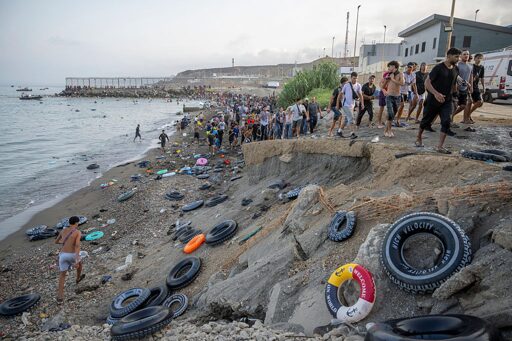
Earlier this month, more than 50,000 Moroccan migrants swam three miles through the open ocean to Ceuta, a Spanish colonial enclave city on the Moroccan side of the Strait of Gibraltar.
These migrants are largely young Moroccan men and boys who are unemployed or precarious workers in search of a future. Youth unemployment is around 37 percent, and the Moroccan government represses political dissent. The mass exodus shows that tens of thousands of Moroccan youth would quite literally rather risk their lives than remain in Morocco, where resources have been funneled towards the 2030 World Cup and multinational industry, and away from the wellbeing, health, and opportunities of its people. And indeed, more than one hundred of these youth died in the crossing to Ceuta.
These deaths are the responsibility of the “progressive” Socialist Workers’ Party (PSOE) and Sumar government coalition of the Spanish state.
Sánchez and PSOE Are to Blame
Sánchez enacted a strategy of attrition: to convince the migrants to return to Morocco, he would first starve them. The tens of thousands of immigrants arriving on the shores of Ceuta last week received with no aid, healthcare, shelter, food, or legal assistance. Rather than traveling onto the Spanish mainland, as they had hoped, they were left to sleep on the beach and on the streets.
Then, the Sánchez administration coordinated with Moroccan authorities, as its subservient puppet-state, to “speed up” the deportation of those who entered Ceuta, and the Spanish military was deployed. Videos show authorities shutting off sources of potable water at the beach in Ceuta where many migrants stayed, and the Spanish civil guard brutalizing migrants. These “security” forces expelled those who did not leave voluntarily to the Moroccan town of Fnideq across the border, where families anxiously waited for their children, who had made the journey, possibly never to return.
The massive influx of migrants to Ceuta was likely spurred by a June 29 ruling by the Spanish Supreme Court that migrants arriving by sea (without crossing a physical border) could not be summarily deported without due process, alongside the wide spread of this information via social media. In an ironic escalation, after the Ceuta influx, Spain installed a 500-meter floating barrier between Ceuta and Morocco to effectively reverse this ruling.
Capitalist Violence and Immigration
Migration, a result of the current stage of imperialism and capitalism, is one of the defining issues of our time.
Millions of workers, poor, and oppressed people from semi-colonial nations flee conditions of war, destabilization, climate catastrophe, and economic precarity. Adapting to the chauvinist demands of the capitalist nation-state, it is clear that neither “progressives” like Sánchez nor neo-reformist phenomena expressed in figures like France’s Jean-Luc Mélenchon, parties like Germany’s Die Linke, and other reformist sectors, including publications like Jacobin, can resolve the pro-immigrant sentiments that they purport to represent. The capitalist state relies on borders to as a mechanism that exploits, divides, and cheapens the working class and its labor power. So instead, the progressive sectors serve to normalize the racism and xenophobia of the Right.
The failures of left populism and the neo-reformism on the question of migration go far beyond Ceuta. In France, the “left-wing mediator” party La France Insoumise (LFI) gained popularity after the collapse of the Socialist Party (PS) in 2016 and in the struggles against former president Francois Hollande and current president Emmanuel Macron. Its key figure, Mélenchon, who is running for president again in 2027, won support from workers and the youth through his stances against police brutality, Islamaphobia, and in support of Palestine, a higher minimum wage, and 100 percent renewable energy by 2050, amongst other issues.
However, LFI’s electoralist compass and popular front strategy — it joined the New Popular Front electoral coalition in 2024 to challenge Macron in an election that further polarized parliament — seek the stability of France’s place in the imperialist system. This means that LFI’s “anti-militarism” is paper-thin and more concerned with hegemonic competition with the U.S. than defending the international working class against rearmament writ large. As LFI member of parliament Alma Dufour stated, “We are not against the rearmament of France and Europe; the problem is that if we spend 40 billion euros on military equipment now, where will that 40 billion go? To the United States.” And while LFI formally opposes free trade agreements, it defends French imperialism. As our comrade Julien Anchaing writes,
Amidst escalating international tensions and the race to war in Europe, the “diplomatic” centrality of the so-called “overseas” territories is all the more important for La France Insoumise because they provide the French state with a window onto the world. Because LFI is refusing to be subordinate to the United States or the European Union and is seeking to build alliances on a case-by-case basis, particularly with the BRICS countries, so that the French state can come out on top and oppose the current dynamics, the former French colonies play a fundamental role in its strategy.
Undoubtedly, LFI’s embrace of French colonialism (France has the second largest maritime domain in the world) informs Mélenchon’s position on immigration and borders. While the LFI rhetorically supports the humane treatment of immigrants and the legalization of immigrants with jobs, their political priority is the defense of France’s position on the world stage.
In a recent interview, Mélenchon took a stance against regularizing all undocumented immigrants and against open borders, stating that “there are borders, and we maintain those borders.” In effect, this defense of capitalist competition pits French workers and foreign workers against each other. And further, legalizing only immigrants with jobs would not include those in the informal economy, nor children, the elderly, and the disabled. As a result, this system would incentivize the continued exploitation of immigrant workers and communities, and the divisions wrought by a system that gives full rights only to some.
An Imperialist “Fortress Europe”
But France and Spain are not alone. In Germany, tighter borders, more checkpoints, and stricter laws has led to reduced migration in 2025 — attacks that have been facilitated by Die Linke. The party, which has a strong ideological relationship to the Democratic Socialists of America (DSA) in the United States, exploded in membership in the 2025 election cycle in response to heightened political polarization and the strengthening of the Far Right. Attracting tens of thousands of young people whose consciousness was transformed by the Palestine movement, Die Linke is a neo-reformist party with “Democracy, freedom, equality, justice, internationalism and solidarity [as their] fundamental values.”
But Die Linke, which has been part of the bourgeois state since its inception without a clear conception of revolutionary parliamentarism nor class independence, is rife with contradiction. Most recently, The party betrayed the socialist slogan of “not one cent for militarism,” which has a special significance due to the betrayal of the German SPD in 1914, when members of Die Linke in the Bundesrat voted last year in favor of Germany’s trillion-euro rearmament.
As in France and the Spanish State, we see Die Linke’s support for militarism reflected in its nationalist defense, in practice, of German borders. Rhetorically, the party advocates for the right to asylum, legalization of status, and in the past, open borders. But in actuality, it is deeply integrated into the capitalist state. Indeed, in Germany, deportations are decided by the state governments, of which Die Linke is a part. This means that Die Linke, in effect, is routinely complicit in the deportations of immigrants.
The connection between support for imperialism and defense of national borders reflect the greater regional strategy of the European Union as an imperialist bloc. Ceuta, and the neighboring Spanish colonial enclave of Melilla, are strategic strongholds of imperialist policy in Africa (akin to the position of British rule of the Malvinas), and the only EU territories that border Africa by land. They are key for the “protection” of “Fortress Europe” from the influx of immigrants.
Rather than adopt more brutal border policies themselves, the European Union outsources border enforcement to North African countries through migration or “security” pacts, and thus creates “external borders.” Across Morocco, Turkey, Libya, Tunisia, Egypt, and Mauritania, the EU finances detention centers and border patrols that imprison babies and children and are infamous for mistreatment and torture. Furthermore, Frontex, the EU’s Coast Guard, is responsible for thousands of deaths of migrants in the Mediterranean.
Contradictions of “Progressives” in the U.S.
But the contradiction of “progressive” and neo-reformist projects harboring anti-immigrant and closed border sentiments is not just a feature of the European Union. In the United States, some sectors of DSA, including important figures from Jacobin like Vivek Chibber and Suzy Lee, are denouncing the politics of open borders and adapting to the anti-immigrant stance of the Trump regime. These reactionary polemics come in the context of the dramatic growth in the popularity of the DSA, and in the wake of the “DSA wave” this summer in the Democratic Party primaries. The popularity of socialism is on the rise, with 39 percent favorability among the overall U.S. population, yet Jacobin is scrambling to define it on its own chauvinist terms.
Despite the historic nature of the movement against ICE this year in the United States, from the Twin Cities to Delaney Hall and beyond, in which socialists, DSA rank-and-file members, and immigrant communities organized en masse to protect their neighbors and demand the retreat of ICE, the theoreticians of social democracy in the U.S. defend “regulated borders,” and thus, deportation. For Chibber and Lee, open borders are “too messy” and “not realistic,” and they even go so far as to implicitly blame Biden’s excessively “liberal” immigration policy for the rise of Trump’s anti-immigrant agenda. In reality, Biden’s immigration policy was a brutal continuation of Trump’s first term (Chibber and Lee seem to forget that Biden banned asylum). Furthermore, DSA Congress members Alexandria Ocasio-Cortez and Rashida Tlaib voted to fund ICE on their very first day in office.
Why is it that these progressive and democratic socialist political coalitions, which on paper defend immigrant rights, bow time and time again to chauvinist politics?
These examples point to structural contradictions at the core of these progressive projects. Capitalism relies, in essence, on the subjugation, division, and exploitation of the working class. In an imperialist system, borders create cheapened labor: by deeming some workers “illegal,” capitalists can pay them less under worse conditions, and make, in turn, more surplus value from their work. Politically, the European and U.S. examples we’ve mentioned here are projects that do not aim to challenge this economic world model, but rather find a progressive corner of their capitalist governments in which to nest and advocate for reforms.
In the democratic socialist model, the aspiration is that one day, in the distant future, capitalists will be expropriated and socialism will come into gradual being. But democratic socialists seems content for their final vision of socialism to co-exist with the vestiges of capitalist domination, such as Jacobin’s market socialism and “regulated borders.” On this point, democratic socialism shares with Stalinism an affinity for socialism in one country: if only workers in the United States, France, Germany, or the Spanish State can live a fair and dignified life, they can turn a blind eye to the rest.
There Are No “Humane” Borders
The only answer to the migrant “crisis” is internationalism. Under capitalism, in which national resources, productive prosperity, and time are stolen from the working classes, migration becomes a crisis. As revolutionary socialists, we look to Trotsky’s Theory of Permanent Revolution as a guide: we need to build class independent political organizations everywhere, without collaboration with the ruling classes that oppress us and our working class siblings abroad. There are no “humane” borders; we have more in common with the working classes of other countries than we do with our own bourgeoisie.
And, not only in the United States, but everywhere around the world, immigrants are indispensable to the cultural, community, and political networks that build our socialist working class movement. That is why, in the here and now, we fight for full rights for all immigrants, including full democratic and political rights and citizenship for all.
As our French comrade and Révolution Permanente 2027 presidential candidate Anasse Kazib writes, “These images [of Ceuta] remind us of what distinguishes us, revolutionary communists, from the institutional left: we believe that there cannot be progressive policies that benefit some at the expense of others.”
The post Ceuta and the Ugly Face of Europe’s “Progressive” Nationalism appeared first on Left Voice.
From Left Voice via This RSS Feed.
These deaths are the responsibility of the “progressive” Socialist Workers’ Party (PSOE) and Sumar government coalition of the Spanish state.
Fuck this article. Not a mention of the Israeli disinformation campaign waged to incent these people to cross at Cueta under false pretenses. This is obviously a shill piece.
https://www.brandsynario.com/world/social-media-spain-ceuta-crisis/
https://www.wionews.com/world/spain-israel-ceuta-migrant-crisis-social-media-feud-1785666403370
