

By Wayne Kublalsingh – Aug 6, 2026
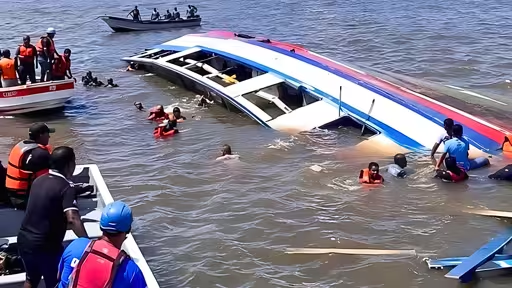
On Saturday 18th July 2026, the MV Barima, a 132-foot passenger and cargo ferry, capsized off the Essequibo Coast in Guyana. It capsized at approximately 11 pm, in 45 feet of water, around 7 miles from shore. Of the estimated 179 persons on board, 76 have been rescued. 73 bodies have been recovered thus far. The wreck, with its cargo and presumably some missing bodies, remains embedded in soft mud, making salvaging operations difficult and dangerous.
MV Barima was 87 years old. It was built in Scotland by Fergusson Brothers Ltd in 1939, at the close of the steamship era. At the time of its sinking, it was regulated and operated, respectively, by the state’s Maritime Administration Department (MARAD) and Transport and Harbours Department. The Georgetown to Port Kaituma Route is approximately 150 miles, a 24-hour journey. Leaving the sheltered waters of the Demerara River in Georgetown, the vessel would forge into the Atlantic, navigate the rough waters at the mouths of the Essequibo and Pomeroon rivers, before turning inland at the Barima River to service largely indigenous communities at Mabaruma, Morawhanna and Port Kaituma.
The Barima tragedy tells a tale of maladministration. In 2010, there was a protest at Port Kaituma against ferry delays and breakdowns. In 2015, President Donald Ramoutar secured a loan from India to purchase a brand-new ferry for Region One. The 220-foot MV Ma Lisha, constructed in Kolkata, has run idle due to delays in port construction at Port Kaituma. In 2019, Region One’s Lady Northcote, the ’sister’ ship of MV Barima, built likewise by Fergussons (1937), was decommissioned. In May 2026, the Government acquired a vessel from Greece, the 150-foot Calopian, to serve Region One, but was awaiting renaming and recommissioning.
Many of the passengers reported that the MV Barima was taking in water early on the trip. Too much. Reports to the captain were of no avail. Reports suggest the vessel was overloaded. It is reported that only one of the vessel’s engines was operational. Passengers had to sink or float for hours in the dark, in rough waters, because of a delayed distress response by the Guyana authorities. Because of a deflated manifest, rescuers did not know how many passengers had been aboard.
The MV Barima was named after the Barima River in Region One, the Atlantic point of entry into the larger Essequibo territory. Region One, Barima-Waini, is referred to as part of Guyana’s North West territory. But it is much more than Guyana ‘territory’ and ‘region’. Region One, and the hinterland regions South of it, Pomeroon-Supenaam, Cuyuni-Mazaruni, Potaro-Siparuni, Upper Takutu-Upper Essequibo, are still largely inhabited by indigenous Amerindians.
From across the border in Orinoco, Venezuela, to this land of Essequibo you will find myriad communities of Warau, Karina, Lokono, Arekuna, Akawalo, Kapohn, Patamon, Macushi, Wapishana, among others. Over 75% of the inhabitants of this region are indigenous or descendants of Amerindians. The MV Barima was meant to service a majority Amerindian population in Barima-Essequibo. Most of the victims of the MV Barima tragedy were Amerindians.
Whilst the Guyana government is trying hard to distract from its systemic failures – by imprisoning crew members on murder charges, by at first hinting that the vessel might not be salvageable, by appointing a Commission of Enquiry, whose legal remit is constrained, and will report only after the current tide of recrimination has receded, it cannot be disputed that a crime has been committed against the indigent citizens of Guyana, particularly against hinterland Amerindian peoples. The MV Barima offered cheaper tickets, so its commuters had to make do with a beaten-up boat. With disregard and neglect.
Amerindian groups have raised their voices in protest. But is calling for the resignation of Public Works and Public Utilities Ministers, Juan Edghill and Deodat Indar, enough? Is calling for the raising of the vessel enough? Is calling for transparency and reform enough? Is calling for a better ferry service enough? Is another march and placard enough? One Amerindian survivor who lost six members of his family cried: “Why are we Amerindian people so soft? Why are we always happy with so little?”
In Guyana, an ethnocracy, based on ethnic voting and preferment by two majority groups, the ‘First Peoples’ shall always be the ‘Last Peoples’. ‘Our Amerindian Brothers and Sisters’, as well as ‘One People, One Nation, One Destiny,’ are mere blandishments, soft-soap. East Indian and African-based governments can never deliver to the indigenous peoples their righteous imperative – the dignity which comes with political and economic independence. The indigenous peoples of Guyana and cross-border Venezuela must cut loose from politically and institutionally clammy (curry favour) Guyana. From pittance, handouts, subsistence living. And win complete political and economic sovereignty over the disputed territory between Guyana and Venezuela – the Essequibo.
You must do this before the Guyana Government negotiates and bargains away all the Barima-Essequibo oil, diamond, gold, timber, bauxite to the US. Do this to create a buffer between the disputing Governments. Do this to right historical wrongs and prevent further predatory encroachment, swamping, neglect, by relatively recently arrived groups. Do this to own your own space, your own nation, your own ethos, your own syncretic development agenda.
Do this to establish majority rule in the Essequibo. Do this to make your own nation, alongside Colombia, Trinidad and Tobago, Venezuela, Guyana, Suriname, French Guiana, Brazil, on the Atlantic front. Do this to become the first Amerindian state in history, to establish a haven for indigenous peoples of the Americas, and a vanguard for Amerindian-indigenous advocacy globally. Do this to overcome the imperialists and the relative newcomers, now warring tooth-and-nail for your ancient and ancestral lands; whilst you sit and watch.
Amerindian shyness and satisfaction with pittance must end. Enough of sleeping on the damp floor of ferries. Go for big. Fight for the nation of Barima-Essequibo, the whole Essequibo. Action after action. And if you don’t win it today, in ten years, in twenty, in thirty or forty you surely shalt.
OT/WK
From Orinoco Tribune via This RSS Feed.