

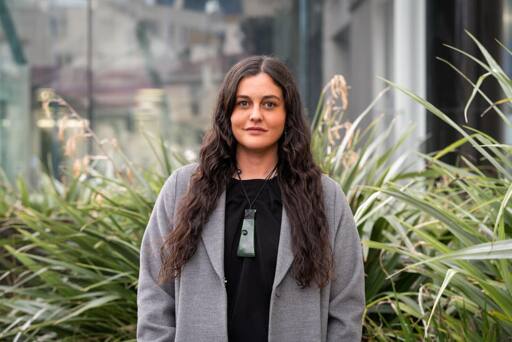

Dr Madi Williams (Photo: Melissa Banks Photography)
Dr Madi Williams didn’t grow up among her Ngāti Kuia relatives at the top of the South Island.
But through her work as a historian at Canterbury University, where she’s a senior lecturer in Māori and Indigenous Studies, she found a way to reconnect with her iwi — leading to a PhD and now a book that pieces together her iwi’s history, Ngāti Kuia: He Pūtake, Hei Pakiaka Ora*.*
Along with her first two books — Polynesia 900–1600: An Overview of the History of Aotearoa, and Rēkohu and Rapa Nui — this pukapuka has earned her a place among eight authors selected for the 2026 New Voices of Aotearoa.
Here she is talking to Dale.
Tēnā koe, Madi. I always start with names in these interviews, and Madi’s short for something, isn’t it? Might you tell us your full names and how you came to carry them?
I go by Madi Williams, but my full name is Madison Mary Williams. Mary is from my great-grandmother. Her full name was Mary Unaiki Brough. Brough was her married name. She passed away when my nana Jan was very young, like about four or five, and so my mum chose to give me that name. It’s to honour her memory. And Williams is from my dad’s side. I think it’s a Welsh last name from our Welsh whakapapa.
Where did you grow up as a kid?
I grew up in rural North Canterbury. I went to high school in town, a Catholic high school, Villa Maria College, and then I moved to Ōtautahi (Christchurch) when I started university. That was the University of Canterbury, where I still am today.
At the time I was born, my mum and dad were a pilot and a flight attendant. I had one sibling, an older brother, and then my mum remarried and I had two more siblings, a brother and a sister, when I was in high school.
I grew up pretty much in te ao Pākehā. My nana had kept a lot of knowledge alive and had done whakapapa research, so we kind of knew where we were from, but I definitely wasn’t raised in te ao Māori. I reconnected through university and through my studies, from when I was 18 onwards.
What was it like for you to reconnect? Were you conscious of your marae? What was it like for you when you first went back as an adult?
It was a really beautiful process. My boss at the time in the Māori Studies department, Sacha McMeeking, was going to Nelson for various wānanga and things she was working on, and she took me with her. And she essentially delivered me back to my relatives, which was a really great experience.
Through my honours year in particular, in 2016, I ended up doing a kaupapa on Māori leadership, which meant that I had a great reason to go back and interview whānau about their leadership, and it really helped me in that reconnection process.
I went to my marae for the first time in 2017, and it was awesome to be able to go back to see where we were from. Because, although we always knew what our marae were and which iwi we’re from, it’s a bit daunting if you’ve never been before, to put yourself out there and just turn up to things.
I became this person who was just turning up to any events they had on, and Ngāti Kuia, in particular, are really fantastic at manaaki for our whānau who are reconnecting. They put on events every year for the specific purpose of whānau being able to come to the marae, to be welcomed and get to know everybody.
I was able to take my nana back to the marae as well, and that was a really special experience. So, it’s been a long process. It was a bit daunting at the start, but I encourage any whānau who are in that stage of their journey to take those opportunities when they come, and go and reconnect, because it’s such a great experience.
There’s a saying that you might not know your whakapapa, but your whakapapa knows you. Where is this Ngāti Kuia marae that you’re speaking of? Could you describe its setting?
The Ngāti Kuia marae is in Havelock, in between Nelson and Blenheim, and it’s actually in an even smaller place called Canvastown. It has our maunga on either side of it. The marae as a whole is called Te Hora, and it’s modern. It was built in the 1990s, so we haven’t got a carved whare yet, but it’s really welcoming. It has a lounge feel to it. It’s a really beautiful place to be.
We’re using the Pākehā ingoa, Havelock and Canvastown. Is there ingoa Māori for the rohe that we could touch on?
The name of the region was called Motuweka. There was a pā there, so that’s the name that applies to the area.

Madi at Te Hora in 2017 with her grandmother Jan Lee (left) and Jan’s sister Nicky Renwick. (Photo supplied)
Who might you describe as some major influences to the thinking and pride you feel now in our culture and mātauranga?
As I said before, Sacha McMeeking was very important in my journey and getting me into where I work now, which is Māori and Indigenous Studies at the University of Canterbury. Also, my PhD supervisors, in particular Te Maire Tau. He was an important mentor for me, and he was really the one who influenced me to do my PhD on Ngāti Kuia.
I had two other great PhD supervisors, too — Dr Martin Fisher and Dr Chris Jones. I’ve also been really lucky having the amazing staff here in Māori and Indigenous Studies and the history department at UC, who I now get to call colleagues.
Peter Meihana, at Massey University, is another major influence. He’s a Ngāti Kuia historian, and he’s of Rangitāne, Ngāti Apa, and Ngāi Tahu as well. I’ve been so lucky to have so many people support my journey and make sure that I’m doing these things justice.
I’m intrigued by historical writing, but it’s important to have people who can help to guide you into this space. What is it about history that intrigues you so much, Madi? You’ve almost devoted your academic career to looking backwards!
I don’t know if there’s a reason behind it or just that it’s my favourite thing to do. I’m endlessly fascinated with figuring out where we’re from and why things are the way they are today, and I have a real deep interest in whakapapa and whānau history in particular. In high school and university, I did a lot of medieval and early modern history, which I’m captivated by as well.
I think it’s the stories that are so fascinating, not just factual collections of information, but the stories of people and how they lived and how that’s different, or the same, as what we do today.
I remember someone asked me what my dream job would be in about my second year at uni, and I said: “A historian would be my dream job, but that’s never going to happen.” It’s really cool to be able to do something you love every single day.

At her PhD graduation in 2021, with husband Jesse Davidson. (Photo supplied)
Is there a collective of Māori historians that you’re part of, or is it an area where we could do with more contributors?
There’s a super cool rōpū that I’m a part of, Te Pouhere Kōrero, and that’s the Māori historians collective. It’s not just academic historians, either. It’s anyone who’s Māori who’s doing history or interested in history. They’ve got heaps of publications that are available online that people might be interested in, and they’ve been the most welcoming bunch of people, too.
Aroha Harris and Nēpia Mahuika are two of the people whose work I drew from throughout my studies, and getting to engage with them and publish in one of the latest issues of that journal was such a privilege.
Are there rights and wrongs when you’re taking in pūrākau (stories, legends) from many sources? Are you trying to find a perfect record of history, or do you let the stories sit with their own mana and piece together something that is understandable, readable, and acceptable to those who will be interested in the work you’re doing?
I think letting things sit in their own mana is really important. Just because something might not be true for everybody, it doesn’t mean it’s not true for the groups that hold those pūrākau and those traditions.
In te ao Māori and our Māori historical perspectives, there’s space for those things to sit alongside one another, even if they aren’t in complete agreement. We’re so used to iwi, hapū, and whānau having different perspectives of the same event, or different pūrākau. But not all being the same isn’t a negative thing. It’s the beauty of it, having these multiple perspectives and traditions.
It can be a bit hard to get your head around it when you’ve been trained in western history, which gets into notions of truth that I deal with a bit in the PhD. I don’t think there’s such a thing as universal truth, so I like to have the pūrākau all sitting in their own mana.

Ngāti Kuia historian Peter Meihana at the Marlborough Book Festival 2026, where Madi’s new book, Ngāti Kuia: He Pūtake, Hei Pakiaka Ora, published by Auckland University Press, was launched. (Photo supplied)
For a long time, we’ve been reliant on Pākehā Eurocentric ethnography — guys like Percy Smith and the like. It’s not that we need to disregard them, but do they carry the same weight and mana as some of our old kuia from Ngāti Kuia who also have a story that they share with you? How do you balance these perspectives when you line them up together?
I think for us and the ethnographers, it’s not really clear. They weren’t all good, and they weren’t all bad for us Ngāti Kuia. Percy Smith, in particular, played a really important role in maintaining our history. He sat down with one of our elders, Eruera Wirihana, back in the early 20th century, and recorded hundreds of waiata, karakia, pūrākau — and he wrote them down verbatim in te reo. Without that, many of them would have been lost to us because of the devastation that happened to our community.
True, Percy Smith adds some value judgments when he translates the stories. He translates things from a Eurocentric perspective. But the verbatim reo stuff that he’s written down is the best resource we have. I have a lot of respect for the mahi that he did because he did it with us. Our elders had enough respect for him at the time to sit down with him for many days. They trusted him with this mātauranga, so there had to be a certain kind of respect there. That’s not to say everything he did was great, but we would have been a bit lost without it.
James Cowan was another one who sat down with our tohunga of Ngāti Kuia and recorded a lot of our pūrākau about our taniwha Kaikaiāwaro.
So there are ethnographers whose work I use, but I think it’s important that we have it reinterpreted by Ngāti Kuia scholars. So for the pukapuka (book), because my reo is nowhere near the level needed to translate these beautiful waiata, we had whaea Angie Stretch come in. She translated the waiata and the karakia for the book, and gave them a fresh Ngāti Kuia perspective.
How hard was it trying to put together these pieces of Ngāti Kuia history? How many works were available to you? You mentioned a couple of books on waiata and mōteatea and the like that you referred to. Were there any other definitive books on Te Hora or the area of Ngāti Kuia that you could refer to as well?
There weren’t many books, but there was a surprisingly large number of sources. It’s like that quote from Te Kenehi Teira, who said that trying to piece together the history of Ngāti Kuia was like trying to find the pieces in a huge jigsaw puzzle.
I was trying to find the pieces and put them together. A lot of the material came from the Waitangi Tribunal mahi that whānau did. Elders who are no longer with us put their oral histories into briefs of evidence for the claim. They also had to be part of the tribunal’s cross-examination process, so having the transcripts and recordings of the hearings was really important, because you’ve got their voices being recorded talking about our histories.
It might look like there’s not much when you first start researching, because it’s not all published in traditional books, but it’s all over the place. I saw my role as gathering it all and putting it in a place that’s more accessible for our whānau, so they can just go to one spot to start their journey of learning about it.
How does your work sit with your cuzzies down home at the pā?
I think it’s sitting pretty well. My book’s just been launched, but I think for Ngāti Kuia, we’re generally pretty excited that our stuff is going out there, because for so long we’ve been the underdog and we’ve been left out of history, or we’ve been put in wrong. So I think our people are generally supportive of having Ngāti Kuia voices and perspectives out there.

Madi and aunties at the launch of Ngāti Kuia: He Pūtake, Hei Pakiaka Ora last month. (Photo supplied)
Can you describe the challenges that the iwi has faced? We know the story of land loss, of lost opportunities, of racist behaviour towards our people that’s reflected in kōrero up and down the country. But might you take a moment to speak of Ngāti Kuia and why this story is important to note, and how it might illustrate what’s happened to other hapū and iwi across the country?
It’s really important to have these localised iwi, hapū and whānau perspectives and histories because it makes the stories concrete when you can see the names and places that these things happened to, as opposed to talking at a homogeneous Māori level, like all of these things happened to all Māori. That doesn’t hit as hard as local details, and so I like to read the specifics to get to the wider picture.
The story of Ngāti Kuia is one that has a lot of adversity. We’ve had a lot of struggles over the years, but I wanted to make sure that the book didn’t just speak to that but spoke to the mana and the agency of our tīpuna in the face of this adversity, and how we managed to continue on and maintain our culture despite all of this. So it’s taking a strength-based approach to it.
And I hope that when people read it, they’ll think: “Oh, this is really interesting. We’d love to have more iwi histories.” Because, with more and more of these, you’re going to get such a beautiful full picture of the rich stories of Aotearoa.
When you’re writing a thesis, you’re writing for an academic reader, but when you’re writing a book for the general public, I guess you need to take a different approach. How challenging was it to turn thesis material into a book like this, writing for the reader’s eye and heart rather than for your assessor at varsity?
Even in my academic work, I try as much as possible to write in an accessible way, especially when you’re dealing with iwi whānau histories, because even if it’s for a PhD, it’s really for whānau as well. But when I turned my thesis into the book, I did strip out a lot of the theory and the methodological stuff that you have to do in a thesis. And I replaced that with more stories, more pūrākau, more stuff that whānau are interested in.
But I do think it’d be great to see those of us in the academic space write more accessibly, and not just write for an academic audience. Making sure our work’s relevant to the community is really important to me.

Madi is among eight writers selected as the 2026 New Voices of Aotearoa by the Coalition for Books. (Photo supplied)
I think it’s wonderful that you’ve spent so much time and put so much of yourself into doing this on behalf of your own people, our people. Where’s life taking you in recent times?
Me and my colleague Dr Kirsty Dunn are doing a taniwha research project, and we actually went to the Netherlands for a Pacific art conference. And then I was back at the Leeds Medieval Congress just before I flew home last month.
I enjoy encountering medieval and Indigenous ideas together, so it’s been a busy year of doing a lot of different things.
What sort of Māori perspectives do you throw into the mix at a conference like the medieval conference that you’ve just returned from?
I was actually there with two Native American colleagues, Tarren Andrews and Wallace Cleaves, and we did a roundtable session on how Indigenous methodologies and ways of thinking can help us interpret the medieval. I used examples of maps, such as Tuki’s map, which is very similar to how medieval Europe made maps. It’s not so much about putting us back in the medieval era, but about thinking about how our ways of thinking can be relevant and useful to this traditionally Eurocentric discipline, and making them think a little differently.
There was actually another Māori medievalist there this year, which was really exciting. Manu Braithwaite-Westoby is a postdoc who’s a Viking specialist, and he was doing a cool comparison of Vikings and Māori perspectives.
Can you share what you think about the comparisons between our travelling traditions as Pacific people and the Vikings?
It’s not my area of expertise. I like comparisons to a certain extent. I find them an interesting thought exercise, though it can get dangerous if you take them too far and expect them to exactly match up.
But there are certainly some interesting similarities, and the Viking comparison can help people who aren’t familiar with the Pacific or our histories here think differently and give them an entry point. If they’re really familiar with the Vikings, it’s going to make a little more sense to them when they start looking at the Pacific as well, understanding voyaging and navigation and just how far we could go.
The taniwha research project. What’s the aim there?
We’re writing a book about taniwha. It’s changed a little bit from when we initially got our Marsden grant, but we’re looking at representations of taniwha as an entry point. Kirsty and I, along with Chloe Cull at the Christchurch Art Gallery, curated an exhibition which ran from September to February, and within those beautiful representations of taniwha we thought it could be a great way to get into the wider relevance of taniwha.
What about other things you do, Madi? What do you do to stay keen on life while your head is in your books?
Horses would be my main passion outside of mahi. I have a horse and a dog and a cat, so that keeps me busy.
(This interview has been edited for length and clarity.)
The post Madi Williams: Finding reconnection through iwi history appeared first on E-Tangata.
From E-Tangata via This RSS Feed.