

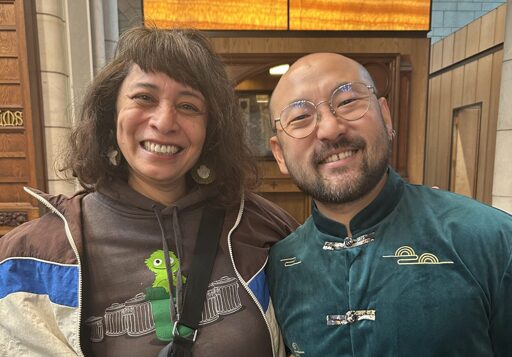

Ara Alam-Simmons and Green Party MP Dr Lawrence Xu-Nan.
Winston Peters’ racist outburst in parliament recently exposes the lie that success can buy migrants of colour acceptance and belonging — and protection from racism, writes teacher and researcher Ara Alam-Simmons.
It was another day at school, and during morning tea, I heard the principal’s voice over the loudspeaker, reminding all students to “use kind words” when speaking to other students and teachers.
It was the day after Winston Peters vomited his racist bile at Green Party MP Dr Lawrence Xu-Nan, and the principal’s announcement was an attempt to respond to a moment that reminded us all of how racist we are as a country.
I understood the impulse behind the principal’s response, but I also felt its inadequacy.
Many of the 10- and 11-year-olds in my primary school class that day come from Indigenous, migrant, and ethnic backgrounds like my own.
Some of them had seen the clip of Mr Peters telling China-born Xu-Nan “to go back to where he came from”. They’d seen how Peters had dismissed another MP’s right to claim belonging to Aotearoa, how he’d attacked the country he came from, and how he’d refused to apologise.
And they’d also seen how he hadn’t faced any real consequences.
The irony wasn’t lost on them that while they were being encouraged to “be kind” and “respect difference”, one of the country’s most senior politicians was modelling the opposite behaviour — and getting away with it.
This echoed Lawrence Xu-Nan’s comments as he described how these words of hate would also make their way into our schools and migrant communities.
And what of the prime minister’s response to this? “I have a strong view about it. It is racist and offensive. That’s it,” said Christopher Luxon in a statement that can only be described as performative and lacking accountability. Five days after Peters’ outburst, he still hadn’t spoken to his foreign affairs minister about his “racist and offensive” comments.
What this demonstrates to migrant, mixed-heritage and ethnic young people, especially those who also share Lawrence Xu-Nan’s Chinese heritage, is that they can be racially abused with no meaningful consequences for the abuser.
It sends the message that consequences apply to them, not to people in power, and that racist rhetoric can be rebranded as robust political debate.
In the most devastating way, it teaches young people that this is how things work here. That Aotearoa’s niceness, its supposed progressiveness, and its claim to be better than other places are a myth.
It also compounds the racism that many children already endure in a New Zealand education system that has yet to implement any systematic anti-racism responses, beyond being culturally capable. A 2026 study of school wellbeing survey data from more than 108,000 primary, intermediate, and secondary school students found that 20 percent of learners, particularly Māori, Pacific, and Asian students, reported experiencing discrimination related to their culture or family each month.
Racism needs to be understood as a system of governance. It’s not merely about individual comments but an organising principle that shapes how society distributes power and resources, determines whose rights are upheld, and decides who is kept safe or given the chance to thrive. It’s a system that decides who gets policed, who dies early, and who gets to belong or is marked as the perpetual foreigner.
It’s not a system that will ever benefit Indigenous people, migrants of colour, and ethnic lives and livelihoods.
I’m a British Bangladeshi migrant from the UK who came here in 2004, and I can say, hands down, that I’ve had my most vicious experiences of racism living here as an adult. Some of it has been so extreme that I’ve needed racialised trauma support.
That’s saying something coming from a country that invented the colonising playbook — one that dispossessed and eliminated Indigenous peoples and their cultures worldwide, and took their lands and resources.
New Zealand has a particular brand of racism that’s taken me over 20 years to figure out. Racism here operates through a precise register that is loud enough to feel, but subtle enough that it can be denied or dismissed. But when you name it, you’re either imagining things or causing trouble, which requires you to be isolated and dealt with.
This is the type of racism that many of us experience daily. It is racism calibrated to sit just below what the system will acknowledge, leaving those affected to hold harm that they can’t prove to others who’ve already decided it’s an over-sensitive reaction or something else.
It’s cruel — not just the racism, but also the debate and the gaslighting that follow, and the lasting impacts it has on the body, which is known in the health sector as “weathering”.
Weathering describes how racialised bodies living under racism are worn down over time. It can cause premature ageing and chronic illness.
So what can we do?
My experience as a migrant living in Aotearoa is that this has never been a place that has accepted me or made me feel I might belong. Only my labour and skills are welcome.
That reality means I now prefer to engage in “unbelonging” as a form of migrant resistance that reminds us of our own power.
As migrants and Indigenous communities, we hold significant power together. The idea of unbelonging, which comes from the work of Gayatri Sethi, offers us a political stance that refuses the conditional inclusion that racism as governance demands.
So, rather than chasing the need to belong through assimilation and engaging in the “model minority” myth — staying silent when tangata whenua are attacked, and staying away from individuals and marginalised communities who speak up — we migrants can choose “unbelonging”.
To unbelong is to deliberately reject the terms by which the settler state offers inclusion.
It recognises that belonging to a settler nation that erodes Māori rights, allows racism to slide in parliament with no consequences, and lets our young people in schools continually experience racism, with no plan to respond, requires complicity.
If Winston Peters’ racist outburst exposes anything, it’s the lie that success can buy you protection from racism. That it can buy you acceptance and belonging.
Instead, as unbelonging migrants, we can find ourselves in each other’s imaginations and come together this election to vote this coalition out and give our children a different story to tell.
Ara Alam-Simmons is a teacher, cultural producer, and researcher. She holds a PhD in Māori and Indigenous studies. Her work sits at the intersections of South Asian diaspora and Māori solidarities, community arts as resistance, and anti-racist education. Ara was the lead community organiser for the Inaugural Weaving Anti-racist futures in education conference held in Tāmaki Makaurau this year.
The post ‘Unbelonging’: When migrants refuse the bargain appeared first on E-Tangata.
From E-Tangata via This RSS Feed.