

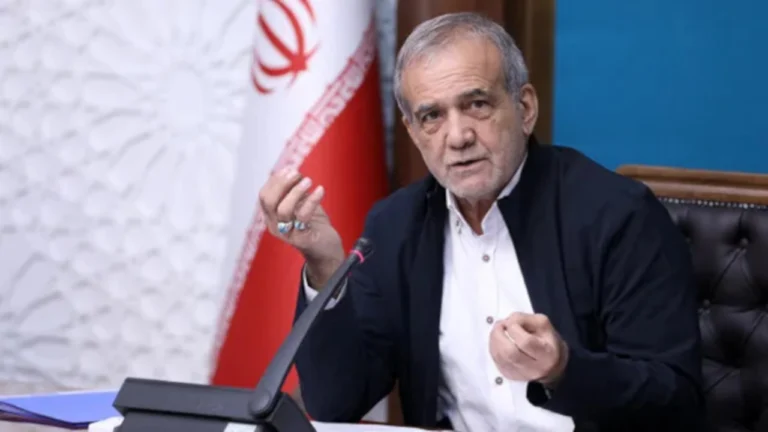
Iran-US tensions deepen as President Masoud Pezeshkian condemns Washington’s alleged genocidal mindset and warns over the Strait of Hormuz.
Related: Iran Supports Any Decision Palestinian Leaders Make in Ongoing Negotiations
Iran-US Tensions Sharpen Over Nuclear War Legacy
Iran-US tensions have intensified after Iranian President Masoud Pezeshkian accused the United States of maintaining what he called a “genocidal mindset” eight decades after the atomic bombings of Hiroshima and Nagasaki.
Pezeshkian made the statement on Saturday, August 8, during international commemorations marking the destruction of the two Japanese cities in 1945. His comments linked the historical attacks to current threats issued by Washington and to the ongoing military confrontation involving Iran, the United States and Israel.
The Iranian president published his message on the social media platform X, arguing that those who reject the horror of nuclear warfare must also condemn what he described as a continuing mentality in Washington that threatens to annihilate nations and destroy civilian infrastructure.
“On this anniversary of the US atomic bombings of Hiroshima and Nagasaki—one of the greatest crimes against humanity—those who reject that horror must also condemn the same mentality in Washington that today threatens to annihilate nations and destroy civilian infrastructure. Never again,” Pezeshkian wrote.
His remarks were released as Iran-US tensions remain closely connected to the future of the Middle East, the security of maritime trade and the unresolved dispute over Tehran’s nuclear program.
Iran-US Tensions Invoke Hiroshima and Nagasaki
Hiroshima Peace Memorial Museum | United Nations Office for Disarmament Affairs
The atomic attacks against Hiroshima and Nagasaki took place on August 6 and August 9, 1945, respectively. The first bomb was dropped on Hiroshima, while the second was used against Nagasaki three days later.
The bombings caused the immediate destruction of large urban areas and exposed survivors to burns, radiation sickness and long-term health consequences. Estimates cited in the Iranian statement place the total number of deaths at approximately 246,000 people, including around 166,000 in Hiroshima and 80,000 in Nagasaki.
The exact death toll remains difficult to determine because many victims died months or years later from radiation-related illnesses. However, the attacks are widely regarded as the first and only use of nuclear weapons in warfare.
For Tehran, the anniversaries represent an opportunity to criticize what it describes as a double standard in international security policy. Iranian officials argue that Washington condemns nuclear proliferation while maintaining a large military presence abroad and threatening military action against countries that reject US demands.
Pezeshkian’s statement also reflects Iran’s effort to place the current crisis within a historical and moral framework. By invoking Hiroshima and Nagasaki, the Iranian president portrayed present-day threats against Iran as part of a broader pattern in which powerful states use military force against civilian populations.
The Iranian government has repeatedly accused the United States and Israel of targeting civilian infrastructure during their military campaign. Washington and Tel Aviv, however, have presented their operations as measures intended to address Iran’s nuclear program, missile capabilities and regional military influence.
Those competing narratives have deepened Iran-US tensions and complicated diplomatic efforts. Tehran insists that its nuclear activities are peaceful and that it has the right to develop civilian nuclear energy. The United States has demanded restrictions on uranium enrichment and guarantees that Iran will not produce a nuclear weapon.
Pezeshkian’s message was therefore not only a commemoration of the victims of the 1945 bombings. It was also a direct political warning that Iran considers threats against its territory and infrastructure unacceptable.
Trump Threats and Hormuz Standoff
International Atomic Energy Agency | International Maritime Organization
The Iranian president’s remarks came against the backdrop of military hostilities that, according to Tehran, began on February 28, when a coalition formed by the United States and Israel launched an attack against Iran.
The US and Israeli governments have defended their military actions by referring to concerns about Iran’s nuclear activities and security policies. Iranian officials describe the campaign as an act of aggression and have demanded an end to foreign military operations on Iranian territory.
Pezeshkian’s statement also followed threats attributed to US President Donald Trump, who warned that Iran could be “wiped off the face of the Earth” if it failed to meet Washington’s demands.
Trump has separately warned that Iran would be hit “really hard” if negotiations collapsed, while reiterating that Washington would not accept Tehran obtaining a nuclear weapon. The statements have raised fears that negotiations could be used alongside military pressure rather than as an alternative to it. foxnews
Iran has responded by linking the continuation of maritime restrictions in the Strait of Hormuz to what it calls US pressure and a naval blockade. Iranian authorities announced that the strategic waterway would remain closed while those measures continued.
The Strait of Hormuz connects the Persian Gulf with the Gulf of Oman and the Arabian Sea. It is one of the world’s most important energy routes, and any prolonged disruption can affect oil shipments, insurance costs and global supply chains.
Behnam Saeedi, secretary of the Iranian Parliament’s National Security and Foreign Policy Committee, said Iran would not accept a US military presence in the area unless an equitable agreement was reached and international commitments were respected.
The position reflects Tehran’s demand for recognition of its sovereignty and security interests in the waterway. Washington, meanwhile, has argued that commercial shipping must be allowed to pass freely and has opposed any attempt by Iran to impose unilateral conditions on maritime traffic.
As of August 8, reports indicated that the waterway remained largely closed, although Iran and Oman were discussing a possible route for commercial vessels. Iranian officials said the coordinates of a proposed route had been agreed upon, but warned that the arrangement would depend on the absence of interference by third parties. aljazeera
The dispute has already affected shipping in the region. Some vessels have avoided the waterway, while others have waited for assurances regarding safe passage. On August 8, reports also said that a United Arab Emirates vessel had been targeted by a missile as tensions surrounding the strait remained high. cnbc
The confrontation has consequently moved beyond the nuclear question. It now involves maritime access, military escorts, regional energy infrastructure and the possibility of retaliation against US allies in the Gulf.
Geopolitical Context
The escalation carries consequences far beyond the immediate confrontation between Washington and Tehran. The Strait of Hormuz is a global economic chokepoint, and any sustained closure could raise energy prices, disrupt international trade and intensify economic pressure on countries dependent on imported fuel.
The crisis also places Gulf states in a difficult position. Countries such as Oman, Qatar, the United Arab Emirates, Saudi Arabia and Bahrain have economic and security ties with Washington but remain geographically close to Iran. Any expansion of the conflict could expose their ports, energy facilities and shipping routes to retaliation.
Diplomatic efforts led by Oman could therefore become increasingly important. Muscat has historically served as an intermediary between Iran and Western governments, and the discussions over a maritime route may provide a limited channel for reducing the risk of direct confrontation.
The dispute also tests the authority of international institutions. The International Atomic Energy Agency has a central role in monitoring Iran’s nuclear activities, while the International Maritime Organization promotes safety and security in international shipping.
For countries in the Global South, the conflict reinforces concerns about the unequal application of international law. Iran argues that the United States uses threats and military force while claiming to defend a rules-based order. Washington counters that its actions are intended to prevent nuclear proliferation and protect regional security.
The reference to Hiroshima and Nagasaki adds another layer to that debate. By connecting the historical use of nuclear weapons with present military threats, Pezeshkian is seeking to frame Iran’s position as part of a global demand for nuclear disarmament, civilian protection and national sovereignty.
The immediate path forward remains uncertain. The United States has demanded changes to Iran’s nuclear program, while Tehran insists that negotiations cannot take place under military threats or a maritime blockade.
Unless both sides reach an agreement, Iran-US tensions are likely to remain a major source of instability across the Middle East. The future of the Strait of Hormuz, the status of nuclear negotiations and the possibility of renewed military strikes will shape the region’s security outlook in the coming weeks.
Pezeshkian concluded his message with a call for “never again,” invoking the global pledge that the destruction witnessed in Hiroshima and Nagasaki must not be repeated. For Iran, that warning applies not only to nuclear weapons but also to threats against civilian populations and critical infrastructure.
On this anniversary of the US atomic bombings of Hiroshima and Nagasaki-among greatest crimes against humanity-those who reject that horror must also condemn the same mentality in Washington that today threatens to wipe out nations and destroy civilian infrastructure. Never again
— Masoud Pezeshkian (@drpezeshkian) August 7, 2026
From teleSUR English via This RSS Feed.