

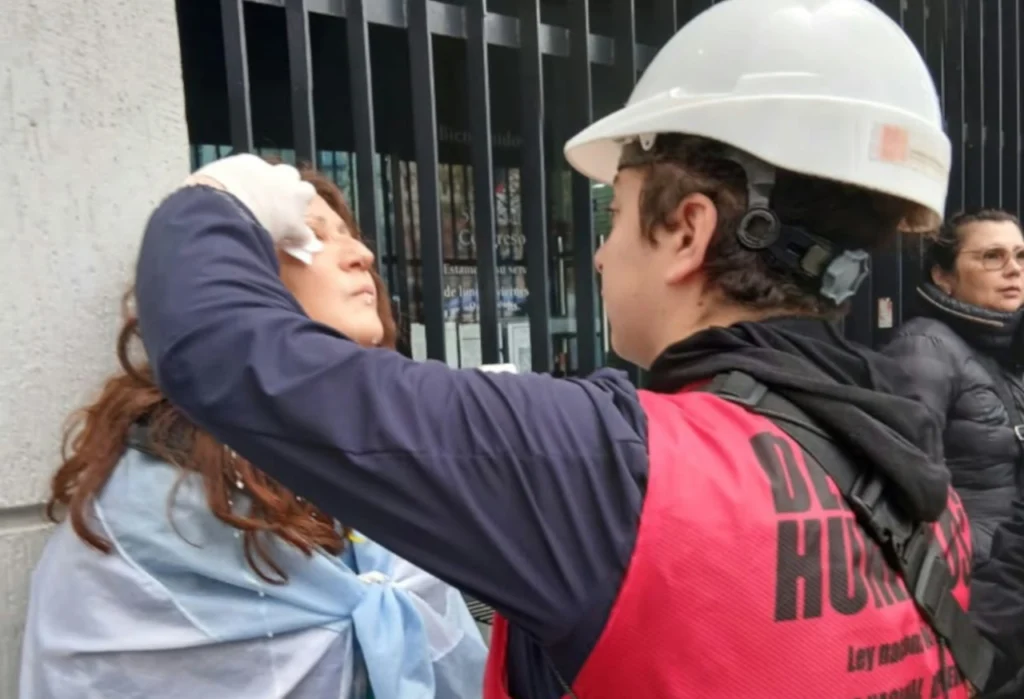
Argentina protest repression leaves 1,500 injured and 28 detained as rights groups accuse security forces of abuses during a Buenos Aires rally.
Related: Argentina Senate Passes Revised Property Rights Bill
Argentina Protest Repression: 1,500 Hurt in Alarming Crackdown
Argentina protest repression has triggered a judicial investigation after the Provincial Commission for Memory (CPM) filed a complaint against the Buenos Aires City Police and federal security forces over alleged rights violations and physical attacks on journalists and demonstrators during a protest held on Thursday, August 6.
The complaint was accepted by Federal Court No. 10 in the Comodoro Py judicial complex, according to the report published on August 8. The filing followed the CPM’s documentation of injuries, arrests and alleged abuses during the mobilization, including the serious injury suffered by a photojournalist who sustained head trauma. Her identity has not been disclosed for security reasons. telesurtv
Argentina Protest Repression Under Investigation
Provincial Commission for Memory | CELS report on criminalization of protests
The complaint was signed by Nobel Peace Prize laureate Adolfo Pérez Esquivel, as well as academic Dora Barrancos and human rights advocate Roberto Cipriano García. In the document, the signatories stated that they had verified repeated patterns in the use of force during security operations, along with mass and arbitrary arrests carried out beyond legal and constitutional limits.
The CPM said the incident took place during a demonstration called in opposition to a proposed law on land and private property. The protest occurred while lawmakers debated legislation that has been described by government supporters as a measure to strengthen property protections.
According to testimonies cited in the complaint, the photojournalist was attacked by police officers at approximately 7:50 p.m. while she was covering the demonstration at the intersection of Lima Street and Avenida de Mayo. The journalist was reportedly working when officers intervened, and she later required medical attention for a severe head injury.
The case has drawn particular concern because journalists and photojournalists were present in the area to document the security operation. Press workers covering demonstrations are protected by the principles of freedom of expression and access to information, while attacks against them can restrict public knowledge of how authorities respond to dissent.
The CPM’s report documented the use of more than 100 tear-gas and pepper-gas grenades, as well as rubber bullets that affected more than 40 people. The organization also recorded injuries caused by chemical irritants, rubber ammunition, blows from shields and batons, and the general advance of security forces into areas occupied by demonstrators.
The organization counted 28 arrests in total. Federal forces detained 21 people, while the Buenos Aires City Police detained seven. Members of the CPM and personnel from the Evacuation and First Aid Corps were among the people reportedly affected during the operation.
The commission estimated that approximately 1,500 people were injured. The figure includes demonstrators, journalists, human rights monitors and emergency responders who were assisting people affected by gas, projectiles and physical impact.
The scale of the injuries has been corroborated in reports by local media and statements attributed to CPM representatives. Roberto Cipriano García, the commission’s secretary, described the operation as unusually harsh and extensive, saying it lasted for several hours and moved beyond the immediate area around Congress. radioprovincia.gba.gob
The CPM’s account states that federal forces broke through the security barriers that had been installed around the protest area and advanced against demonstrators. The organization described the demonstration as peaceful before the deployment intensified.
The allegations remain subject to judicial review. The acceptance of the complaint means the case can proceed through the courts, but it does not represent a final determination of criminal responsibility. Investigators will have to establish what happened, identify the officers involved and examine available evidence, including medical records, testimonies, photographs and video footage.
Government Files Counter-Complaint
External sources: Centre for Legal and Social Studies | CPM monitoring of social protest
Following the CPM’s complaint, the administration of President Javier Milei filed a counter-complaint asking the Justice system to investigate what it described as an alleged “attack against the constitutional order” linked to events at the demonstration.
The government’s filing was signed by Germán Pugnaloni and Lisandro Franco. It reportedly included allegations of aggravated damage, an attack against democratic life and resistance to authority.
The official complaint did not acknowledge government responsibility for the injuries or material damage reported during the security operation. Instead, it focused on alleged offenses committed by demonstrators during a day marked by confrontations between protesters and police.
The legal dispute therefore presents two competing narratives. Human rights organizations argue that security forces used disproportionate violence and carried out arbitrary arrests. The government maintains that certain actions during the protest may have threatened public order and democratic institutions.
The Centre for Legal and Social Studies, known by its Spanish acronym CELS, criticized the counter-complaint as a severe form of criminalization against people who exercise their right to protest. Victoria Darraidou, speaking on behalf of the organization, said the government’s response sought to turn social protest into a criminal matter.
The CELS has previously documented the risks faced by demonstrators in Argentina, including arbitrary searches, physical assaults, chemical irritants, rubber bullets and arrests based merely on a person’s presence at a protest. The organization has warned that the classification of protest as a criminal act can weaken constitutional guarantees and expand the use of force by police agencies. cels.org
The August 6 operation comes amid a broader debate over the government’s approach to demonstrations. Since Milei took office, officials have defended stronger measures to prevent street blockades and maintain traffic flows. Rights groups, however, say that such policies can restrict freedom of assembly and create conditions for excessive police intervention.
The use of so-called less-lethal weapons has become a central issue in this debate. Although these weapons are designed to reduce the risk of fatal outcomes, they can cause serious injuries when fired at close range, aimed at the upper body or used indiscriminately in dense crowds.
The reported injury to the photojournalist has intensified concerns about the protection of the press during police operations. A traumatic brain injury can have long-term consequences, and the case has become one of the most serious incidents recorded during the protest.
The courts will now have to determine whether the allegations against the security forces meet the standards required for a criminal investigation. They must also assess whether the government’s accusations against protesters are supported by evidence or whether they constitute an attempt to discourage further demonstrations.
Geopolitical Context
The dispute extends beyond Argentina’s domestic politics. Across Latin America, governments facing economic adjustment, legislative opposition and social discontent have increasingly framed public order as a priority. At the same time, regional human rights institutions have emphasized that states must protect peaceful assembly, freedom of expression and the safety of journalists.
Argentina’s case could establish an important regional precedent regarding the limits of police power during demonstrations. If the courts investigate the alleged abuses, the proceedings may influence debates about accountability, the regulation of security forces and the use of less-lethal weapons in other countries.
The conflict also reflects a broader tension between elected governments and civil society organizations. Authorities often present restrictive protest measures as necessary to preserve democratic stability, while rights groups warn that suppressing dissent can weaken democracy rather than protect it.
For Argentina, the controversy is particularly sensitive because memories of state violence remain deeply embedded in public life. Human rights organizations have repeatedly argued that democratic institutions must prevent the normalization of arbitrary detention, collective punishment and attacks against those who document public events.
The CPM reported in January that it had monitored 79 public demonstrations during the previous year and identified repression in 34 of them. It also recorded at least 1,369 injured people during those protests, suggesting that the August 6 events form part of a wider pattern rather than an isolated confrontation. comisionporlamemoria
The judicial process in Comodoro Py will determine whether complaints against the security forces advance alongside the government’s counter-complaint. The outcome could influence how future protests are policed and how courts interpret the relationship between public order and constitutional rights.
For now, the central questions remain unresolved: who ordered the use of force, whether the response was proportionate, and who will be held accountable for the injuries and arrests. The answers will be closely watched by journalists, human rights organizations and social movements in Argentina and throughout Latin America.
Unas 1.500 personas heridas en una de las represiones más salvaje del último tiempo
Frente a una multitud que protestaba pacíficamente contra la ley de propiedad privada, las fuerzas de seguridad desplegaron una represión tan salvaje, que cuenta con pocos precedentes.
La… pic.twitter.com/YPUSIWD8dJ
— Comisión Provincial por la Memoria (@CPMemoria) August 7, 2026
From teleSUR English via This RSS Feed.